
"These fragments I have shored against my ruins"
Tiszaeszlár: The Aftermath of a Modern Blood-libel Trial
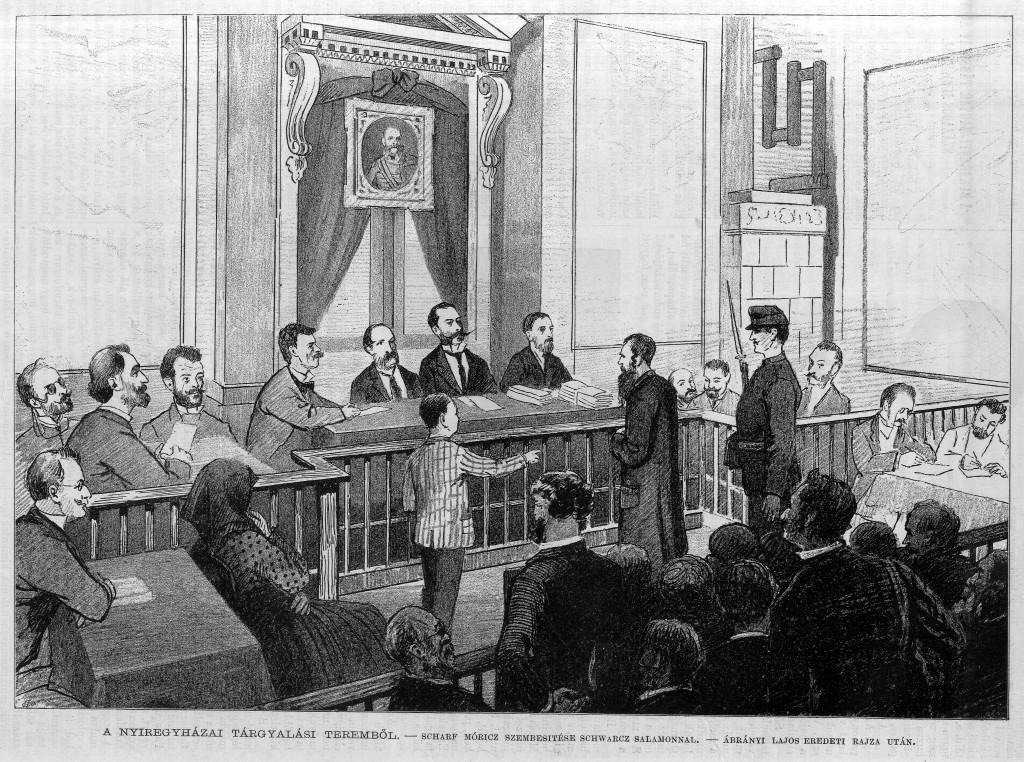
The Trial of the Tiszaeszlár Affair in 1883 (Vasárnapi Újság 1883 No. 28 - Public domain)
Hungary’s modernity was on trial in Tiszaeszlár as much as the accused Jews themselves. Károly Eötvös, the defense attorney whose name would become inseparable from the case, embodied the liberal vision the country liked to claim for itself. A lawyer, journalist, and former opposition politician, he approached the trial not only as a legal challenge but as a test of Hungary’s capacity for rational judgment. His method — meticulous cross‑examination, reliance on forensic evidence, and a refusal to indulge in the prosecution’s emotional theatrics — represented the very modernity the liberal elite celebrated. Yet, his victory revealed the limits of that project. The acquittal made him a hero to some, but to the emerging antisemitic movement, he became proof of a corrupt system shielding an alien minority. In the months that followed, Eötvös found himself defending not only his clients but the very idea that truth and law could still govern public life.
The acquittal of 3 August 1883 was meant to end the affair. Instead, it marked the moment when the case finally escaped the courtroom and entered the bloodstream of Hungarian political life. The verdict did not calm the country; it inflamed it. The supposed triumph in a rural court ignited what the accusation had primed.
Riots had already broken out the previous summer, long before the trial began. At first, they were scattered; small demonstrations, broken shop windows, the familiar choreography of resentment. After the acquittal, however, the violence intensified and spread with remarkable speed. Between August 1883 and June 1884, Jews were attacked in some 100–130 localities; apartments and shops looted across the country. Towns across Transdanubia, Bratislava County, and western Hungary saw mobs attacking Jewish homes and businesses. In several counties, martial law was declared. Soldiers were deployed to restore order, sometimes firing into crowds. The state could contain the unrest only by force.
Within Hungary, the violence remained limited in its lethality. The riots were not primarily about killing Jews; they were about destroying their world. Shops were looted, homes ransacked, synagogues vandalised. The mobs were destructive, no less purposeful but not yet murderous in the way that pogroms in the Russian Empire would soon become. In this respect, the Hungarian events followed a Central European pattern: humiliation, intimidation, displacement, destruction of property, and public assertion of dominance rather than mass killing. The message was unmistakable: if the courts would not punish the Jews, the streets would.
Given the scale and scope of the violence, the death toll was astonishingly low. A pregnant woman was shot dead in Nyulas, an abused Jew died of his injuries in Zalaegerszeg, and a Jewish barkeeper was beaten to death in Sárhida. Strangely, there were many more victims among the rioters. Dozens of attackers were killed, some by Jewish resistance, others by counterattacks and retributions of the military and police. Over 200 people were arrested, mostly craftsmen, journeymen, and day labourers.
The political consequences followed immediately. The emotions stirred up by the antisemites were of political benefit to them. Riding the tide of the anti-Jewish sentiment, Győző Istóczy and his allies founded the National Antisemitic Party in October 1883 — the first explicitly antisemitic political party in Europe. The new political formation included former members of the government party and members of the opposition. In the 1884 elections, 55 candidates ran for office, 17 of whom won seats. Unsurprisingly, 12 of the 17 victories were in counties where the violence of 1881–84 had been particularly strong. There were three successful antisemitic candidates in Sopron, two each in Moson, Nitra, and Somogy, and one each in Bratislava, Vas and Zala.
In the aftermath of the Tiszaeszlár affair, organised antisemitism seemed to be a longer-term prospect. For a brief period, it became a viable political force in Hungary, complete with rallies, newspapers, and a coherent ideological programme. However, intra-party divisions soon emerged. The party had already split in 1885, but the two formations contested the 1887 elections together and won 11 districts. However, it was not until 1892 that both finally dissolved.
This was the true legacy of Tiszaeszlár. The trial gave antisemitism a national stage, a shared vocabulary, and a constituency. It transformed a medieval accusation into a modern political instrument. The case did not demonstrate that Hungary was backward; it demonstrated that modernity itself could be mobilised against the Jews. Newspapers, parliamentary debates, mass demonstrations; these were not medieval relics but tools of a new kind of antisemitism that required neither Church nor Inquisition. It needed only a missing girl, a climate of uncertainty, and men who understood how to turn fear into political capital.
This modernity’s dark side emerged clearest in public reaction. The acquittal was celebrated by liberals as a triumph of reason; in the streets, it was experienced as betrayal. In the gap between legal judgment and popular conviction, a movement was born whose influence would extend far beyond Hungary’s borders. The riots of 1883 were not an epilogue to the trial. They were its continuation by other means.
The consequences did not remain confined to Hungary. The Tiszaeszlár affair became a European story almost immediately. Newspapers across the continent followed the case with obsessive interest. Some treated it as a grotesque curiosity; others as proof of Jewish danger; still others as evidence of Hungary’s supposed backwardness. Regardless of political orientation, the effect was the same: the accusation was amplified far beyond the village where it began.
In Germany, Austria, and Romania, antisemitic agitators seized on the case as a ready-made narrative. It provided imagery, language, and a sense of legitimacy. If a modern Hungarian court was willing to prosecute Jews for ritual murder, then the accusation could no longer be dismissed as mere superstition. It could be repackaged as political argument.
In Russia, the resonance was more direct. Some historians have suggested that reporting on Tiszaeszlár in provincial newspapers contributed to the outbreak of the Nizhny Novgorod pogrom in 1884. Whether or not the connection was strictly causal, the timing is revealing. Tiszaeszlár lent antisemites a template: acquittal didn’t discredit the libel, it politicised it. The case entered the Russian press at a moment when the empire was already convulsed by violence, offering a narrative that fitted seamlessly into an existing climate of fear and resentment.
In the decades that followed, at least four major ritual-murder trials in Central and Eastern Europe — Xanten, Polná, Konitz, and Chojnice — reproduced the Tiszaeszlár script with striking consistency: modern states prosecuting medieval myths. The structure was familiar: a missing child, Jewish suspects, a community primed for panic, and political actors ready to exploit the moment. The details varied; the logic did not.
This is the most difficult part to absorb. Hungary’s “victory” in 1883 — the acquittal celebrated as proof of progress — did not prevent future blood libels. It helped normalise them. The trial demonstrated that a modern legal system could be drawn into prosecuting a medieval fantasy, and that even an acquittal could be weaponised by those who needed the accusation more than the truth.
Tiszaeszlár did not invent modern antisemitism. But it gave it form, confidence, and reach. It showed that a ritual-murder accusation could survive the age of railways, telegraphs, and mass politics — and travel farther and faster than ever before.
Even if the tribunal closed the case, it has continued in the public domain to this day, with varying intensity.
If riots were Tiszaeszlár’s immediate aftermath, the long-term aftermath was quieter, more corrosive: silence hardening into dogma. The trial ended in acquittal but not clarity. Eszter Solymosi’s body was never found; the public got verdict without explanation. Into that vacuum flowed speculation, resentment, myth.
After the Holocaust, the case became even more difficult to approach. The moral landscape had shifted so profoundly that certain questions could no longer be asked without suspicion. Tiszaeszlár was absorbed into a narrative of persecution, and any attempt to revisit its ambiguities risked being read as an attack on that narrative itself. The result was intellectual paralysis: the case was remembered, but not examined.
Unwritten rules took hold in Hungarian public discourse. One was that the innocence of the accused Jews must be treated not only as a legal conclusion but as an untouchable moral absolute. Another was that the case should be understood almost exclusively through Károly Eötvös’s canonical defence. These positions were understandable, given the weight of history, but they also made it difficult to acknowledge the case’s unresolved elements.
When László Blutman published his study in 2017, arguing that the most plausible explanation was an accidental death followed by a panicked cover-up, the response was telling. His work was neither widely refuted nor seriously debated; it was largely ignored. The conversation had no room for it. The case had become too symbolic, too entangled with questions of identity and historical responsibility.
This rigidity has consequences. When a society cannot tolerate ambiguity, it leaves certainty to extremists. The far right has long understood this. The tomb of Eszter Solymosi — erected by a Hungarian couple living in Spain who still believe in the guilt of the accused Jews — has become a kind of antisemitic shrine; on the anniversary of her disappearance, far-right organisations regularly commemorate the “crime”. Eszter Solymosi has been transformed into a martyr, her symbolic grave into a pilgrimage site, her story into a weapon. Each anniversary of her disappearance becomes an opportunity to re-enact an accusation that never occurred.
Whether genuine belief or cynical opportunism — or some mix of both — the template persists into recent decades. In 1998, when an eleven-year-old girl was murdered at her home in the Hungarian countryside, although a man received thirteen years’ imprisonment in 2002, widespread public doubt about his guilt, coupled with unanswered questions of means and motive, opened space for far-right reinvention. National-radical circles, including Mi Hazánk MP László Toroczkai who published two articles on the matter, promptly recast it as Tiszaeszlár redux: ritual killing by a shochet, commissioned by an Orthodox entrepreneur to consecrate his soft drink bottling plant with the victim’s blood.
The tragedy is not only that the case remains unresolved, but that its unresolved nature continues to be exploited. The silence surrounding Tiszaeszlár — born of trauma, caution, and the desire to avoid legitimising antisemitic narratives — has created a space in which those narratives flourish unchecked. The dogmas intended to protect the memory of the victims have, unintentionally, made the story more vulnerable to distortion.
Tiszaeszlár is often treated as a closed chapter, a relic of a vanished world. Yet, the dynamics that made the accusation possible — fear, uncertainty, the hunger for simple explanations — have not disappeared, merely changed form.
The case endures because it exposes how quickly a modern society can reach for medieval narratives when confronted with instability. Hungary in the 1880s was not backward; it was modernising rapidly and confident in its institutions. And yet, when a young girl vanished, the nation slid with disturbing ease into a story that should have been impossible in that age.
The lesson is not about Hungary alone. It is about the fragility of modernity itself.
A society can congratulate itself on its rationality and still be undone by its fears. A court can deliver a just verdict, and the public can still choose myth over evidence. The acquittal of 1883 mattered. But its aftermath mattered more.
The final irony of Tiszaeszlár is this: a case celebrated as a triumph of reason became the moment when modern antisemitism learnt to speak fluently — in the language of politics, media, and mass mobilisation.
A society can win the legal battle and still lose the moral one.
Related Topics
Related Posts