Owner of the world's largest Herzl collection
Tu BiShvat
Treasure trove: Herzl’s tree is dead and still lives
During his one visit to Palestine in 1898, the Zionist dreamer planted a cypress. It was destroyed. So why is he depicted standing next to a fully grown tree?
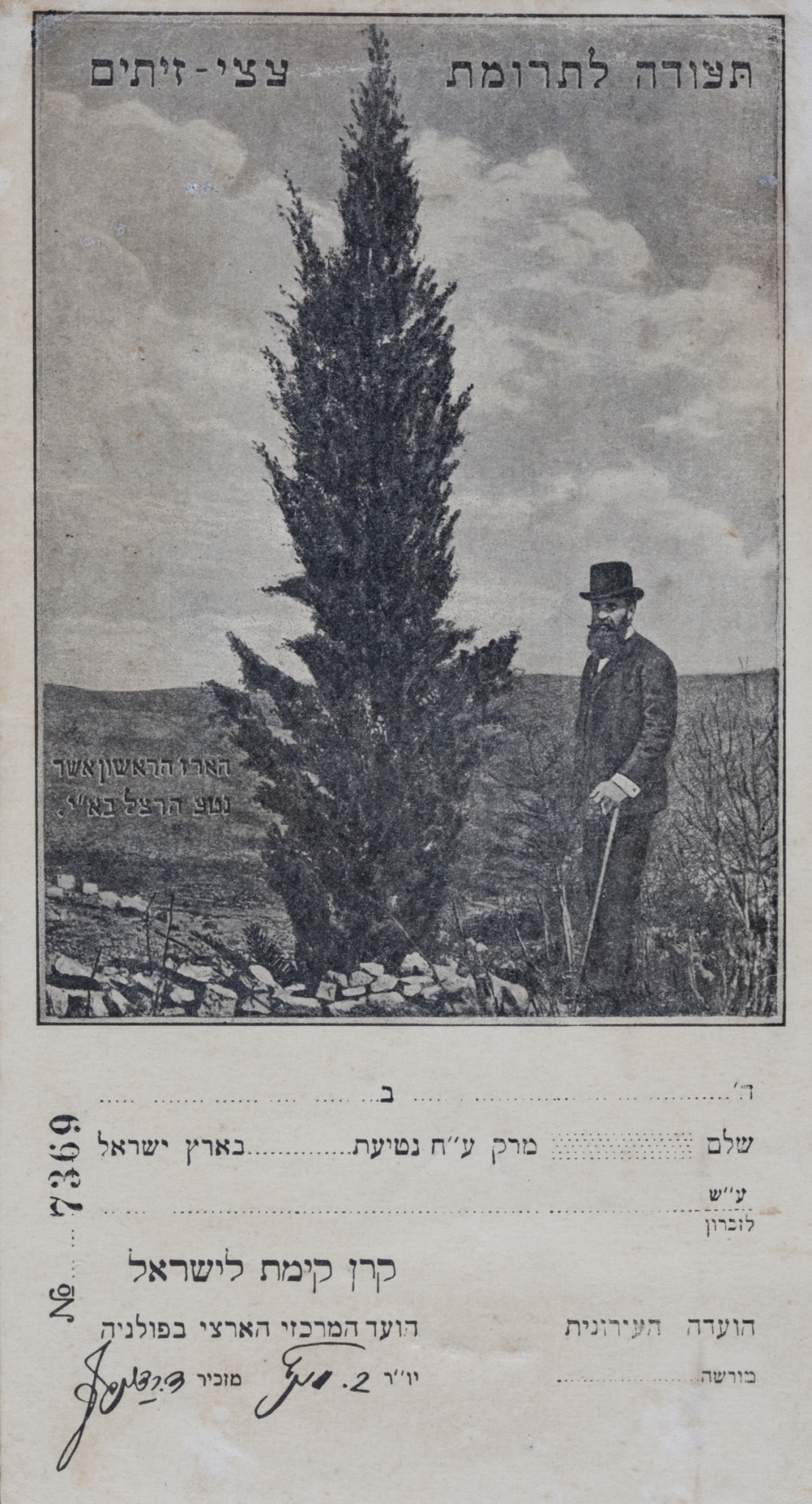
From the Herzl and Zionism Collection of David Matlow, Toronto (www.herzlcollection.com). Photograph by Kevin Viner, Elevator Digital, Toronto. Used with permission.
Tu BiShvat, the new year for the trees, starts at sundown on February 1, 2025. Historically a minor holiday, the Zionist pioneers transformed it into a holiday that celebrated the Jewish people’s connection to the land. Planting trees became a crucial part of building the land as trees help drain malaria-infested swamps, protect crops from wind and provide shade. During the 20th century, 240 million trees were planted in Israel primarily through the efforts of the Jewish National Fund that was founded in 1901.
One of the most famous trees ever planted in the Land of Israel was the one Herzl planted in Motza outside Jerusalem during his one visit to Palestine in 1898. It was a cypress tree, but was mistakenly referred to by Herzl in his diary as a cedar.
In this JNF certificate from Poland from the early 20th century, Theodor Herzl is seen beside his tree. This image is an early form of Photoshop, as Herzl planted a sapling, and never returned to see his tree grown to this height. The document is a receipt for a donation that was applied to planting olive trees in Herzl’s memory after his death in 1904.
The tree became a pilgrimage site for Zionist youth who would visit it annually on Herzl’s yahrzeit (anniversary of his death). This tradition did not last long. In 1915, the Turkish authorities cut it down and burned it. Only the stump remained, which itself became an important Zionist symbol.
During Israel’s War of Independence, when women and children were evacuated from nearby towns as the battle neared, the stump was evacuated too. It was returned to Motza after the war and is now in its original location, enclosed in glass and reinforced with steel.
In a sense, Herzl’s cypress still lives. After they discovered that the tree had been cut down, young Zionists returned to the site and collected cones from the tree that were lying on the ground. Those cones had seeds that were collected and guarded. After World War I ended, the seeds were planted throughout the land, from the Galilee in the north to the Judean Hills.
This is the Jewish story. Often our history is described as they tried to kill us, we prevailed, let’s eat. In this case, it’s: let’s plant. Herzl’s tree was destroyed, its stump has been preserved, and new trees grew from its seeds. Olive trees have an average lifespan of 300 to 600 years, so the trees purchased with the funds donated and marked by this certificate are still young.
As Israel recovers from its struggles over the last two years, it is again time to plant, to rebuild, to restore. Helping Israel rebuild reflects our confidence in its future, and our hope that better days are ahead. Herzl. Hope. Home. is an exhibit of artefacts from my collection that seeks to make this point. It is on display at Holy Blossom Temple in Toronto until the end of February.
—
For more treasures from the Herzl and Zionism Collection of David Matlow, which has appeared weekly in the Treasure Trove column in the Canadian Jewish News (www.thecjn.ca) since February 2021, see https://herzlcollection.com/treasure-trove
Related Topics
Related Posts