Solicitor & foreign policy adviser
Tribes, Not Technocrats, Will Decide Gaza’s Future
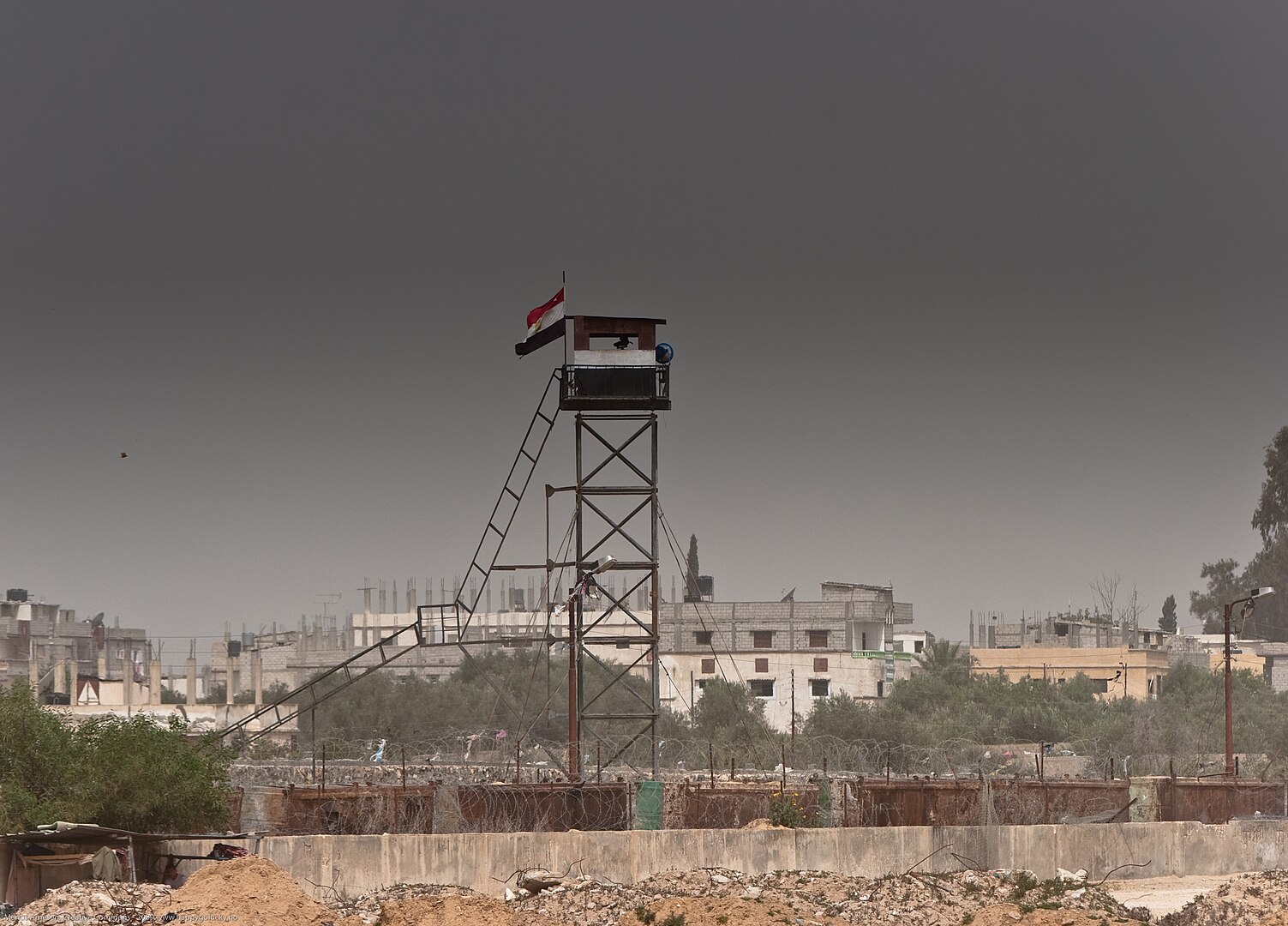
A watchtower on the border between Rafah and Egypt (Photo by Marius Arnesen - Wikipedia Commons)
“Anyone who imagines Gaza’s future as just another exercise in state-building is living in a fantasy,” says Emanuel Segre Amar. “The real fault line—the Middle East scholar contends—is not between Hamas and Israel, but between technocrats and tribal authority; any peace plan that ignores the latter is a recipe for failure.”
Segre Amar is right where it matters. Gaza is broken not because it lacks infrastructure, but because it lacks legitimacy—at least legitimacy that resonates with its people. You can drop billions of dollars in aid, you can create ministries and commissions, but you cannot import loyalty. You cannot override tribal structures with fiat. Western and Arab planners persist in treating Gaza as an empty slate begging for governance; they ignore that it’s already a social system held together by five major tribal confederations—Hayawat, Tarabeen, Tayaha, Ijbara, Azazma (and the scattered Jahalin)—none of which are footnotes.
These tribes are not quaint relics of pastoral life. They remain the backbone of authority in Gaza. The Tarabeen stretch between Sinai, Gaza, and Negev; their membership traffics goods, routes information, enforces social norms—and knows how to survive under siege. The Jahalin, dispersed across Gaza and the West Bank, have lived through repeated displacements and yet maintained lineage memory and collective solidarity. The Hanajira (often a major branch within these confederations) once dominated large swaths of eastern Gaza, with lineages such as Abu Middein, Nuseirat, Sumeiri, and al-Dawahra controlling land and pastoral corridors.
Under Hamas’s grip since 2007, tribal institutions were oppressed but not erased. In many places, clan leaders continued to adjudicate disputes, manage local norms, and negotiate relief delivery. In fractured security zones, these tribal actors often remain the only figures Gazans trust to mediate and protect.
Now imagine a post-war Gaza where a foreign-backed authority, or even a neighboring Arab state, steps in without giving these tribes a role. That’s not peace—it’s subjugation. Without institutionalizing tribal power, you will get a version of the same dictatorship: a violent elite imposing itself top-down on a population that sees it as foreign.
Hence the necessity of a union of emirates: Gaza must be partitioned into zones under tribal rule, federated under a central administrative skeleton. These emirates would not be aristocratic fiefdoms but consensual jurisdictions—places where legitimacy flows from lineage. Each tribe’s territory would elect its emir from within, accountable to clan assemblies, with coordination at the confederal level over defense, border affairs, and external relations.
Such a framework would avoid one-size-fits-all pitfalls. It would prevent the creation of a new “Hamas 2.0” or a carceral state backed by foreign interests. It acknowledges that authority in Gaza cannot be invented. It must emerge from the people’s own networks.
This model also neutralizes part of the hostility to outside Arab states. When Egyptians, Saudis, Jordanians, Qataris or others enter Gaza as donors, reconstruction patrons, or political sponsors, they face a legitimacy deficit. They are tolerated when they dole out tranches of aid; they are ignored or despised when they attempt to act as governors. Their tribes are foreign; their legitimacy is transactional, not genealogical. The Gazawi desire not outsiders’ largesse but local accountability.
Even in Judea and Samaria, the eight dominant tribes (Jahalin, Ka’abneh, Rashaydeh, Ramadeen, Azazme, Sawarka, Arenat, Amareen) reject administrators whose roots lie elsewhere. Any peace architecture that merges Gaza and the West Bank under the same foreign governance will fail to reckon with these parallel systems.
Critics may argue that deputizing tribal power risks entrenching reactionary local schemes or empowering warlords. That is precisely why the emirate model must be constitutional, transparent, and subject to confederal checks. Tribes must answer for abuses. But ignoring them will recreate vacuums in which warlords emerge anyway.
Would such a system prevent cooperation with Israel on security, reconstruction, or demobilization of militias? No—but it would mean those agreements rest on joint legitimacy, not on guns and funding. An emir can negotiate with Israel because his people accept him. A foreign governor cannot.
To put it bluntly: if Gaza’s peace plan refuses tribal structuring, it will fail—not in ten years, but within months. You will see rising insurgencies, contested borders, warlordism, or worse: a revival of Hamas under a new name. You will see populations reject imposed regimes by staying disconnected, by erecting parallel social orders, by insisting on clan courts and local mediation.
Peace is not a technocratic puzzle to be solved from remote capitals. It is a social contract rooted in memory, honor, and communal ties. If the peace plan ignores tribal lineage, it is doomed to inflict tyranny behind the veneer of legitimacy. If it refuses to recognize that Gaza’s future must stem from its own tribes, it reveals that it does not trust Palestinians to govern themselves.
Sheikh Mohammed bin Rashid Al Maktoum, the ruler of Dubai, has repeatedly said that the United Arab Emirates owes its stability to the fact that it is “one family, one tribe.” In his 2012 book Flashes of Thought and several public addresses, he described the UAE’s unity as stemming not from imposed centralization but from the organic cohesion of its tribal confederation—particularly the Al Bu Falasah (the ruling branch of the Bani Yas tribe, to which the Al Maktoum family belongs). He argued that this shared lineage allowed the emirates to form a federation without rivalry, bound by kinship and mutual respect rather than coercion. In his words: “We were not brought together by politics but by blood.”
Gaza is not a blank page, and institutional formulas will not redeem it. Peace will come only by restoring authority to those who governed it long before elections or ministries existed—the tribes whose legitimacy still binds the land. Only then can stability replace repression disguised as order.
Related Topics
Related Posts