The views expressed herein are solely mine.
Tripoli for Golan? The New Middle East Power Play
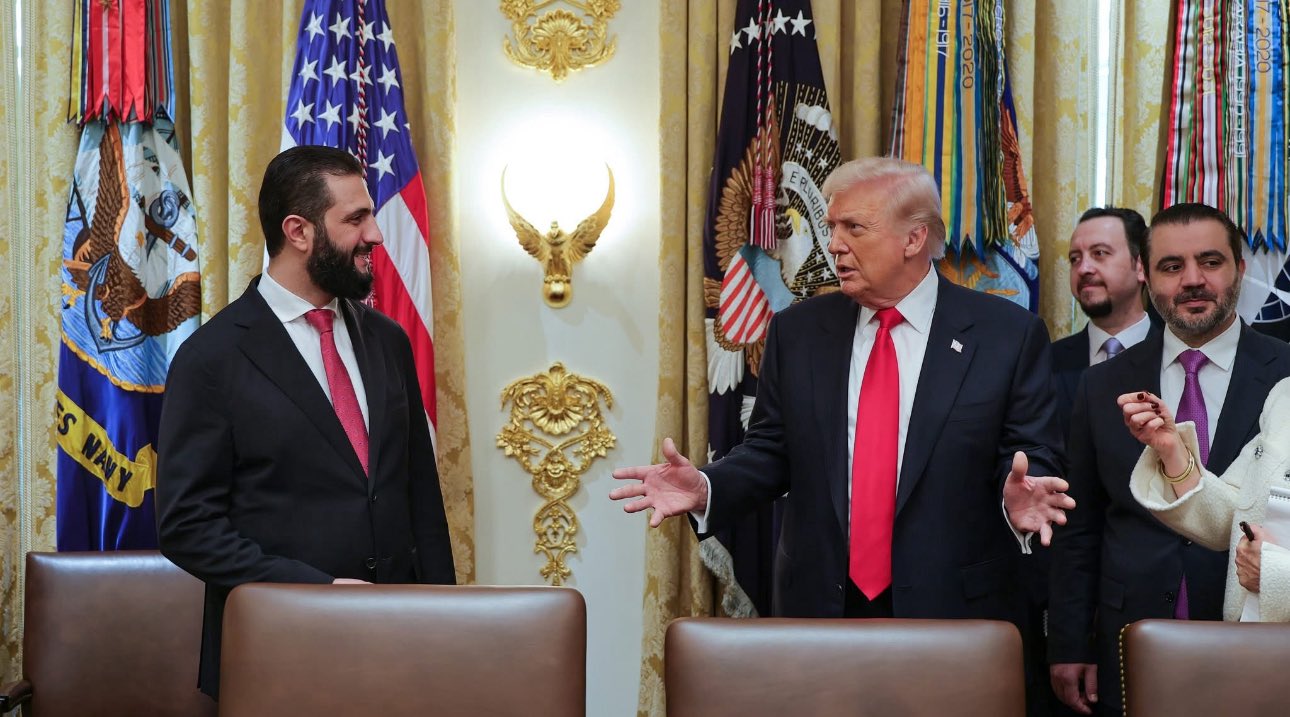
In this photo released by the Syrian Presidency press office, US President Donald Trump, right, speaks with Syria's President Ahmad al-Sharaa, at the White House in Washington, Nov. 10, 2025. (Syrian Presidency press office via AP)
Everyone’s celebrating or panicking over the wrong story.
The real shockwave is this: Al-Sharaa is positioning himself to take Tripoli (Lebanon), a move that could shrink Hezbollah’s map and hand Israel a strategic win nobody saw coming.
And this is not speculation.
Recent open sources evidence now indicates that the most explosive negotiation in the Levant involves Al-Sharaa—formerly Abu Mohammad al-Julani and now Syria’s President—quietly demanding de facto control over Tripoli in exchange for accepting Israeli terms on the Golan Heights.
Undeniably, this is not tabloid noise—Tripoli matters. Lebanon’s second-largest city fuels up to 40% of the country’s shadow economy, anchors Sunni power networks, and connects Syria’s northwest to global markets.
Therefore, control it, and you manage the smuggling routes, the cash flow, and the political oxygen. For Syria, it is the lifeline for economic recovery—and Al-Sharaa knows it.
At the same time, Tripoli offers what Damascus cannot: a sovereign maritime outlet independent of Lebanese politics, international sanctions pressure, and Hezbollah’s chokehold on Lebanon’s southern ports.
With Assad gone and the remnants of the Syrian state now consolidated under Al-Sharaa’s technocratic-Islamist governance, Syria has shifted from a fractured battleground into a hybrid state run by former insurgents, intelligence defectors, and Gulf-backed administrators. The new leadership has legitimacy among large Sunni constituencies and tacit recognition from key regional actors, including Turkey and Saudi Arabia.
Thus, if Al-Sharaa secures Tripoli, he could transform Syria from a landlocked recovery project into a regional trading power.
Evidently, ports create sovereignty. Maritime access builds economies. A Mediterranean outlet rewrites Syria’s strategic future.
From Israel’s standpoint, the proposition is equally stunning.
A Sunni Syrian leader publicly recognizing Israel’s control of most of the Golan Heights would be a geopolitical earthquake.
For decades, the Golan claim was the ideological backbone of the “resistance axis”—the excuse Iran and Hezbollah used to justify their military presence in Syria and Lebanon.
Hence, Al-Sharaa accepting Israeli sovereignty would strip that narrative bare and sever Iran’s last strategic justification for operating west of the Euphrates.
Conversely, it would fracture Tehran’s influence among Sunni militants and gut Hezbollah’s rhetorical monopoly inside Lebanon.
But here is the biggest highlight: putting a major Lebanese port under Al-Sharaa’s influence does not bolster Hezbollah—it strips it.
As Tripoli moves into his sphere, Hezbollah loses territory, revenue, and Sunni leverage, while Al-Sharaa consolidates power across Syria and the region.
The State of Israel, in turn, quietly benefits: a fragmented Hezbollah front and a shrinking logistical corridor.
Although, the risk of a Gaza 2.0-style enclave exists, the more immediate consequence is a strategic inversion where Hezbollah’s influence contracts as a rival power center rises beside it.
And Lebanon?
Unequivocally, it becomes collateral damage—or an opportunity. Tripoli is already economically devastated, with youth unemployment near 50%, rampant poverty, armed factions, and no functioning state.
As a consequence, dropping Al-Sharaa’s disciplined, battle-hardened network into that environment could ignite a sectarian clash with Hezbollah within weeks—but it could also impose order where Beirut has failed.
Henceforth, if he manages to stabilize the port, control the smuggling economy, and restore basic security, Al-Sharaa could transform Tripoli into a revenue machine and a geopolitical launchpad, weakening Hezbollah while consolidating his own power across the region.
And Israel? It quietly benefits.
By dragging Syria’s attention and resources toward Tripoli, Al-Sharaa shifts the strategic focus away from the Golan, allowing Israel to solidify its position there with far less resistance.
Unmistakably, a distracted Damascus chasing a new political project in Lebanon means fewer claims, fewer negotiations, and less pressure on the Golan frontier.
The real significance of this demand is not whether it happens—it won’t.
The significance lies in what it exposes: borders and sovereignty are no longer dictated by treaties or Western diplomats, and non-state actors who become states now negotiate territory like empires.
In my opinion, the Sykes–Picot order is collapsing, replaced by armed movements transforming themselves into governments through ports, borders, and war economies.
When a former warlord believes he can trade Tripoli for the Golan, it means the Middle East is being reshaped not in conference rooms, but by leaders with militias, money, and leverage.
And while that should alarm every capital from Beirut to Washington, it also signals a rare opening: the old regional stalemate is breaking.
If handled decisively, this upheaval could weaken Iranian-allied entrenched extremists, empower local governance, and finally push the Levant toward a more stable balance of power—one driven not by chaos, but by opportunity.
Related Topics
Related Posts