


Middle East Analyst
Trump and the Buried Iranian Enriched Uranium
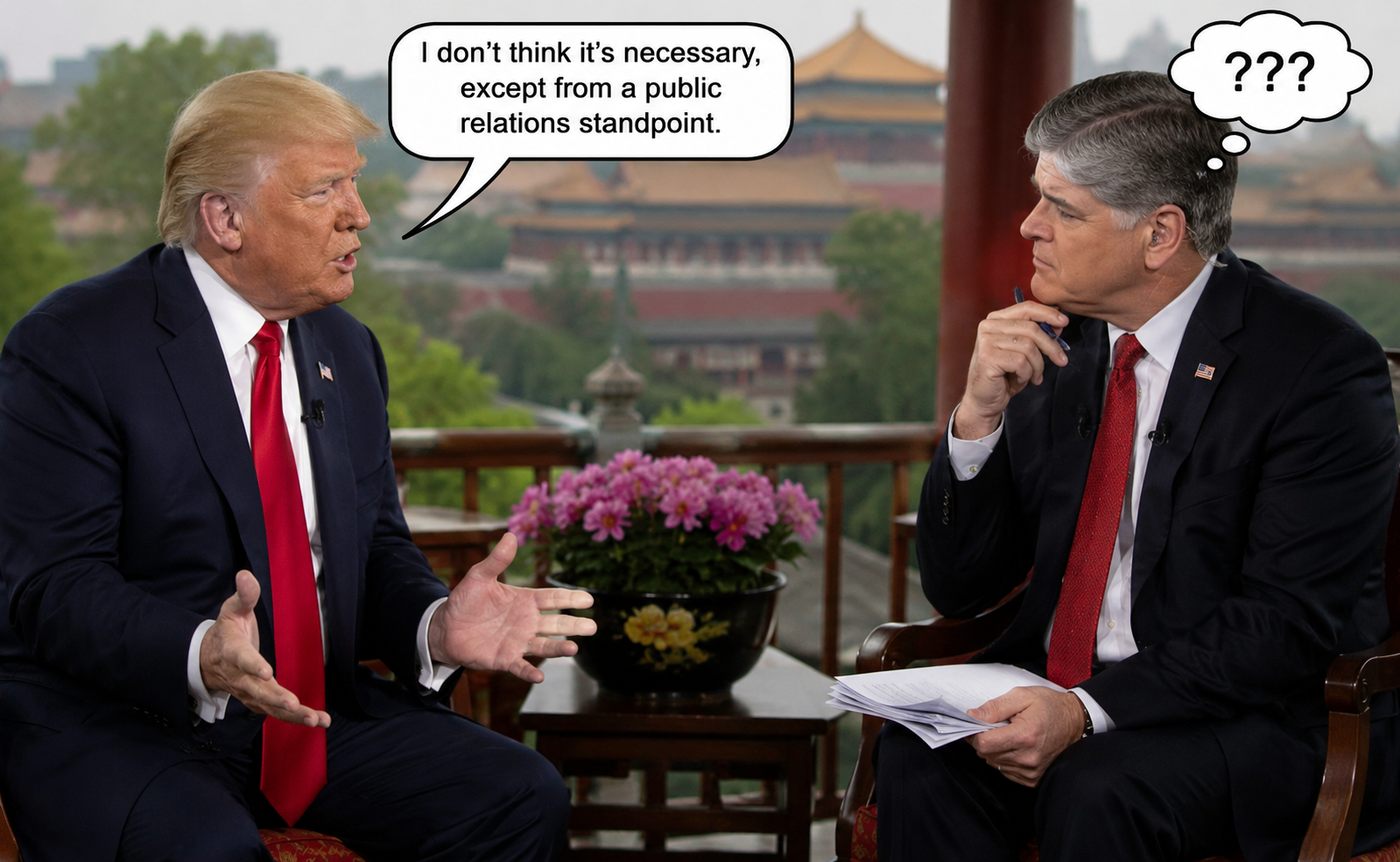
By author (AI)
When “Public Relations” Becomes Strategic Policy
On May 14, 2026, speaking to Fox News host Sean Hannity from Beijing, President Donald Trump made a remark that may prove politically and strategically difficult to contain.
Asked about the roughly 970 pounds of highly enriched uranium believed to remain buried beneath Iran’s bombed nuclear facilities, Trump said: “I just feel better if I got it, actually, but it’s — I think, it’s more for public relations than it is for anything else.”
He continued: “I don’t think it’s necessary, except from a public relations standpoint. I think it’s important for the fake news that we get it.” Trump added that the United States has “nine cameras” monitoring the sites continuously and that “nobody’s even gotten close to it.”
The comments were unusually candid because the uranium stockpile was presented publicly as the central strategic rationale for escalation. If the surviving material is inaccessible, immobilized, and under constant surveillance, then the administration’s own language increasingly suggests it is not viewed as an immediate breakout threat. That raises uncomfortable questions about the strategic logic behind the widening conflict that followed.
THE EVOLUTION OF THE WAR NARRATIVE
The contradiction did not emerge overnight.
On June 21, 2025, following US strikes on Iran’s nuclear facilities at Fordow, Natanz, and Isfahan — collectively referred to as Operation Midnight Hammer — Trump declared that Iran’s “key nuclear enrichment facilities have been completely and totally obliterated.” The White House reinforced the claim in official statements the next day.
Israeli Prime Minister Benjamin Netanyahu declared on June 24 that Israel had “achieved a historic victory” and had sent Iran’s nuclear program “down the drain.” Defense Secretary Pete Hegseth described the operation as “a resounding success.”
Those statements established a clear public narrative: the nuclear threat had effectively been eliminated.
But subsequent events steadily complicated that narrative.
A November 2025 White House document described the June strikes more cautiously, saying Iran’s nuclear program had been “significantly degraded” rather than destroyed. Leaked Defense Intelligence Agency assessments, along with Israeli intelligence reporting, reportedly concluded the strikes delayed Iran’s program by perhaps two years at most, and possibly far less. Some independent nuclear analysts argued even those estimates may have been optimistic.
The contradiction widened further in early 2026. Administration envoy Steve Witkoff stated publicly that Iran was “probably a week away from having industrial-grade bomb-making material,” a claim used to help justify Operation Epic Fury, the much larger US-Israeli campaign launched on February 28, 2026.
That escalation raised an unavoidable strategic question: if Iran’s nuclear program had truly been “obliterated” in June 2025, why was a second major military campaign necessary only months later? If it had not been obliterated, why had the administration repeatedly claimed otherwise?
Trump’s Beijing remarks do not resolve that contradiction so much as expose it.
WHAT THE BEIJING INTERVIEW REVEALED
Trump’s comments suggest the administration privately understands the uranium stockpile differently than it has described publicly.
His remarks implied:
- the material is buried,
- inaccessible without major effort,
- continuously monitored,
- and not presently usable by Iran.
That is not the language of an imminent nuclear emergency. It is the language of containment.
To be clear, inaccessible uranium today does not necessarily eliminate future proliferation risks. Iran could eventually regain access to buried material, particularly if international monitoring erodes over time. From the Israeli perspective, this helps explain the continued insistence on physical removal rather than long-term containment.
But Trump’s comments nonetheless weaken the administration’s public case that the surviving stockpile constituted an urgent strategic threat requiring prolonged military escalation.
They also sharpen the distinction between political objectives and military necessity.
When asked by Hannity whether the uranium could simply remain entombed beneath the destroyed facilities, Trump answered: “It can be. But I’d rather get it, to be honest with you.”
That phrasing matters. It suggests the issue is no longer primarily about immediate nuclear danger, but about demonstrating total victory, preserving credibility, and avoiding the appearance of an incomplete outcome after months of maximalist rhetoric.
THE COSTS OF STRATEGIC AMBIGUITY
Those distinctions matter because the costs of Operation Epic Fury continue to expand far beyond the battlefield.
On May 12, Pentagon acting comptroller Jules Hurst III told Congress the war had already cost approximately $29 billion, excluding long-term repair costs for damaged US regional installations. Outside estimates from the Center for Strategic and International Studies, the American Enterprise Institute, and the Penn Wharton budget model placed likely total costs substantially higher.
Thirteen US service members have been killed and more than 400 wounded. Iran’s Health Ministry estimates at least 3,375 Iranian deaths.
The broader global economic consequences may prove even more significant.
Repeated disruption in the Strait of Hormuz pushed crude oil prices above $120 per barrel at peak levels and triggered the sharpest short-term gasoline price increase in the United States since Russia’s 2022 invasion of Ukraine.
But the larger danger lies downstream.
Modern agriculture depends heavily on affordable fuel, fertilizer production, and uninterrupted maritime trade. Prolonged instability in the Gulf threatens all three simultaneously:
- higher diesel and shipping costs,
- rising fertilizer prices tied to energy markets,
- disrupted supply chains,
- and reduced agricultural productivity in import-dependent regions.
Historically, sustained energy shocks have often translated into delayed food shocks. Fertilizer shortages reduce planting efficiency months later, not immediately. Shipping disruptions compound the problem by increasing transportation costs for grain, fuel, and agricultural inputs simultaneously.
The consequences are likely to fall hardest on fragile import-dependent states across parts of Africa, the Middle East, and South Asia, where food inflation has historically contributed to political instability, unrest, migration pressures, and humanitarian crises.
The risk, therefore, is no longer confined to whether Iran could someday recover buried uranium. The more immediate danger may be that a prolonged conflict centered on symbolic strategic objectives destabilizes the global economy in ways that outlast the military campaign itself.
NETANYAHU’S POSITION AND THE PROBLEM OF MAXIMALISM
Netanyahu has made clear that, from Israel’s perspective, the conflict cannot end while enriched uranium remains inside Iran.
In a recent interview with CBS News, he stated the war was “not over” until the uranium is physically removed and remaining enrichment infrastructure dismantled.
That position is strategically understandable even if politically difficult to sustain.
Israeli planners have long viewed partial rollback agreements skeptically, fearing Iran could rebuild capabilities over time once international attention fades. From that perspective, physical removal represents irreversibility — the difference between temporary disruption and permanent denial.
Yet this position also collides with earlier declarations of decisive success.
In June 2025, Netanyahu publicly declared the nuclear threat effectively eliminated. Less than a year later, Israeli leadership continues to describe surviving enrichment sites and buried uranium stockpiles as unresolved strategic problems requiring ongoing military pressure.
That gap between declared victory and continuing escalation has become increasingly difficult to ignore.
A GROWING CREDIBILITY PROBLEM
The deeper issue may now be one of credibility.
Governments often employ optimistic rhetoric during wartime, but repeated claims of “obliteration” created political expectations that later intelligence assessments could not fully support. Once those claims became politically embedded, strategic flexibility narrowed.
Admitting partial success after promising total elimination carries political costs. Escalation can then become partly driven by the need to reconcile earlier rhetoric with evolving reality.
Trump himself hinted at this dynamic weeks earlier when he told Reuters the buried uranium was “so far underground, I don’t care about that,” adding that Iran was “incapable” of developing a nuclear weapon under current conditions.
Taken together, these remarks suggest an administration increasingly caught between:
- its original public claims,
- Israeli demands for irreversible dismantlement,
- and a strategic reality that looks closer to containment than elimination.
That distinction matters enormously.
Containment is a recognizable strategic framework. It implies monitoring, deterrence, and long-term management of risk.
Elimination, by contrast, implies finality. Once leaders publicly promise elimination, anything short of complete physical control over the remaining material risks appearing incomplete, regardless of the actual operational threat.
That may explain why the uranium issue increasingly resembles a political and symbolic objective as much as a military necessity.
About the Author
William (Bill) Keenan is a Middle East analyst who served as: an Arabian Peninsula counterterrorism analyst at the Pentagon; an Arab Gulf states political/military analyst at the NATO Intelligence Fusion Centre; a counterterrorism analyst at the US European Command (EUCOM); and a professor of intelligence for the Multinational Security Transition Command - Iraq (MNSTC-I) at the Iraq Ministry of Defense Intelligence Directorate. He lived and worked in the Middle East and North Africa (MENA) for 15 years.
Related Topics
Related Posts


William Keenan