The views expressed herein are solely mine.
Trump Arms the Desert: Israel’s Edge on Fire
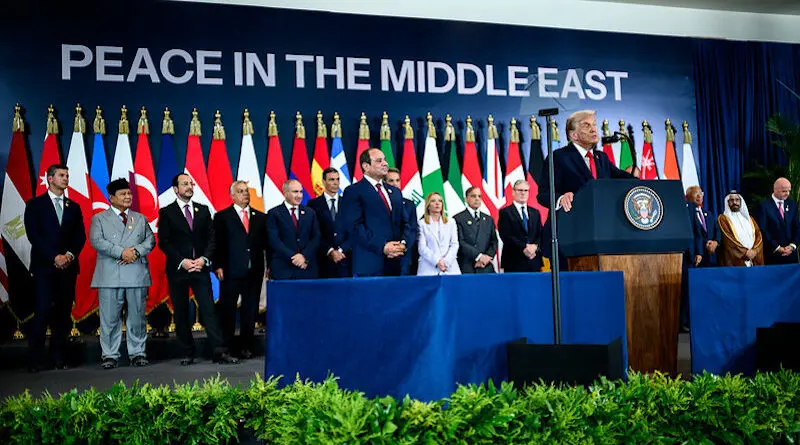
President Donald Trump delivers remarks at the Tonino Lamborghini International Convention Center in Sharm El Sheikh, Egypt, Monday, October 13, 2025, during a summit of world leaders on ending the war between Israel and Hamas in Gaza and advancing peace in the Middle East. (Official White House Photo by Daniel Torok)
Donald Trump has a new gospel for the Middle East: let everyone have the toys, call it peace, and pray it does not blow up.
His latest move—greenlighting Saudi Arabia’s request to buy 48 F-35 stealth fighters—is being sold as another “Abraham Accords miracle.”
But make no mistake: this is not peace. It is power redistribution dressed in the rhetoric of normalization.
Trump wants parity in the region: equal planes, equal prestige, equal promises.
But equality among rivals who hate each other is not stability—it is mutually assured paranoia.
Doubtlessly, he is turning the Middle East into a balanced powder keg, where every faction smiles for the cameras while fingering the trigger.
At first glance, Israel looks like a winner.
Saudi normalization could be historic: Arab cooperation, intelligence sharing, open skies, and shared deterrence against Tehran.
At the same time, a Riyadh armed with F-35s could stand as a counterweight to Iran’s rising nuclear menace and give Jerusalem a strategic buffer.
For now, it feels like deterrence through abundance.
But history is not kind to naïve balances.
Once the photo ops fade and Trump exits the scene, the same Gulf states armed to “keep peace” will start eyeing each other across the dunes.
The Turkish-Qatari-Iranian bloc will inevitably clash with the Saudi-Emirati one.
While Erdogan dreams of reviving the Ottoman frontier through northern Syria, Qatar bankrolls his ambitions under the guise of “regional development”; both share a creeping contempt for Israel’s success.
On the other hand, after Iran stabilizes its sanctions-battered economy, it will rearm through its proxies, shifting the arms race Trump just ignited into overdrive.
But Qatar—oh, Qatar—, is the quiet monster in the room. Quietly, Doha is buying power the way Wall Street buys influence.
While a new defense pact with Washington is on the table, U.S. troops are expanding at Al Udeid. Qatari fighter pilots are training in Idaho. Massive endowments flow into American universities. Even Trump’s own circle whispers about private deals and luxury aircraft exchanges.
Certainly, Qatar plays both sides while hiding behind its polished soft power façade.
Doha is pro-U.S. on paper, pro-Turkey in action, and dangerously cozy with Iran in practice. In effect, Qatar has become the authentic “Switzerland of jihad finance.”
Thereby, this new balance is not a fortress—it is a carousel. Everyone rides; nobody steers.
But whenever the music stops, Israel might find itself surrounded not by allies but by well-armed “partners” with diverging agendas and stealth fighters of their own.
Sadly, the West’s blind Islamization only adds fuel to the fire.
Increasingly, Western universities and NGOs invite Islamist ideologues in the name of tolerance, accelerating the rot of the Middle East’s supposed “peace.”
For this reason, the seed of internal collapse often grows from the West’s own moral confusion and what begins as coexistence ends as surrender.
Plainly, Trump’s vision sounds bold—“peace through strength”—but this time, the strength is evenly distributed.
Nevertheless, we all know that parity in the Middle East is not peace; it is tension disguised as diplomacy.
Hence, Trump is arming the very future adversaries that Israel’s deterrence doctrine was designed to contain. Today, it is “shared deterrence.” Tomorrow, it will be “shared betrayal.”
When Trump is gone, the Saudis will hedge, the Emiratis will calculate, and the Qataris will cash in.
By contrast, the Turks and Iranians will pounce and Israel—the region’s only true democracy—might stand alone again, facing an arsenal it once helped justify.
The truth is simple: Trump’s arms revolution may build a short-term alliance, but it also builds the next war’s supply chain.
Israel’s edge is not being protected—it is being outsourced.
And when the desert catches fire, America’s friends will discover that “regional balance” is just another word for chaos.
Related Topics
- Abraham Accords
- Democracy in Israel
- Donald Trump
- Hamas
- Hezbollah
- Iran
- Islam
- Israel At War
- Israel-Iran Conflict
- Israel-Saudi Normalization
- Israel: Jewish and Democratic
- Israeli Foreign Policy
- Jewish-Muslim Relations
- Lebanon
- Middle East
- Muslim-Jewish Dialogue
- Peace Builders
- Peace Process
- Qatar
- Saudi Arabia
- Syria
- Terrorism
- The Arab World
- Trump Peace Plan
- Turkey
- UAE - United Arab Emirates
- UAE-Israel Peace
- Yemen