Trump Attacked Iran. A Window Opens for Israel.
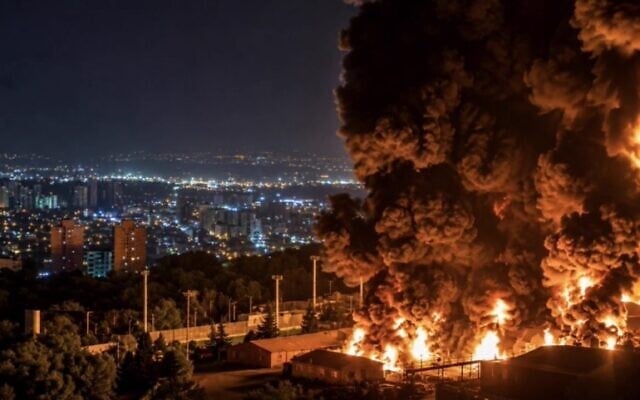
The United States struck Iran for a second consecutive day on Wednesday, and Iran responded by targeting American military bases in Kuwait and Bahrain. Donald Trump declared the ceasefire with Tehran finished, dismissed any further negotiations as a waste of time, and described the campaign as an effort to strip Iran of its nuclear capability. The collapse of the talks removes the main constraint that had kept a wider regional escalation in check.
That constraint had rested largely on Washington. For weeks, while the United States pursued a negotiated settlement over the Strait of Hormuz, Israel held back from major operations against Iran. With his sights set on a deal, Trump had little interest in letting Netanyahu derail it. Now that Trump has abandoned the diplomatic track, that restraint has weakened.
A funeral built to project continuity
The moment coincides with the final day of an extended state funeral for Ayatollah Ali Khamenei, killed in a joint US-Israeli strike on February 28. The ceremonies began on July 4 and were designed to run for six days across Tehran, Qom, the Iraqi cities of Najaf and Karbala, and finally Mashhad, where Khamenei is set to be buried on Thursday at the shrine of Imam Reza.
Analysts have described the event as a political undertaking presented as a religious one, meant to show that the Iranian state remains stable despite the loss of the man who led it for nearly four decades. Iranian authorities called for mass participation, and state media estimated that millions would take part.
The most senior foreign delegations attended at the start. Pakistan’s prime minister and his army chief were in Tehran on the opening day, along with representatives from China, Russia, India, the Taliban government of Afghanistan, and officials from Qatar, Oman, Saudi Arabia, Iraq, Cuba and Serbia. Most paid their respects during the first days of ceremonies in Tehran and did not remain for the burial in Mashhad, a domestic religious occasion rather than a diplomatic one.
The schedule follows the official protocol, which placed the international portion of the funeral at the beginning. Whether other considerations also shaped the departures is not publicly known. Governments rarely disclose the intelligence that guides the movements of their officials, and Iran had closed the airspace over Tehran and warned the United States and Israel against any attack during the funeral. The concentration of foreign guests in the early days is consistent with the published schedule, and there is no public evidence that any delegation changed its plans in response to a specific threat.
The absent successor
The more significant question hanging over the ceremonies concerns the man expected to inherit Khamenei’s authority. Mojtaba Khamenei, the ayatollah’s son, was named Supreme Leader after the February strike. Since then he has not appeared in public, has not spoken, and has not led prayers at any point during the funeral. His image is on posters throughout Tehran, but the man himself has not been seen. Iranian media reported that he did not attend his own wife’s funeral the week before. Three of his brothers were shown at the ceremonies; he was not.
The government has attributed his absence to injury. US Defense Secretary Pete Hegseth said in March that Mojtaba had been wounded and likely disfigured in the strike that killed his father, mother and wife, and Reuters reported in April that he was recovering from serious injuries. That account remains unconfirmed and unverifiable, and the continued absence of the country’s designated leader at the burial of his predecessor leaves a central figure of the Iranian state unaccounted for at its most public moment.
A leadership without a settled direction
The combination presents a particular vulnerability. Iran is burying one leader without being able to present the next, and that leaves the chain of command uncertain. Power in practice rests with the Revolutionary Guard commanders and the officials who have managed the succession, but no visible figure stands at the top for the state to organize around.
With Ali Khamenei alive and in charge, Iran could absorb a military setback and answer with a single voice. Now, concealing that absence at its center, the response tends to fracture, as rival power centers each move to protect their own standing. That internal division, more than any single strike, is what makes this period so unstable for Tehran.
The rhetoric reflects the tension. The Revolutionary Guard has warned of a crushing response to any attack during the mourning period, and Israeli Defense Minister Israel Katz has said publicly that Mojtaba is marked for death.
The limits of the opening
None of this indicates that Israel will act on Thursday. A strike on the burial at the shrine of Imam Reza, surrounded by large crowds of pilgrims, would carry a symbolic and human cost that even an unconstrained Netanyahu would be reluctant to pay. An opening is not the same as the decision to use it.
The opening itself, however, is real. The American restraint that limited Israeli action for months has eased, and the Iranian government is at its most exposed, mourning its former leader in public while shielding the one it named from view. Israel’s past conduct toward Hezbollah shows that Netanyahu tends to time his major operations to moments when Washington’s posture allows them, and that posture has just shifted. What Israel does with that latitude, and when, is the question the coming hours and days will answer.