Trump Leads Historic Board of Peace Meeting
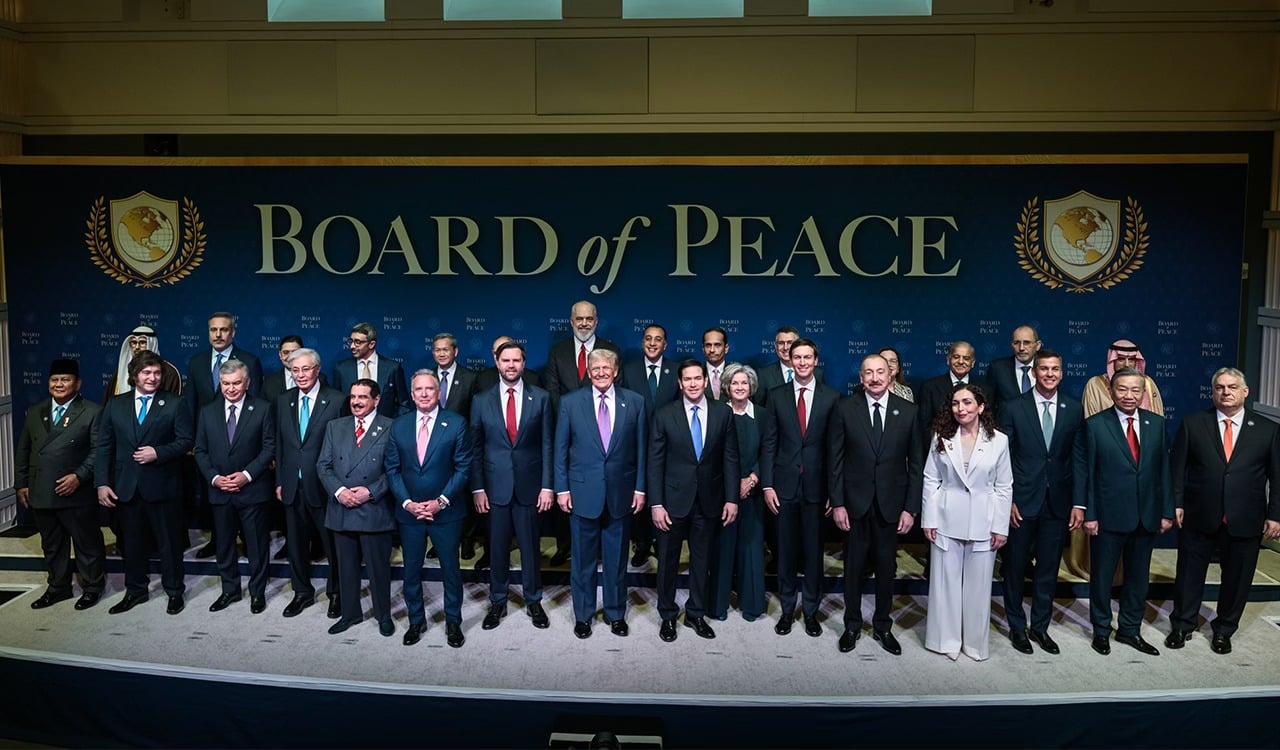
The inaugural summit of the Board of Peace at the Donald J. Trump Institute of Peace in Washington marked an ambitious moment in contemporary diplomacy. With nearly 50 nations in attendance and more than $17 billion pledged for Gaza’s reconstruction and stabilization, the gathering signaled that the international community is prepared to move from rhetoric to reconstruction.
PRESIDENT TRUMP: The Board of Peace is very generous with money because there's nothing more important or less expensive than peace. pic.twitter.com/Y1xcrK2FdN
— Department of State (@StateDept) February 19, 2026
The meeting, presided over by US President Donald Trump, was a serious effort aimed at delivering results. By the conclusion of the event, over $17 billion had been promised for the stabilization and rebuilding of Gaza. The US alone committed $10 billion, with further contributions from partners throughout the Middle East, Central Asia, and beyond. The plans for an International Stabilization Force, potentially including up to 20,000 personnel, highlighted that reconstruction would be pursued alongside security guarantees.
World leaders and founding members of the Board of Peace gather for the inaugural meeting at the Donald J. Trump Institute of Peace. pic.twitter.com/F8f67yrlZZ
— The White House (@WhiteHouse) February 19, 2026
President Trump’s address set a defining tone. He described peace as a simple term that requires hard work, framing the BoP as a means of turning diplomatic energy into real results. He pointed to recent efforts to de-escalate conflicts and promote peace as proof that ongoing engagement can disrupt cycles of violence. For Gaza, he highlighted the need for demilitarization, rebuilding, and economic revival as parallel efforts in which security and prosperity go hand in hand.
PRESIDENT TRUMP: I think the Board of Peace is one of the most important and consequential things that I'll be involved in.
I've been involved with a lot of the people up here. We work together on ending wars with their country. It's been amazing. pic.twitter.com/plPJl2zTof
— Department of State (@StateDept) February 19, 2026
He stressed the end of the Gaza war, warned of potential military action against Iran if negotiations falter, and emphasized the board’s role in global peacekeeping. “What we’re doing is very simple: peace. It’s called the Board of Peace, and while it’s an easy word to say, it’s a tough one to create — peace.” He called the board the “most prestigious ever assembled,” surpassing corporate boards, and insisted that those who choose not to join “can’t play cute with me.”
Security, prosperity, and peace – that’s what @POTUS wants to see in Gaza.
Today’s Board of Peace meeting proved once again that President Trump is the Peace President. pic.twitter.com/Oj9McbHSEp
— Tommy Pigott (@StateDeputySpox) February 19, 2026
Senior officials in the US really emphasized that message. Vice President JD Vance pointed out the broader economic benefits that come from stability, while Secretary of State Marco Rubio noted how political will has turned what once looked impossible into a coordinated global effort. This sense of optimism was shared by international leaders, such as Kassym-Jomart Tokayev, who offered financial support and scholarships for Gazan students, and Israeli Foreign Minister Gideon Sa’ar, who reaffirmed his commitment to long-term security arrangements.
Ambassador Waltz @USAmbUN spoke at the Board of Peace meeting in Washington about the progress made in Gaza thanks to President Trump’s historic leadership. Watch: pic.twitter.com/tirmZ7QQFw
— U.S. Mission to the UN (@USUN) February 19, 2026
Speaking at the inaugural Board of Peace meeting in Washington, Sheikh Abdullah bin Zayed, Deputy Prime Minister and Minister of Foreign Affairs, announced that the UAE would provide an additional $1.2 billion in support for Gaza as part of Donald Trump’s peace initiative.
Speaking at the inaugural Board of Peace meeting in Washington, Sheikh Abdullah bin Zayed, Deputy Prime Minister and Minister of Foreign Affairs, announced that the UAE would provide an additional $1.2 billion in support for Gaza as part of Donald Trump's peace initiative. pic.twitter.com/GNPBS0ztW8
— The National (@TheNationalNews) February 19, 2026
Vice President JD Vance’s speech focused on US commitments and critiqued opponents. He highlighted trillions in investments enabled by Trump’s peace advocacy: “The countries represented here represent trillions of dollars of investment in the United States of America that would not have been possible without POTUS’ leadership.” He praised President Trump’s vision for Gaza, including economic revival.
The President's pursuit of peace around the world is also a mission for prosperity right here in America.
Proud to take part in President Trump's historic Board of Peace meeting in Washington this morning. pic.twitter.com/ptj86PFsDZ
— JD Vance (@JDVance) February 19, 2026
Secretary of State Marco Rubio emphasized Trump’s role in achieving the impossible: “We are here today because of President Trump’s vision. If we go back just a few months ago, people thought what was happening in Gaza was impossible to solve… But President Trump had the vision and the courage.”
MARCO BOSS MODE: Marco Rubio just nailed it at the Board of Peace event!
He praised Trump for thinking outside the box on Gaza. Existing international institutions couldn't solve it.
Trump used his power to create a unique solution!
Got UN approval but built a new coalition of… pic.twitter.com/IsFjGkBRRK
— Bill Mitchell (@mitchellvii) February 19, 2026
Former British Prime Minister Tony Blair said he hopes Hamas would disarm peacefully and transition into political activity without weapons. “They’ve got to give up the violence that has done so much damage to people in Gaza. So our hope is that we can do this by agreement,” Blair said.
“Right now, the important thing is not to focus on all the problems, but to look at how we can provide solutions for the people in Gaza,” Blair added.
Speaking at Trump's Board of Peace meeting in Washington the former UK PM spoke in support of the US president's plans for Gaza.
World leaders and national delegations gathered in Washington, for the inaugural meeting of Donald Trump's Board of Peace.
https://t.co/flOU1DqjxB pic.twitter.com/ozbqLpc5TI
— Sky News (@SkyNews) February 19, 2026
Israeli Foreign Minister Gideon Sa’ar thanked President Trump‘s comprehensive plan, which addresses the root of the problem: disarmament of Hamas and Islamic Jihad, demilitarization of the Gaza Strip and deradicalization of Palestinian society there. He said, the president’s visionary leadership has created, for the first time, an opportunity for a better future. Thank you, Mr. President!
Israel Foreign Minister Gideon Sa’ar at the Board of Peace:
“Remember our 925 brave soldiers who sacrificed their lives in the war against pure evil: Hamas, Islamic Jihad, and Hezbollah. These are the best people. We owe them our very existence and all our achievements. They… pic.twitter.com/uOjtN1cs7d
— Open Source Intel (@Osint613) February 19, 2026
During his address, President Trump expressed his admiration for Pakistan’s PM Shehbaz Sharif and Chief of Army Staff Field Marshal Syed Asim Munir. His comments were both candid and personal. “I have a lot of respect for Prime Minister Shehbaz Sharif,” he said, recalling how their diplomatic interactions during the fraught days of the Pakistan-India crisis helped create a working relationship centered on crisis management.
Reflecting on that period of increased tension between the two nuclear powers, President Trump emphasized that it was during those challenging times that their communication channels became stronger. The message was unmistakable: even in tough situations, diplomacy can build a foundation of trust.
President Donald Trump, while addressing the inaugural landmark meeting of the Board of Peace at the United States Institute of Peace, praised Pakistan’s Prime Minister Shehbaz Sharif, saying he “really likes this man.” He also commended CDF Field Marshal Asim Munir, describing… pic.twitter.com/iF5nUqbswk
— Pakistan TV (@PakTVGlobal) February 19, 2026
For Pakistan, the acknowledgment was more than courtesy. It reflected Islamabad’s evolving diplomatic posture — one that combines strategic steadiness with political engagement. Pakistan’s participation underscored its readiness to contribute constructively to multilateral efforts, particularly on issues as sensitive as Gaza’s ceasefire enforcement and reconstruction. In his speech, PM Shehbaz adopted a forward-looking tone, expressing confidence that under decisive international leadership, Gaza can transition from devastation to development.
Met today with Pakistani Prime Minister @CMShehbaz. Appreciate Pakistan’s ongoing support of @POTUS’s Peace Plan for Gaza and for joining the Board of Peace. In our meeting, we discussed the importance of our strategic relationship on critical minerals development and… pic.twitter.com/vMSl6i4bvz
— Secretary Marco Rubio (@SecRubio) February 19, 2026
Gaza’s path ahead remains demanding. Demilitarization, reconstruction, and political reconciliation will test the resolve of all stakeholders. However, for the first time in months, the conversation in Washington centered not on escalation, but on investment, stabilization, and opportunity. If the commitments announced at the Board of Peace translate into concrete progress on the ground, the summit will mark the beginning of a structured, internationally backed effort to secure a just and lasting peace in Gaza.
With President Trump at the helm, the inaugural Board of Peace meeting has kicked off a journey that’s both ambitious and intricate, but undeniably filled with hope. The task ahead is formidable. The opportunity, however, is equally historic.