
Two Ways Trump Could Use the Mother of All Bombs to Knock Out Pickaxe Mountain
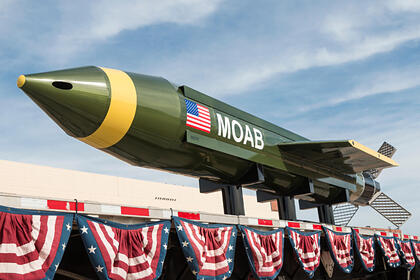
On October 15, 2026, President Donald Trump raised the possibility of striking Iran’s Pickaxe Mountain, declaring that the United States might have to target the deeply buried nuclear facility. During an interview with Newsmax, Trump also discussed the Mother of All Bombs (MOAB), emphasizing that it is a conventional, not a nuclear, weapon.
His most striking statement was also his most confident: “We’ll knock it out fast.”
That same day, CNN reported that American military planners had developed contingency plans involving the GBU-43/B Massive Ordnance Air Blast bomb, including its potential use against Iranian nuclear facilities such as Pickaxe Mountain. Trump has not publicly confirmed authorizing such an attack.
The possibility raises an intriguing question: What could the Mother of All Bombs actually accomplish against the nuclear complex protected by Pickaxe Mountain?
The MOAB is among the most powerful conventional bombs ever used in combat. Weighing approximately 9,800 kilograms (21,600 pounds), it carries roughly 8,480 kilograms of high explosives and releases energy equivalent to approximately 11 tons of TNT. Unlike the GBU-57 Massive Ordnance Penetrator (MOP), specifically developed to attack hardened underground facilities, the MOAB is primarily an air-blast weapon designed to produce an exceptionally powerful explosion over a broad area.
Despite its terrifying nickname, the Mother of All Bombs releases less than one-thousandth of the explosive energy of the atomic bomb dropped on Hiroshima. That nuclear weapon had an estimated yield of approximately 15 kilotons of TNT, compared with the MOAB’s 11 tons. The MOAB produces no nuclear explosion or associated nuclear radiation.
Public estimates have placed the MOAB’s blast radius at approximately 150 meters in open terrain, although the extent of damage depends on the conditions and the effects being measured. Pickaxe Mountain presents an entirely different environment, where mountainous terrain and underground structures would substantially alter the explosion’s effects. Nevertheless, the figure offers a useful illustration of the weapon’s extraordinary destructive power.
The United States has employed the MOAB only once in combat. On April 13, 2017, an American aircraft dropped the weapon against an Islamic State tunnel and cave complex in Afghanistan’s Nangarhar province. Afghan officials subsequently reported dozens of militants killed, although independent verification of the casualties and the full extent of the destruction remained limited.
Approximately 15 MOABs were reportedly manufactured. The number remaining in the American inventory today has not been publicly established.
An October 16 assessment by the Institute for Science and International Security found that activity at Pickaxe Mountain remained limited. Nevertheless, valuable equipment or materials may remain inside the underground complex.
If Washington eventually decides to employ the MOAB against Pickaxe Mountain, two broad possibilities deserve examination.
The first concerns combining the MOAB with the GBU-57 Massive Ordnance Penetrator.
These weapons were designed for different purposes. The GBU-57 concentrates its destructive effects against hardened underground targets, while the MOAB produces a massive conventional air blast. The hypothesis is that their different characteristics might contribute to a common objective: severely damaging the underground installation rather than merely devastating the mountain’s surface.
However, this scenario would be more complicated than simply dropping one GBU-57 and then following it with a MOAB. Pickaxe Mountain is believed to be exceptionally resistant, and a single GBU-57 might not penetrate deeply enough to reach the heart of the facility. American planners could therefore need to use several GBU-57s against precisely the same location, gradually weakening the mountain and enlarging the penetration path until the weapon finally opened a route into the underground complex.
Only after that breach had been created could the MOAB potentially be used against the same point. Its purpose would not be to penetrate the mountain, but to exploit the opening created by the penetrating weapons and send intense blast, heat, and fire into the installation from above. In theory, this sequence could combine the GBU-57’s ability to bore through hardened material with the MOAB’s ability to generate a massive destructive effect once the protective barrier had been compromised.
The major weakness of this hypothesis is uncertainty about the mountain’s internal structure. Unless American intelligence has identified a particularly vulnerable section of Pickaxe Mountain, repeated GBU-57 strikes could fail to create a usable breach. In that case, the strategy could consume several extremely valuable penetrators without ever reaching the facility’s critical areas. The MOAB would then have little opportunity to affect the underground complex, because its blast would still be largely confined to the exterior.
The concept therefore depends on more than the destructive power of the weapons. It requires accurate knowledge of the mountain’s geology, the thickness and composition of its protective layers, the location of the underground chambers, and the precise point at which repeated impacts could produce a meaningful opening.
The second possibility concerns the relationship between a powerful external explosion and the underground complex’s connections to the outside world.
The Institute for Science and International Security has identified four tunnel portals associated with Pickaxe Mountain through satellite imagery. These access points are significant features of the facility, although their precise relationship with its internal infrastructure has not been publicly established.
Unlike the first hypothesis, which involves the complementary characteristics of penetrating and air-blast weapons, this scenario examines whether the MOAB’s extraordinary explosive effects could seriously disrupt the underground installation through its exterior connections.
One possible sequence would involve first opening a breach at each of the four tunnel entrances, using penetrating weapons or repeated strikes to damage and clear the portals. The MOABs could then be dropped directly into those openings, allowing their blast and heat to travel into the tunnel network rather than detonating solely against the mountain’s exterior. This approach would depend on the entrances providing a sufficiently direct path toward critical internal areas.
A large conventional explosion generates intense pressure and heat. In an underground facility, damage to critical infrastructure could have consequences extending beyond the immediate area affected. The possibility of internal fires and widespread disruption is therefore relevant to the analysis, although neither can be assumed to follow automatically from an external detonation.
Both hypotheses ultimately concern the same strategic objective: neutralizing a deeply buried facility through conventional airpower without committing American ground troops.
But the most intriguing element of this story may not be the MOAB itself. It is Trump’s apparent certainty that a formidable underground facility can be neutralized quickly.
American military planners may already possess extensive intelligence about Pickaxe Mountain’s construction.
The absence of an attack so far does not necessarily indicate a lack of military options. Political calculations, diplomatic considerations, and the consequences of escalation may also influence Washington’s decisions.
Of course, presidential confidence does not establish that a military operation would succeed. Nor does Trump’s discussion of the MOAB prove that he has selected it as his weapon of choice.
This analysis is conditional: it examines two possible roles for the MOAB if Washington ultimately decides to employ it against Pickaxe Mountain.
He says he can knock it out fast. Whether the Pentagon can deliver on those words remains to be seen.