
Founder & Principal, Line of State
Trump Promised Turkey. Israel Will Ensure Washington Blocks It
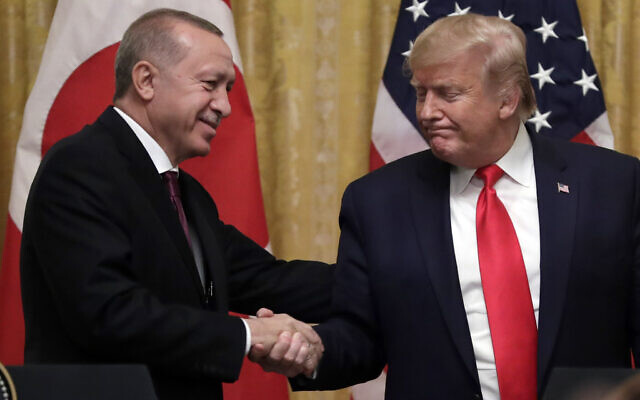
A handshake built on personal chemistry rather than institutional consensus. US President Donald Trump meets Turkish President Recep Tayyip Erdoğan at the White House - a moment reflecting promises made person-to-person, long before Washington’s system weighs in. (AP Photo / Evan Vucci)
What looked like a cordial meeting at Mar-a-Lago concealed a sharper reality. Turkey was not a side note to the Netanyahu-Trump talks; it was the core issue. Not Iran. Not Hamas. Not Gaza. At stake was a familiar method disguised as diplomacy: personal assurances replacing policy, performance replacing strategy. F-35s on one track, Turkish forces in Gaza on another, wrapped in promises that “everything will be fine”. But Jerusalem understands what Ankara prefers to ignore: Washington is not a villa in Florida, nor a single voice. When red lines are tested quietly, systems respond. This is about power and the limits of what can be promised.
The real story of this week’s Netanyahu-Trump meeting is simple: Turkey. Not Iran. Not Hamas. Not Gaza.
The deployment of Turkish forces in Gaza and the sale of F-35s to Erdogan are not policy ideas but a method: regional management through personal deals and assurances rather than hard reality. Trump himself illustrated this approach when he dismissed the issue as if it were a neighborhood misunderstanding: Israel “will be fine” and Turkey “won’t use them against you”. This is not policy; it is a dangerous assumption. In the Middle East, it does not work.
Turkey was not removed from the F-35 program on a whim. It was removed after choosing to deploy Russia’s S-400 system on its territory – an asset fundamentally incompatible with a stealth fighter. Washington drew a clear red line: S-400 or F-35 – never both. This was a security and technological principle, not a political impulse. US law explicitly ties the S-400 affair to Turkey’s exclusion from the F-35 program. Personal chemistry does not override legislation.
Even if a “creative solution” to the S-400 issue were found, the risk would not be technical. It lies in Turkey’s behavior. Erdogan positions Turkey as a regional center of gravity, with its surroundings expected to adjust accordingly. In the Aegean and the Eastern Mediterranean, this translates into sustained confrontation with Greece and Cyprus over maritime boundaries. Cooperation between Israel, Greece, and Cyprus is viewed in Ankara as a challenge. This is not a partner seeking de-escalation; it is a power seeking strategic maneuvering space.
Turkey’s pattern of force employment speaks for itself. Ankara routinely uses military force against Kurdish targets in Iraq and Syria; this is policy, not an exception. There is no realistic scenario in which Turkish stealth aircraft would be intended to deter Russia or contain Iran. They would be integrated into Turkey’s existing priorities.
Turkey will not confront Russia. It is bound to Moscow by energy and financial ties: the Akkuyu nuclear project is built and financed by Russia, and TurkStream serves as a major conduit for Russian gas to Europe. A state that functions as an oxygen pipeline does not deploy its most sensitive platforms against Moscow.
Nor will Turkey confront Iran. Ankara maintains routine trade and energy relations with Tehran. A country dependent on its neighborhood does not open a regional front. This is where the reassuring argument – “they won’t use it against Israel” – collapses: not because of friendship, but because of interests. And that is precisely where power is exercised.
This leads to the most dangerous idea of all: deploying Turkish forces in Gaza. This is not a matter of interpretation; it is a direct security risk. Erdogan’s Turkey is not a neutral mediator. He has defined Hamas as a “liberation organization”, hosts its leadership in Ankara and grants them Turkish passports. A Turkish force in Gaza would mean Erdogan’s presence in Gaza – flag, uniforms, command structures, and intelligence – creating a permanent friction zone with the IDF, where any local tactical incident could escalate into a diplomatic crisis. This would not be stabilization; it would be a Turkish foothold at the heart of Israel’s most sensitive arena.
The sale of F-35s and the deployment of forces in Gaza are not separate initiatives. They are the same deal along two tracks: restoring Turkey to the top tier of military technology while establishing a Turkish presence adjacent to Israel under international cover. This is neither accidental nor naïve.
In Trump’s worldview, performance is not always a prelude to reality. At times it replaces it; at times it is the policy. Jerusalem understands this clearly: Trump can be with Israel and with Erdogan at the same time. For him, this is not a contradiction but a method.
Israel possesses a strategic asset that many countries lack: a deep relationship with the United States as a system – the Congress, the Senate, the Pentagon, and the security community – designed to safeguard interests, not to automatically approve initiatives, and at times to block moves that harm Israel, even when they originate with “the most pro-Israel president”. This tool has been used before. Presidents were angered; Israel endured. There is no need for public confrontation – only for clear boundaries and quiet enforcement.
An earlier Hebrew version of this analysis appeared in Maariv. This is a revised English edition by the author.
Related Topics
Related Posts