
Trump’s Aladdin’s Lamp: Cuba’s Role in Breaking the Iran Deadlock
Donald Trump built his brand on dealmaking. So why, after bombing Iran for forty days, does a lasting agreement still feel out of reach?
The bombs worked — up to a point. American and Israeli strikes degraded Iran’s military capabilities significantly, eliminating commanders and destroying facilities that Tehran spent decades building. A ceasefire took hold in April. But military success and political success are different things. Iran has not capitulated. The regime is battered, not broken. The popular uprising Trump appeared to anticipate has not materialized. And the uncomfortable question hanging over Washington is: what would more bombing actually achieve at this point?
To understand why, it is worth turning to the world’s most influential book on negotiation.
Roger Fisher and William Ury’s Getting to Yes has been taught in law schools and business schools for over four decades. Fisher himself helped broker the Camp David peace deal between Egypt and Israel. The book’s central insight is simple: what matters most in any negotiation is not the opening offer or the deadline. It is what each side will do if talks fall apart. Fisher and Ury called this the BATNA, the Best Alternative to a Negotiated Agreement. The side with the stronger fallback holds the real power, regardless of who is making the most noise or wielding the bigger stick.
Iran’s BATNA remains surprisingly resilient. Despite the devastation, the regime can still claim survival itself as a form of victory, deepen ties with China and Russia, and wait for Trump’s domestic political window to narrow as mid-term elections approach.
Trump’s BATNA has weakened. Further bombing risks diminishing returns — militarily, diplomatically, and politically. The naval blockade on the Strait of Hormuz squeezes Iran but also punishes allies whose economies depend on those waters. You cannot build a coalition by strangling your friends.
What Trump needs is not another air raid over Tehran. He needs a win closer to home. And ninety miles from Florida sits an island that could deliver one — while changing the Iran equation at the same time.
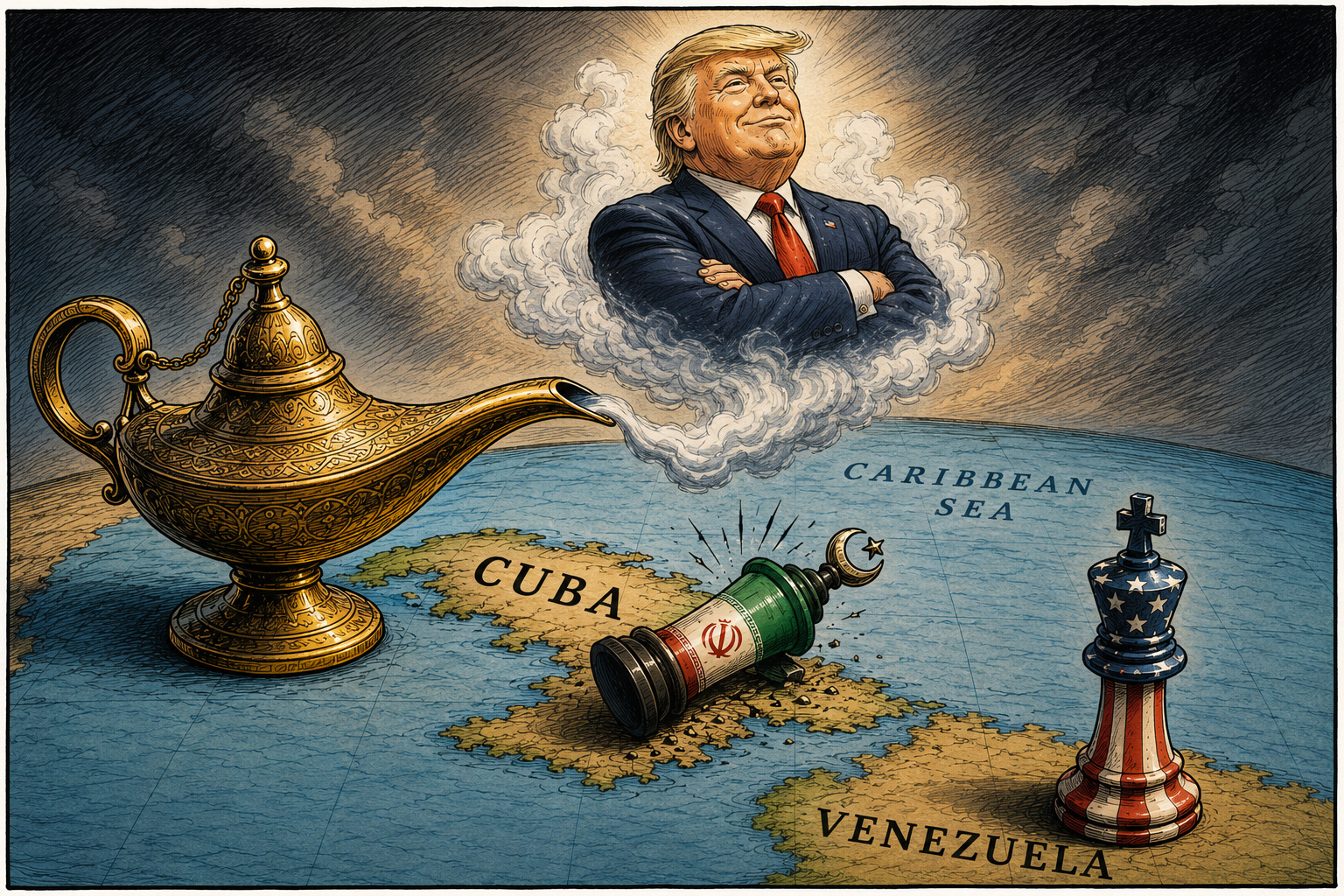
Cuba is Trump’s Aladdin’s lamp.
Like all Aladdin’s lamps, it looks like nothing much. Tarnished, overlooked, dismissed as a relic of the Cold War. But for a president stuck in an Iranian stalemate, rubbing it could release the genie that breaks the deadlock entirely.
Consider what has already happened. In January, the United States intervened militarily in Venezuela, captured Nicolás Maduro, and effectively ended his regime. It was swift, decisive, and by the standards of recent American military adventures, relatively clean. Venezuela had been Cuba’s economic lifeline. With Maduro gone, Cuba’s crisis deepened overnight. Trump moved fast, imposing an oil blockade, declaring Cuba a national security threat, and telling Havana to make a deal. And in March, Cuba publicly confirmed it was engaged in diplomatic talks with Washington. Those talks have stalled. And this week, Trump’s administration indicted Raúl Castro, a signal that Washington’s patience is running out.
American intelligence reports that Iranian military advisors are now operating in Havana, that Cuba has acquired over 300 military drones supplied by Iran and Russia, and that Cuban officials have discussed using them against Guantanamo Bay and targets in Florida. Cuba, it turns out, is not a distraction from the Iran problem. It is another front in the same war.
Which explains why the pressure is escalating so rapidly. The Trump administration has conducted 25 military intelligence flights off Cuba’s coast since February. And this week the USS Nimitz entered the Caribbean Sea. The ship is America’s oldest active aircraft carrier, a vessel that has projected American power from the Taiwan Strait to the Persian Gulf across five decades, and is by all accounts on its final operational mission before decommissioning. If there is a fitting final chapter for the Nimitz, helping dismantle one of the last Cold War adversaries of the United States, one now hosting Iranian military assets less than a hundred miles from Florida, might be it.
A Venezuela-style operation against Cuba — whether special forces, a targeted strike, or something more — would be faster, simpler, and geographically tidier than anything Trump has attempted in the Middle East. The Cuban regime is already economically hollowed out. The Maduro precedent has been set. And with midterm elections five months away, a swift Cuba success would give a president whose Iran campaign has produced a deadlock exactly the foreign policy trophy he needs.
But here is the argument that matters beyond domestic politics — the one Tehran should be reading carefully.
A successful Cuba operation would do two things to the Iran negotiation simultaneously. First, it would solve Trump’s BATNA problem. Right now he needs a deal with Iran, and that need is his greatest weakness at the table. A Cuba win would mean he no longer needs Iran to validate his presidency before the midterms. And unlike Iran, Cuba is a win that most Americans could feel directly. Ninety miles from Florida, with a diaspora that has waited decades for this moment and an island whose economic potential, once opened, would be immediate and visible. Once Trump no longer needs the deal more than Tehran does, the entire dynamic at the table shifts.
Second, and more dangerously for Tehran, it would destroy Iran’s own BATNA. Iran’s walkaway option has always been regime survival through resistance. Hang on long enough and the pressure lifts. But Venezuela fell. If Cuba falls too, and with it an Iranian military foothold in the Western Hemisphere, the message is unambiguous. This president’s maximum pressure does not stall and does not bluff. It concludes. Suddenly waiting Trump out looks less like a strategy and more like a gamble with existential stakes.
Cuba is not Iran. It is smaller, less entrenched, and without nuclear capabilities. But it has defied Washington since 1960, nearly twenty years longer than Iran. If that regime falls, after Venezuela already did, the message to Tehran is pointed. Two successes in the same playbook cannot be dismissed as a fluke. In Tehran, nobody will be calling it a coincidence.
The Nimitz is already in the Caribbean. Aladdin’s lamp is in Trump’s hands.