
Founder & Principal, Line of State
Trump’s Board of Peace Reduces Policy to Personal Adulation
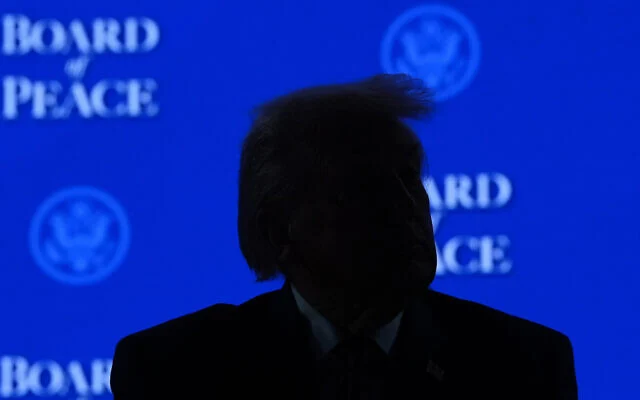
Peace as a backdrop. Power as a performance. US President Donald Trump listens to speakers after the signing of a Board of Peace charter during the Annual Meeting of the World Economic Forum in Davos, Switzerland, January 22, 2026. (AP Photo/Evan Vucci)
Anyone who looks at the emblem of Trump’s “Board of Peace” does not need to read its founding documents. This is not a globe of the world, but America alone, rendered as a map and placed at the centre. The Middle East is not there. Europe is not there. “The world” has been removed. This is not a design choice; it is a statement. The outcome is not peace, but the conversion of sovereignty into personal adulation.
The Board is not an international working framework. It is a brand, built on loyalty rather than rules. Joining it is entry into a circle, not membership in an institution.
Membership is by personal invitation of the Chairman, Donald Trump. The charter defines the Chairmanship as a personal appointment, separate from Trump’s role as a representative of the United States and independent of his tenure as President. The term is limited, but its extension rests solely at his discretion. The Chairman holds veto power, interpretive authority, dismissal powers, and the right to appoint his successor. The dissolution of the body is subject to his unilateral decision alone. In practice, this is not an international institution, but a concession.
The entry price for a seat is one billion dollars. This is not participation; it is a loyalty vote. In a system where international bodies are built on institutional balance and accumulated memory, this is a structure that exists only so long as its owner chooses to maintain it.
The problem is not aesthetic; it is structural. The brand presents operability, but produces language rather than capability. Around Gaza, operational terms were introduced – “buy-back”, external oversight, a stabilisation force, phased withdrawal – without mandate, enforcement mechanisms, or binding consent. These formulations lack both authority and effect.
The list of participants reflects weakness, not strength. Around a table ostensibly convened to “dismantle Hamas” sit states that maintain open channels with it, host its leadership, or trade in it as a political asset. Turkey and Qatar are not anomalies; they are part of the pattern. When those who hold the keys to Hamas are shaping “the day after”, this is not a working arena but a platform devoid of executive authority. The operational question is not who is inside, but what is being purchased with the entry ticket – and at whose expense.
Those who chose to remain outside did so out of a sober reading of reality. This framework does not add capability; it confuses responsibility. Peace is built through treaties, budgets, and enforcement mechanisms. A structure centred on a single individual generates noise, not functionality.
Against this backdrop, Israel’s decision to join was correct and grounded in a clear-eyed assessment of reality. When Washington establishes a framework that begins in Gaza and seeks to project outward, Israel chooses to be inside. Not for endorsement, but for influence and damage limitation. Weak frameworks are not neutral; when they are given a stage, they generate harm.
Kazakhstan provided a clear example. Trump announced its “joining” of the Abraham Accords as a breakthrough, when no such breakthrough existed. Relations had existed for decades, cooperation was already in place, and no peace or regional balance was altered. A headline was created. A geostrategic placebo. In Jerusalem, this was met with no public response, and with internal derision. The instruction was clear: do not comment, do not respond, do not participate. Silence was policy.
The problem runs deeper. Kazakhstan is not part of the Middle Eastern space and is not an anchor of the Indo-Mediterranean corridor. It sits at the core of the Middle Corridor – a land route linking China to Europe through Central Asia, the Caspian Sea and the Caucasus – serving Turkish-Eurasian rather than Middle Eastern interests. Its economy remains tied to Moscow, and no headline alters that structural dependence. Wrapping it in Middle Eastern branding strengthened nothing. It blurred maps and confused partners as to what Washington was actually advancing.
This is the pattern. Trump’s Washington presents frameworks without mechanisms, names without depth, and symbols in place of rules. This is not a malfunction; it is a method. Noise increases, capability erodes, and the mask falls the moment execution is required.
Jerusalem is measured by its ability to execute, not by its attachment to shifting international frameworks. Councils rise and fall; interests endure. That is true of this Board, and it is equally true of the American President who stands at its head – replacing substance and process with a collection of packaging.
—
An earlier Hebrew version of this assessment circulated in Maariv. This English version has been revised by the author.
Related Topics
Related Posts