The views expressed herein are solely mine.
Trump’s F-35 Gamble to Detonate Mideast Power
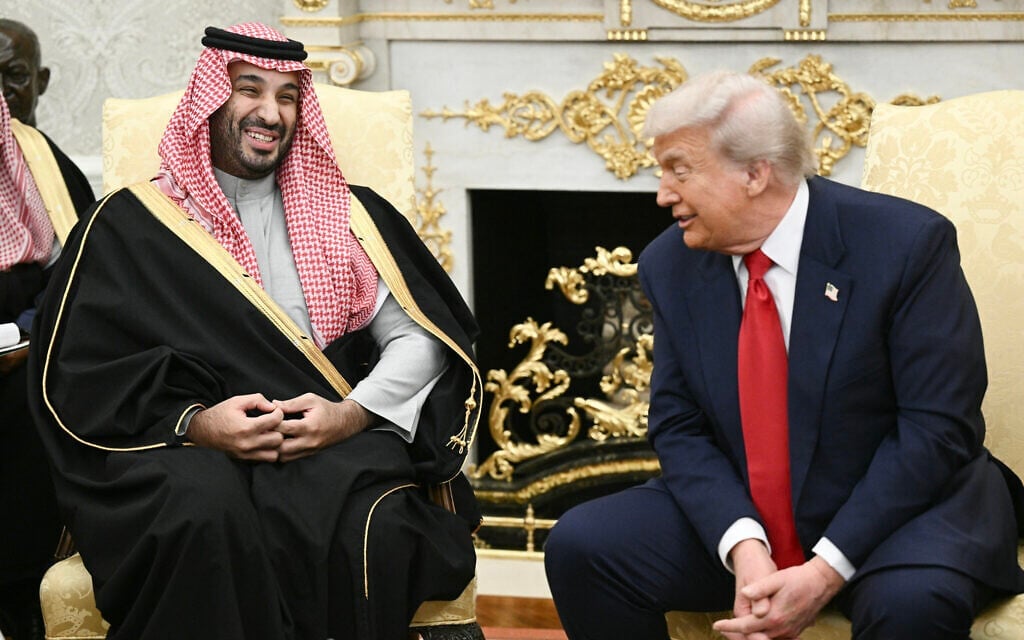
US President Donald Trump meets with Crown Prince of Saudi Arabia Mohammed bin Salman in the Oval Office of the White House in Washington, DC on November 18, 2025. (Brendan SMIALOWSKI / AFP)
Mohammed bin Salman did not fly to Washington for pageantry. He came for leverage, hard power, and a shot at rewiring the regional balance.
At the center of his visit was the most consequential weapons negotiation in the Middle East since the Cold War: the potential sale of U.S. F-35 stealth fighters to Saudi Arabia.
The last time Washington armed Riyadh with a breakthrough platform was in 1978 with the F-15. But today the stakes are far greater — because the F-35 is not just a jet. It is the American military aviation crown jewel.
The F-35 fuses stealth, electronic warfare, sensor supremacy, and real-time integration into a single lethal ecosystem. It is the backbone of U.S. air dominance — guarded more tightly than nuclear blueprints.
In fact, only a handful of trusted allies operate it.
Thus, expand that circle, and the risk that America’s most sensitive aerospace technology gets leaked, cloned, or compromised rises exponentially.
And with Saudi Arabia, that danger has a name: China.
Beijing has spent a decade wiring itself across the Gulf — 5G systems, drone programs, missile factories, surveillance grids, and deep energy entanglements.
Hence, if Saudi Arabia fields the F-35, the idea that Chinese technicians, cyber contractors, or intelligence collectors would gain indirect access to its systems is not speculation — it is nearly mathematical certainty.
The precedent is blunt.
Turkey was expelled from the F-35 program simply for purchasing Russian S-400s.
And make no mistake: China’s extraction capabilities make Russia look amateur.
Consequently, a single compromised F-35 could accelerate China’s stealth program by years and erode the American air superiority that has anchored the global order since the Gulf War.
But China is only half the problem. The other half is Israel.
For 50 years, American strategy has rested on a single principle: Israel must retain a “Qualitative Military Edge” (QME) over every regional actor. This is not merely policy; it is codified in U.S. law, explicitly requiring Washington to preserve that advantage.
Indeed, QME is not symbolism. This is how Israel can deter coalitions, strike preemptively, and operate as the only Middle Eastern air force fully interoperable with NATO systems. The F-35 is the centerpiece of that superiority.
Unfortunately, a Saudi fleet punctures it instantly.
Under normal conditions, Israel would kill the deal on sight. But Jerusalem offered a conditional green light — based on one monumental trade: normalization.
Saudi Arabia wanted stealth jets; Israel wanted diplomatic recognition and strategic guarantees, including basing restrictions that kept Saudi F-35s far from Israeli airspace and its eastern border.
That was the bargain. Now normalization is wobbling.
Riyadh demands sweeping Palestinian concessions that no Israeli government can deliver. And if the process collapses, Washington will still hand Saudi Arabia the jets — while Israel gets nothing. No normalization. No basing guarantees. No joint architecture to stabilize the new parity.
For Israel, that is the nightmare: a powerful Arab state shielded under the strong and deterrent Pakistani nuclear umbrella and safeguarded by American stealth capability but without the political or strategic guardrails originally promised.
This is why the request is not just bilateral. It is tectonic.
Trump’s revived approach flattens the hierarchy America spent decades constructing.
For generations, U.S. policy structured the region: Israel at the top, Arab partners in the middle, adversaries below.
Trump rejects all that.
His worldview is transactional: if you pay, you play. That is why he secured a landmark Saudi pledge of $600 billion in U.S. investment over the next four years — with the target of $1 trillion in the mid-term view.
Doubtlessly, that is not alliance politics — that is balance-sheet diplomacy.
Sadly, short-term deals follow, but the geopolitical consequences are explosive.
Therefore, equalizing military power in a region defined by sectarian rivalry, proxy warfare, and fragile borders does not create stability.
Irrefutably, this unorthodox geostrategic approach breeds competition, accelerates arms races, and pushes states toward riskier doctrines to compensate for lost superiority.
Unquestionably, a Saudi F-35 deal without normalization would ignite exactly that spiral.
Indisputably, Israel would accelerate development of its classified sixth-generation platform. Iran would double down on missile and drone saturation. Turkey, Egypt, the UAE, and Qatar would demand comparable upgrades. And Beijing would move in even deeper.
The Middle East — already fractured — could shift from U.S.-led hierarchy to multipolar rivalry.
Nonetheless, if normalization succeeds, the F-35 could anchor a historic realignment.
But if it fails — and by the latest signs, Mohammed bin Salman has said that Saudi Arabia wants to join the Abraham Accords only in the long term and if a “clear path toward a two-state solution” is secured — the deal becomes a strategic coup gifted to Riyadh without the strategic quid pro quo.
In short: America may hand world-class stealth capability to an ambitious autocracy — without extracting the price that once justified such a dangerous bet.
In the Middle East, power does not merely shift. It snaps. And right now, the clock is not just ticking — it is echoing.
Related Topics