
Trump’s Gaza Peace Plan Meets the Reality of Regional Divides
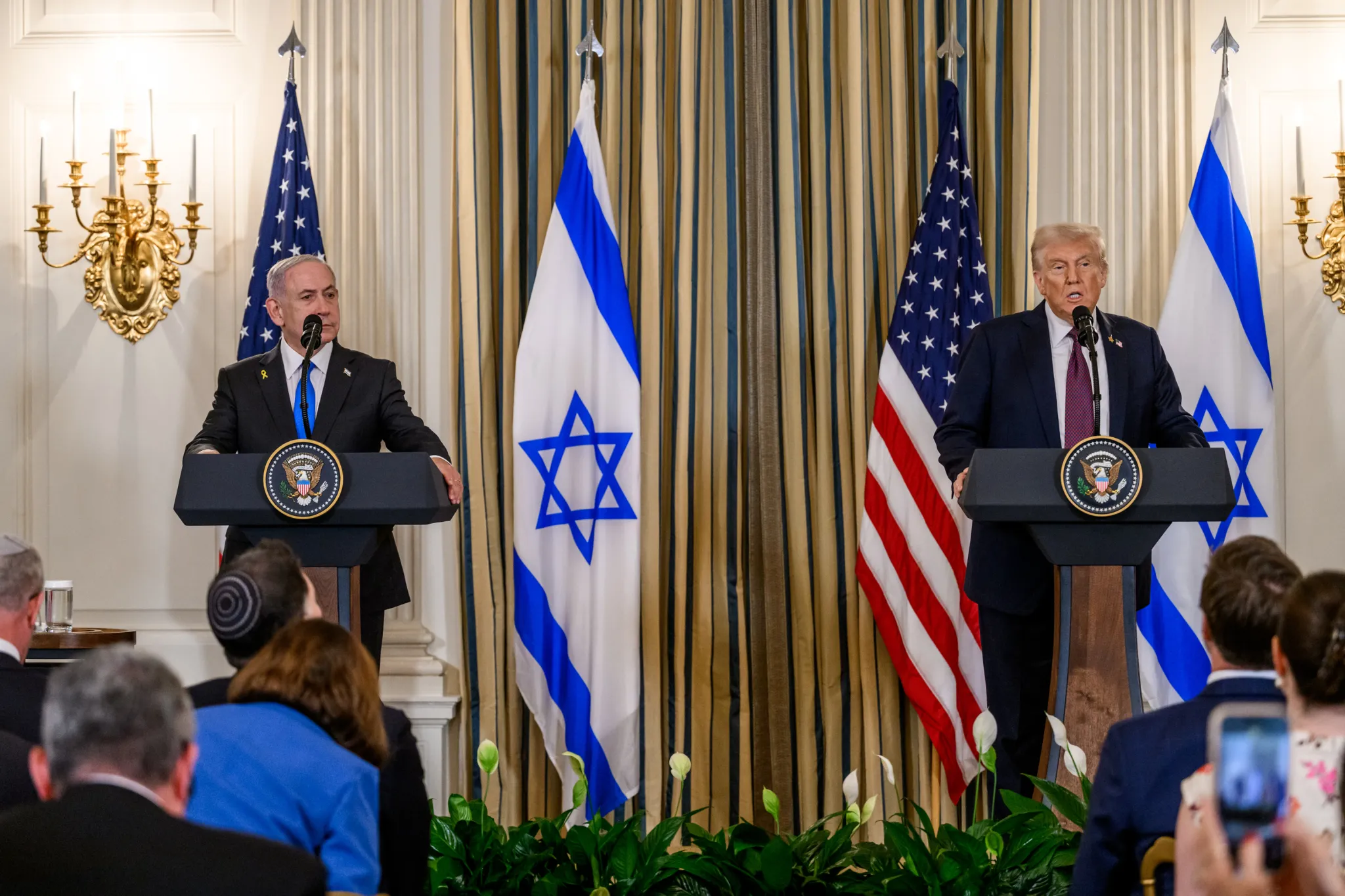
US President Donald Trump on Wednesday reaffirmed his confidence that the ceasefire in Gaza will hold, saying “nothing is going to jeopardize” the truce, even as he defended Israel’s decision to strike back following the death of one of its soldiers in Rafah.
“They killed an Israeli soldier, so the Israelis responded — and they had every right to,” Trump told reporters aboard Air Force One. He cautioned that Hamas must “behave” if it wants the calm to last, adding bluntly, “If they keep their word, they’ll be fine. If not, they’ll be finished.”
Trump’s remarks came as part of a broader effort to reinforce his Middle East peace initiative — a 20-point Gaza plan unveiled earlier this year. Confident and characteristically assertive, he framed the proposal as a realistic path to end recurring cycles of violence through a permanent ceasefire, an orderly Israeli pullback, and the creation of an International Stabilization Force (ISF) involving US allies and Muslim-majority nations.
According to US officials, Washington is already in advanced discussions with several countries about forming the ISF — a key element of Trump’s framework designed to prevent another collapse of the fragile truce. The plan, developed under US Central Command (CENTCOM), envisions Arab and Muslim participation alongside a new Palestinian security force trained by the United States, Egypt, and Jordan.
But as events in the region quickly showed, translating that blueprint into reality is far more complicated. The problem is not only Hamas’s refusal to disarm or Israel’s skepticism about outside intervention. It’s also the deep political and strategic rifts among the very Muslim and Arab states expected to implement Trump’s plan.
Vice President JD Vance, during his recent visit to Jerusalem, captured the dilemma bluntly: “We have a tough task ahead — to disarm Hamas and rebuild Gaza at the same time.” That balance—security versus reconstruction—now defines the challenge of enforcing the ceasefire and keeping Trump’s vision alive.
Speaking to reporters at the end of a visit aimed at shoring up the fragile ceasefire, Vance said an international security force—one that hasn’t even been formed yet—would take the lead on dismantling Hamas’s military capabilities. “It’s going to take some time and it’s going to depend a lot on the composition of that force,” he cautioned.
Earlier, Vance had opened the Civil-Military Coordination Center in Kiryat Gat, southwest Israel, where American and allied troops will monitor the truce and oversee aid deliveries to Gaza—but crucially, no US forces will actually deploy inside the Strip itself.
Trump’s plan relies heavily on cooperation from regional players—Egypt, Qatar, Turkey, Saudi Arabia, and the UAE. Yet these countries view Gaza through entirely different lenses.
Recent reporting from Laura Cellier and others has exposed just how deep those divisions run. The Gulf states, particularly Saudi Arabia and the UAE, have drawn a line that could either force genuine security transformation or doom reconstruction before it begins. According to Israel Hayom, both countries have told American intermediaries they will withhold financial support for Gaza’s reconstruction unless Hamas is fully disarmed. Arab and American sources revealed these conditions following high-level meetings in Riyadh in late February, where tensions reached a peak during gatherings that included Saudi Crown Prince Mohammed bin Salman, Egyptian President Abdel Fattah el-Sisi, Jordan’s King Abdullah, UAE President Mohammed bin Zayed, and Qatari Emir Tamim bin Hamad.
The Gulf position is not a negotiating stance—it’s an ultimatum. One Gulf official reportedly stated it with brutal clarity: “Not a single rifle or bullet should remain in the hands of Hamas in Gaza, because otherwise, the Strip will be destroyed over and over again, even after it is rebuilt.” No disarmament, no Gulf money. Full stop.
This represents a calculated bet by the Gulf monarchies that economic leverage can reshape Gaza’s political landscape. It’s also a direct challenge to Egypt, Qatar, and Turkey, whom Riyadh and Abu Dhabi view as enablers of instability through their willingness to accommodate Hamas in various forms.
Egypt’s position provides the clearest counterpoint. As Middle East Eye reported in October, an internal Saudi foreign ministry document reveals that while Riyadh plans to “support the deployment of an international peacekeeping mission in Gaza” and work toward Hamas’s “progressive disarmament through international and regional agreements,” Cairo has consistently argued that completely removing Hamas from Gaza’s political equation is unrealistic and counterproductive. Egyptian officials contend that any settlement which marginalizes major Palestinian factions will fail to gain traction among Gazans themselves.
At the February Riyadh meetings, Egypt attempted to position itself as the dominant player in reconstruction, reserving authority to select companies and organizations involved—an opportunity worth billions. The Gulf states pushed back hard. Saudi and Emirati representatives firmly stated that Hamas is responsible for the war and its devastating consequences, and they will not fund any reconstruction plan that does not include full demilitarization of the Strip.
The mediation landscape itself reflects these divisions. While Egypt, Qatar, and Turkey have served as primary mediators throughout the conflict—helping broker the ceasefire—their approaches differ markedly from Gulf preferences. As J Street noted in its analysis of guarantor roles, Qatar has hosted and provided financial support to Hamas’s political leadership since 2012, creating what many view as a conflict of interest in mediation efforts. Turkey, meanwhile, has granted passports to Hamas operatives and turned Ankara into what Israel Hayom described as “a refuge for a movement that calls for Israel’s destruction.”
Trump’s envoy team—including private-sector figures like Steve Witkoff and Jared Kushner—finds itself navigating between these competing visions. The warnings from Saudi Arabia and the UAE have been delivered directly to these envoys, with Arab and US diplomatic sources confirming the communications.
Hamas’s signals on disarmament have been mixed. While Israel Hayom reported in October that “despite public declarations by some senior Hamas officials that the terrorist organization would not give up its weapons, its stance at the negotiating table was far more flexible,” other Hamas officials have been categorical in their refusal. One Hamas representative told Middle East Eye that disarmament would only happen “when the Israeli occupation ends and there is an independent Palestinian state.”
What makes this standoff particularly significant is that it exposes two deeper strategic questions. First, whoever controls reconstruction funding effectively controls Gaza’s future political and security architecture. The Gulf states understand this perfectly. As Igbere TV reported, the UAE signaled it will keep funding relief and rebuilding in southern Gaza, where Israel maintains military control, but it will not back broader reconstruction without a framework for Hamas disarmament and full civilian and security control by international forces.
Second, this tests whether American-led diplomacy can substitute for broader multilateral legitimacy. Critics have noted—including analysis in Security Council Report’s October forecast—that Trump’s 20-point plan, while ambitious, leaves crucial operational questions unanswered. Who will provide stabilization forces? How will returns be managed? What governance structures will be established?
The plan calls for immediate cessation of hostilities, full restoration of humanitarian access, release of all remaining hostages, disarmament and decommissioning of Hamas supervised by independent monitors, deployment of an international stabilization force, and establishment of an interim technocratic government. But implementation mechanisms remain vague—exactly the problem Vance acknowledged in Jerusalem this week.
The Saudis and Emiratis fear these gaps could allow Hamas to maintain or rebuild its capabilities. Their concerns intensified after the ceasefire began, with Israel Hayom reporting in mid-October that Hamas has engaged in “systematic assassination of rivals from competing clans, armed displays in the streets, extortion of local merchants, and statements by senior officials flatly rejecting the prospect of disarmament.”
In their latest communications with Washington, according to multiple reports, the Saudis warned that unless there is a decisive US response and a change in approach by the mediators—Egypt, Qatar, and Turkey—to enforce the plan’s terms on Hamas, Saudi Arabia will not participate in the continuation of the process. The kingdom is reportedly downgrading its engagement and is unlikely to attend Egypt’s planned reconstruction conference.
The political symbolism was stark at October’s Sharm el-Sheikh summit, when Trump gathered world leaders to discuss Gaza’s future. Saudi Crown Prince Mohammed bin Salman and UAE President Mohammed bin Zayed were conspicuously absent. As media reported, Egyptian, Saudi and Emirati sources said their absences reflected irritation that they were not playing as prominent a role in the agreement as they wanted to.
Several uncomfortable truths emerge from this standoff.
First, this is fundamentally about leverage, not humanitarian concerns. Gulf capitals are using reconstruction financing to secure their preferred political outcomes and diminish rivals they view as destabilizing forces. A Saudi diplomatic source told Israel Hayom that the kingdom has made clear its position for months: “There is no viable solution to the war in Gaza or to the future of the Palestinians in general as long as Hamas remains part of the equation.”
Second, the practical challenges of disarmament are immense. Military demobilization in a densely populated territory with porous borders cannot happen overnight. Egypt has reportedly proposed compromise initiatives, including one that would see most members of Hamas’s military wing surrender their weapons to be held in trust by an Arab entity inside Gaza, returned only if the ceasefire is violated. But as Israel Hayom reported in March, both Saudi Arabia and the UAE oppose allowing Hamas to retain “even a single Kalashnikov bullet.”
Third, a fractured Arab front weakens everyone’s position. The Baker Institute’s analysis noted that of various proposals circulating—including Trump’s proposals that drew widespread opposition—and the Arab-backed plan put forward by Egypt and endorsed by the Arab League, but that plan’s viability depends on Gulf financing, which remains contingent on Hamas disarmament.
If Riyadh and Abu Dhabi follow through on their threat to withhold funding, the reconstruction vacuum will be filled by actors with different priorities—or by an underfunded process that fails to deliver security and services, breeding the next cycle of instability. As Chatham House observed, “transforming the hostage release and ceasefire into a historic, new beginning will require many further steps, each of which will be no less significant.”
In July at the United Nations conference, the 22-member Arab League, the entire European Union and another 17 countries backed a declaration that for the first time included a joint call for Hamas to disarm and relinquish power in Gaza. French Foreign Minister Jean-Noël Barrot noted the significance: “On the part of Saudi Arabia and the Arab and Muslim countries, who for the first time will condemn terrorism, the acts of terror on the 7th of October, a call for the disarmament of Hamas.”
But declarations are one thing; implementation is another. The General Assembly’s September endorsement of the New York Declaration—which Security Council Report described as setting out “a roadmap envisioning a ceasefire in Gaza that would entail the release of the remaining hostages held by Hamas, the group’s disarmament, and the deployment of a Security Council-mandated stabilization mission”—has yet to translate into ground-level changes.
This brings us back to Vance’s visit and his acknowledgment of the “very, very tough task ahead.” The vice president’s candor is refreshing, but it also underscores a fundamental problem: the international community is trying to build a reconstruction framework on a foundation that doesn’t yet exist. Creating an international security force capable of disarming Hamas while maintaining order in Gaza is not a technical challenge—it’s a political Rubik’s cube that requires coordinating competing interests, establishing clear mandates, and securing commitments from countries willing to put their troops in harm’s way.
The composition of that force matters enormously. Will it include Turkish troops despite Israeli objections? Will Arab states participate if their demands for Hamas’s complete disarmament aren’t met? Will European countries commit forces without clearer guarantees about rules of engagement and exit strategies? These aren’t minor details—they’re the difference between a functional peacekeeping mission and a symbolic gesture that collapses under pressure.
As Khaled Abu Toameh, a researcher at the Jerusalem Center for Public Affairs, warned in March reporting by Israel Hayom, any reconstruction effort without Hamas’s disarmament would replicate the Lebanese model, where a terrorist organization holds real power while an impotent government exists only on paper. Lebanon’s experience should serve as a cautionary tale: Hezbollah’s ability to maintain an armed presence despite international resolutions has perpetuated instability and made genuine sovereignty impossible.
The policy implications are stark. If the United States and its partners want a durable settlement rather than a temporary pause, they must translate abstract demands for disarmament into concrete, verifiable steps. Who exactly will compose security forces in Gaza? What monitoring systems will operate at border crossings? What political guarantees will be offered to ordinary Gazans who fear complete disenfranchisement? Without answers to these questions, pledges and press conferences mean little.
Saudi Arabia has made its position unambiguous. As one official told Israel Hayom, Hamas “has inflicted enormous harm on the Palestinian people” and “will sabotage any force” that tries to restore order. Without a serious move to end Hamas’s influence in Gaza, “there is no chance of its rehabilitation and reconstruction.”
The coming weeks will test whether regional powers are willing to prioritize durable solutions over immediate leverage. Vance’s diplomatic mission this week was designed to reassure Israel about American commitment to the ceasefire framework, but reassurance alone won’t resolve the fundamental question: Can an international community deeply divided over Hamas’s role actually implement a plan that requires Hamas’s elimination as a military force?
The answer will determine not just Gaza’s future but the credibility of the entire reconstruction framework. If diplomacy devolves into a contest of wills rather than a carefully constructed program of verified security measures and inclusive governance, any reconstruction will be more illusion than reality—promised in headlines, absent in practice.
Here’s the uncomfortable truth that Vance’s visit underscores: without disarming Hamas, there is no path to lasting peace in Gaza. Every other element of the reconstruction plan—humanitarian aid, infrastructure rebuilding, economic development, governance reform—depends on establishing basic security. As long as Hamas maintains the capacity to launch rockets, conduct raids, or intimidate rival factions, Gaza remains a powder keg waiting for the next spark.
Whether the international community can rise to meet this challenge remains uncertain. But one thing has crystallized in the weeks since Vance’s visit: Gaza’s reconstruction cannot begin in any meaningful sense while Hamas retains its arsenal. This is not a question of sequencing or phased implementation—it is a fundamental prerequisite. As long as Hamas possesses the weapons to resume hostilities, no donor will commit billions to rebuild infrastructure that could be destroyed in the next round of fighting. No international force will deploy without assurances that it won’t become a target. No governance structure can take root while an armed faction maintains parallel authority.
The Gulf states understand this with perfect clarity, which is why their ultimatum is absolute rather than negotiable. They have seen what happens when reconstruction proceeds without genuine security: money poured into Gaza after previous conflicts only to watch it diverted, infrastructure rebuilt only to be weaponized, and humanitarian aid transformed into leverage for armed groups. They refuse to repeat that pattern.
The choice facing the international community is therefore stark and binary. Either Hamas is disarmed through a credible, verifiable process, making reconstruction and rehabilitation possible, or it is not, ensuring that Gaza remains trapped in an endless cycle of destruction. There is no middle ground where meaningful rebuilding happens alongside an armed Hamas. The two are mutually exclusive. Get this foundational question right, and Gaza might finally have a path toward the stability and prosperity its people desperately need. Get it wrong, and the ceasefire becomes merely an intermission before the next war—another chapter in a tragedy that could have been prevented.