
Middle East Analyst
Trump’s Islamist Litmus Test: Transactional Normalization
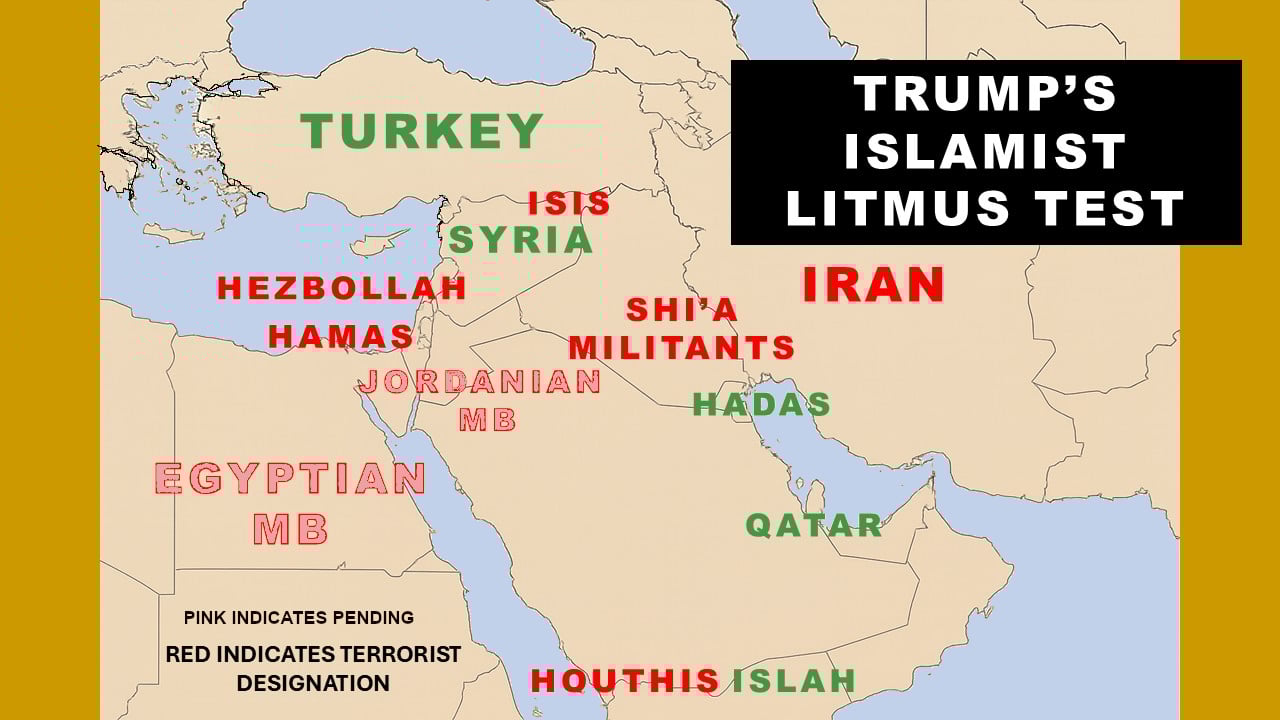
Graphic by author
President Trump’s recent executive order directing a chapter-specific review of Muslim Brotherhood (MB) entities marks a decisive shift in U.S. counterterrorism posture. But contrary to initial framing, this is not an ideological campaign against Islamism. It is a transactional security alignment—one that redefines the coalition’s threat architecture around a single litmus test: recognition of Israeli sovereignty and cessation of security threats.
This reframing has profound implications. It clears the geopolitical field of actors who reject normalization (Hamas, non-compliant MB chapters), while opening space for those who accept it—most controversially, Syria under President Ahmed al-Sharaa. The order institutionalizes an anti-resistance baseline that now anchors the Abraham Accords coalition, superseding traditional Islamist/non-Islamist divides.
From Ideology to Transaction: The New Inclusion Formula
The executive order does not designate the MB as a whole. Instead, it enables targeted determinations that align U.S. policy with Saudi, Israeli, and Egyptian threat perceptions while avoiding the diplomatic fallout of a blanket designation. The operational logic is simple: Recognition of Israel + cessation of threats = inclusion. Rejection = designation.
This formula explains why Syria, despite its entanglement with HTS and AQI residues, is being floated for Accords entry. Al-Sharaa’s White House visit signals transactional compliance. MB chapters in Egypt, Jordan, and Lebanon are now under formal review and are the most likely to be designated. Egypt’s Brotherhood, banned domestically since 2013, remains central to regional threat narratives. Jordan’s MB, operating through its political arm, the Islamic Action Front, has resisted normalization and is increasingly seen as a liability to coalition cohesion. Together, they represent the frontline cases in Trump’s transactional litmus test.
Saudi Arabia’s Situational Policies and the MbS Reset
Saudi Arabia’s posture toward MB networks has long been situational. Riyadh alternated between sheltering MB exiles, employing MB-trained educators, tolerating societal fundraising for Hamas, and cooperating with MB-affiliated actors in Yemen and Iraq when this served counter-Iran objectives. These oscillations were strategic, not doctrinal.
Crown Prince Mohammed bin Salman’s rupture with Islamist movements reflects a deeper reorientation. His project fuses political pragmatism, developmental necessity, and theological repositioning. MbS seeks to subordinate clerical authority to the state, promote a state-defined “moderate Islam,” remove religious constraints on reform, and enable diplomatic engagements once considered impermissible—including normalization with Israel.
This makes his anti-MB posture not merely a security stance but a civilizational reset underpinning Vision 2030 and Saudi Arabia’s rebranding. Yet the legacy of public support for Hamas—telethons in the 1990s and 2000s, gold donations from Saudi women—complicates current messaging and remains a latent source of narrative vulnerability.
Egypt’s Post-Coup Radicalization and the MB–AQ Continuum
The 2013 removal of the Morsi government triggered a radicalization cascade. Egypt saw a surge in violence involving overlapping MB, AQ, and revolutionary elements. Though MB leadership publicly disavowed violence, several dynamics blurred the boundary between political Islamism and armed jihadism:
- Radicalization of MB youth: Disillusioned by mass detentions and leadership paralysis, segments of MB youth gravitated toward violent factions.
- Operational overlap: AQ-linked groups such as Ansar Bayt al-Maqdis (later ISIS–Sinai Province) expanded recruitment through the post-coup vacuum.
- Diaspora messaging: MB diaspora leadership increasingly framed the Sisi government as illegitimate and endorsed “resistance,” creating rhetorical ambiguity.
- State narratives: Cairo amplified MB–AQ ties for political ends, but the narrative drew strength from real personnel flows and ideological migration.
These factors shape Saudi, Israeli, Emirati, and now U.S. threat perceptions. They explain why the EO treats MB chapters as security variables—not merely political movements.
Syria’s Inclusion and the Jihadi Lineage Debate
Syria under President Ahmed al-Sharaa presents a doctrinal paradox. His regime is geographically and politically entangled with HTS, AQI residue, and MB-derived networks. Yet his transactional pivot—recognition of Israel and security guarantees—positions Syria for Accords entry.
This forces renewed examination of MB–al-Qaeda lineage debates:
- Breakaway thesis: Al-Qaeda originated as a militant splinter from MB, rejecting gradualism while sharing long-term goals.
- Continuity thesis: AQ functions as a deniable militant wing parallel to MB political structures—akin to Hezbollah’s partitioned roles.
- Post-2013 reinforcement: The radicalization cascade produced real-world linkages between MB cadres and AQ/ISIS networks, strengthening continuity arguments.
If Syria joins the Accords, coalition partners must reconcile their anti-Islamist baseline with Syria’s proximity to these lineages. Transactional compliance becomes the decisive criterion, overriding doctrinal ambiguity.
Timing and Coalition Drivers
The Israeli strike on Doha and Netanyahu’s “Greater Israel” rhetoric catalyzed regional closure. Muslim states closed ranks despite ideological divisions, creating political space for Trump’s 20-point plan and ISF initiation. The Sharm el-Sheikh Declaration’s vision of a largely Islamist stabilization force reopened fissures. Trump’s EO re-anchors coalition identity around an anti-resistance baseline.
Saudi–Israeli convergence is central. Both states view MB networks—especially Hamas—as existential threats. The EO aligns U.S. policy with this convergence and reinforces Egypt’s centrality in the emerging security architecture.
Implications for ISF and Reconstruction
The EO provides an operational lexicon for ISF formation: the target set includes actors obstructing normalization or ISF deployment. Troop vetting becomes threat-driven rather than ideology-driven, making coalition participation more flexible but risking incoherence if transactional compliance is unevenly enforced.
Reconstruction and governance conditionality mechanisms can bypass MB-linked networks, but risk service gaps in Gaza, Sinai, Jordan, and Syria if substitutes are not established. Past situational policies toward Hamas and MB social networks mean bypasses could be perceived as punitive unless robust alternatives are in place.
Strategic Risks
- Alliance friction: Turkey and Qatar’s support for non-compliant MB chapters strains basing agreements, intelligence channels, and NATO cohesion.
- Jordan destabilization: Jordan’s MB operates as a political safety valve. Forced designation risks driving opposition toward more rigid, violent factions.
- Intelligence manipulation: Partner states may inflate MB–AQ linkages to justify domestic crackdowns, distorting U.S. assessments.
- Narrative vulnerabilities: Saudi Arabia’s situational policies complicate its current posture, providing adversaries narrative leverage.
- Lineage ambiguity: Persistent uncertainty regarding MB–AQ linkages threatens doctrinal clarity. Syria’s inclusion forces coalition partners to treat lineage debates as secondary to transactional behavior.
Conclusion
Trump’s executive order functions as a strategic alignment mechanism. It harmonizes U.S. policy with Saudi and Israeli threat perceptions, reinforces Egypt’s role, and sets conditions for ISF formation and Accords expansion. The transactional litmus test—recognition of Israel and cessation of threats—explains both the exclusion of MB chapters and the potential inclusion of Syria under Ahmed al-Sharaa.
The policy carries significant risks: alliance friction, Jordanian instability, narrative vulnerabilities, intelligence manipulation, and unresolved lineage disputes. Yet it consolidates an anti-resistance, pro-normalization coalition architecture and clears the political space required for the next phase of the Accords.
Related Topics