The views expressed herein are solely mine.
Trump’s Power Brokers Behind the Curtains
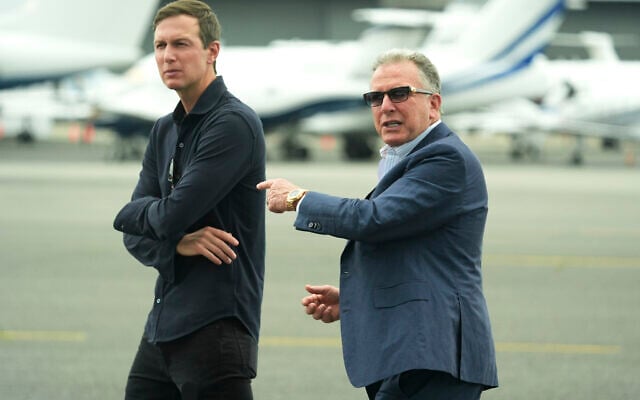
White House special envoy Steve Witkoff, right, and Jared Kushner wait for the arrival of President Donald Trump at Teterboro Airport in Teterboro, New Jersey on July 13, 2025. (AP Photo/Jacquelyn Martin)
Jared Kushner and Steve Witkoff were never supposed to be the central axis of Trump’s second-term foreign policy.
Yet here they are — two unelected power brokers who have managed, once again, to dominate some of the world’s most volatile geopolitical arenas.
Kushner, formally a senior adviser during President Trump’s first administration, entered this term with no official portfolio. But the Middle East still answers his calls. Gulf leaders who trust his discretion and owe him favors from the Abraham Accords era have pulled him back into the cockpit.
That is why, despite holding no title, he has re-emerged as a crucial intermediary in the Gaza ceasefire negotiations, the Israel–Hamas hostage-release talks, and the ongoing US–Saudi normalization channel. His influence operates through relationships — not institutions — and Trump knows how valuable that currency is.
On the other hand, Steve Witkoff’s trajectory is even more unusual. Originally brought in simply to replace Jason Greenblatt as a Middle East point man, Witkoff has morphed into Trump’s all-purpose envoy for crises far beyond the region.
His expanding brief now includes work on the Gaza file, back-channel outreach tied to the Russia–Ukraine standoff, and even quiet roles in US–Russia prisoner and detainee-negotiation efforts. When Trump needed someone who could walk into a room with Putin and negotiate without the baggage of the State Department, he sent Witkoff.
Together, Kushner and Witkoff form an unconventional diplomatic tandem: half-statesman, half-deal-maker, operating through personal leverage rather than bureaucratic channels. Their combined footprint is visible in hostage releases, Gaza negotiations, US–Russia crisis management, and even attempts to stabilize Arab–Israeli diplomacy where formal mechanisms have stalled.
But their power comes with shadows.
Both men operate businesses whose activities intersect with the regions they influence. Kushner’s sovereign-wealth partnerships in Saudi Arabia and Qatar, his real-estate ventures connected to Serbia, and Witkoff’s Gulf-funded development deals and heavy Middle East investor base inevitably raise questions about whether economic incentives and political missions are running on parallel tracks — or occasionally the same one.
In an administration that prizes results above process, critics worry that the lines between public duty and private opportunity are blurring at a dangerous speed.
Still, no one can deny the effectiveness. Trump values outcomes, not etiquette — and these two deliver. Their work — from hostage diplomacy to Russia-channel stabilization to brokering Gulf alignments — underscores their role as the most important informal architects of Trump’s foreign policy today.
And the implications stretch far beyond the present.
If Trumpism is shaping a new foreign-policy model, it is this: a system where personal networks outrank institutions, where unconventional envoys outperform traditional diplomats, and where the future of US strategy may hinge less on bureaucratic hierarchies and more on the quiet leverage of an elite, well-connected pair.
Kushner and Witkoff may not look like traditional architects of American foreign policy.
But in Trump’s Washington, they are shaping it more than anyone else — and their influence will define both the present and the future of Trump’s geopolitical playbook.
Related Topics
Related Posts