
Writing on Jewish life, relationships, trauma, and resilience
Tucker Carlson, Thomas Massie, and the Return of the Dual-Loyalty Smear
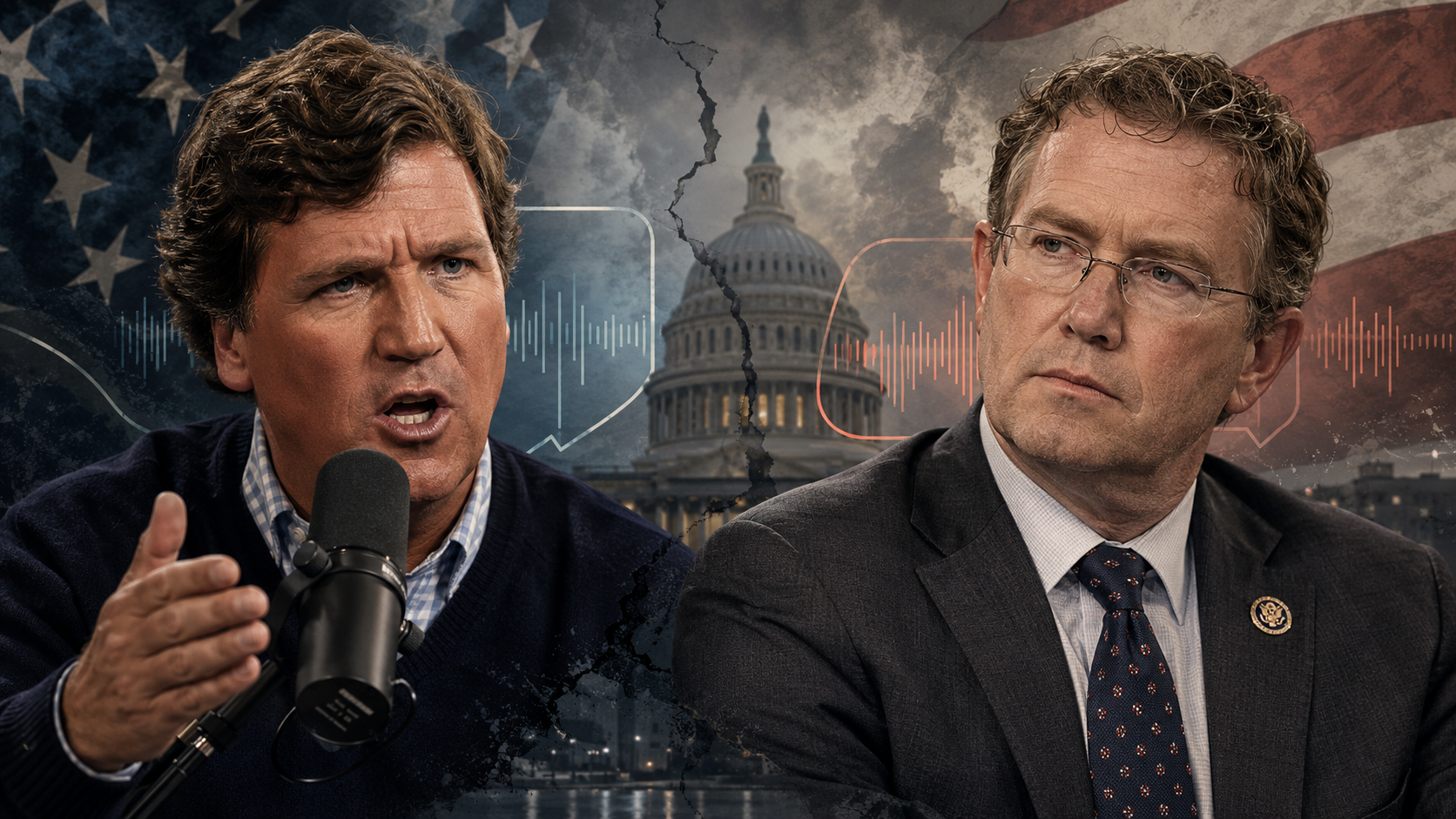
Tucker Carlson and Thomas Massie. AI image created by the author.
Tucker Carlson’s argument about Thomas Massie’s defeat in Kentucky’s Fourth Congressional District is not just mistaken. It reflects a dangerous confusion between legitimate political criticism and suspicion toward the civic participation of American Jews.
Carlson points to the reported role of wealthy pro-Israel donors and organizations, including AIPAC and Miriam Adelson, in helping defeat Massie and suggests this demonstrates that pro-Israel Americans are acting on behalf of a foreign country rather than the United States.
That accusation deserves a direct and careful response.
Criticism of lobbying, campaign spending, or political influence is entirely legitimate in a democracy. Americans regularly debate the power of super PACs, wealthy donors, corporations, unions, activist organizations, and advocacy networks across nearly every major issue in public life.
Pro-Israel organizations should not be exempt from that scrutiny.
People may reasonably question whether too much money influences elections, whether lobbying groups wield excessive power, or whether particular US policies toward Israel truly serve American interests. Those are fair political debates. In a healthy democracy, they should remain open to vigorous disagreement.
But there is an important distinction between criticizing political influence and questioning the legitimacy or loyalty of the Americans participating in that advocacy.
That line matters.
The argument crosses into something darker when criticism stops being about money, policy, or lobbying practices and becomes an assertion that Jewish Americans or pro-Israel advocates are inherently serving a foreign power rather than acting as American citizens exercising political rights.
That is not a debate about campaign finance.
It is a suspicion about belonging.
The Massie Race and the Real Debate
Thomas Massie’s primary race was extraordinary by any measure. Reports described it as one of the most expensive House primaries in American history, with massive spending from pro-Israel groups, wealthy donors, and political allies aligned against him.
Reasonable people can absolutely debate whether such spending improves or distorts democratic accountability.
Many Americans across the political spectrum are uncomfortable with the scale of money in politics. They worry that concentrated wealth and organized influence — whether from corporations, ideological PACs, labor unions, energy companies, defense contractors, or foreign-policy advocacy groups — can overwhelm ordinary voters.
Those concerns are legitimate.
But they must be applied consistently.
If Americans believe outside spending exerts too much influence in elections, then the criticism should extend across the political system rather than selectively focusing on Jewish or pro-Israel participation as uniquely suspect.
That distinction is essential.
American Law, American Elections, American Citizenship
Under American law, independent expenditures are protected forms of political participation, even when they are controversial. Citizens and organizations across the ideological spectrum use those mechanisms to support candidates and causes they believe advance American interests.
Some Americans advocate strongly for Ukraine. Others lobby for Taiwan, Armenia, India, Cuba, or environmental and human-rights causes connected to events abroad. Evangelical Christians advocate for persecuted Christians overseas. Muslim Americans advocate for Palestinians, Syrians, Uyghurs, and Kashmiris.
No serious observer automatically concludes that these communities are disloyal to America because they care deeply about international issues connected to their identity, values, or heritage.
American democracy has never required citizens to enter public life stripped of history, faith, memory, or moral conviction.
Diaspora advocacy is not foreign infiltration.
It is part of the American story.
The Problem of Selective Suspicion
Not every criticism of pro-Israel lobbying is antisemitic.
That point matters and should be stated clearly.
Democracies depend on the freedom to question powerful institutions, organized political influence, and foreign-policy priorities — including those connected to Israel. Pro-Israel organizations should be scrutinized and debated like any other political force in American life.
The problem arises when criticism shifts from examining political behavior to treating Jewish political participation itself as inherently foreign or uniquely suspect.
That selective suspicion has a long history.
For centuries, Jews were told that no matter how fully they participated in civic life, their loyalty remained conditional — always subject to doubt whenever Jewish interests became politically visible.
That history does not mean every critic of Israel or AIPAC is motivated by antisemitism. Clearly many are not.
But it does mean Americans should be careful not to revive old assumptions that portray Jewish civic participation as fundamentally less legitimate than everyone else’s.
There is a meaningful difference between:
- criticizing lobbying practices,
- debating US policy toward Israel,
- questioning campaign finance structures,
and - implying that Jewish Americans advocating for policies they support are somehow acting as agents of a foreign state.
One is democratic disagreement.
The other questions civic belonging itself.
Supporting Israel Can Reflect American Interests
There is nothing inherently un-American about believing that a strong US-Israel relationship serves American interests.
Americans may support that alliance for many reasons:
- strategic cooperation,
- intelligence sharing,
- military innovation,
- counterterrorism coordination,
- democratic partnership,
- regional stability,
or moral concerns following the October 7 attacks.
Others may disagree.
They may oppose aid packages, criticize Israeli governments, reject aspects of Israeli policy, or favor a more restrained American foreign policy.
Those debates are legitimate and necessary.
But disagreement over foreign policy does not justify treating Americans who support Israel as somehow less American than those who oppose it.
Citizens in a democracy are allowed to advocate passionately for the policies they believe best serve the country.
That includes pro-Israel Americans.
Thomas Massie Was Entitled to His Views — and So Were His Opponents
Massie has long opposed foreign aid, including aid to Israel. He was fully entitled to make that case to voters.
His opponents were equally entitled to oppose him because of those positions.
That is how democratic politics works.
Candidates take positions. Advocacy groups organize. Donors contribute. Voters decide.
Critics may argue that too much outside money entered the race. They may argue that lobbying organizations have excessive influence. They may argue that US policy toward Israel is misguided.
All of those arguments belong within democratic debate.
But accusing Americans of divided loyalty because they participate effectively in politics is something fundamentally different.
And if such a standard were applied consistently, it would implicate countless ethnic, ideological, religious, and advocacy communities throughout American public life.
In practice, it rarely is.
That inconsistency is precisely why the issue deserves attention.
The First Amendment Does Not Exclude Jews
American Jews who advocate for Israel are doing something profoundly American.
They are exercising rights protected by the Constitution:
- speech,
- association,
- political organizing,
- fundraising,
- petitioning government,
- and voting.
Those rights do not disappear when the issue involves Israel.
Nor do Jewish Americans need to prove their patriotism by remaining silent about matters connected to Jewish security, antisemitism, or the future of the US-Israel alliance.
Citizenship in America is not conditional on suppressing identity or moral concern.
It never has been.
Scrutiny Is Fair. Equal Standards Matter.
None of this means every pro-Israel campaign is wise, ethical, persuasive, or beyond criticism.
No advocacy organization should be immune from scrutiny.
AIPAC, wealthy donors, activist networks, and political campaigns should all be debated openly and held to the same standards as every other powerful force in American politics.
The key principle is equal treatment rather than selective suspicion.
Criticizing lobbying is American.
Criticizing campaign spending is American.
Criticizing Israeli policy is American.
Opposing aid to Israel is American.
But portraying Jewish Americans as inherently suspect because they advocate effectively for policies they believe serve both American and Israeli interests crosses into something far more corrosive.
This Is What American Citizenship Looks Like
American Jews and pro-Israel Americans have the right to speak.
We have the right to organize.
We have the right to donate.
We have the right to vote.
And yes, we have the right to help defeat candidates whose policies we believe are harmful to American interests or dangerous to Israel’s security.
That is not foreign loyalty.
That is democratic participation.
That is American citizenship.
Related Topics
Related Posts