The views expressed herein are solely mine.
Turkey and Qatar: The Brotherhood’s New Throne
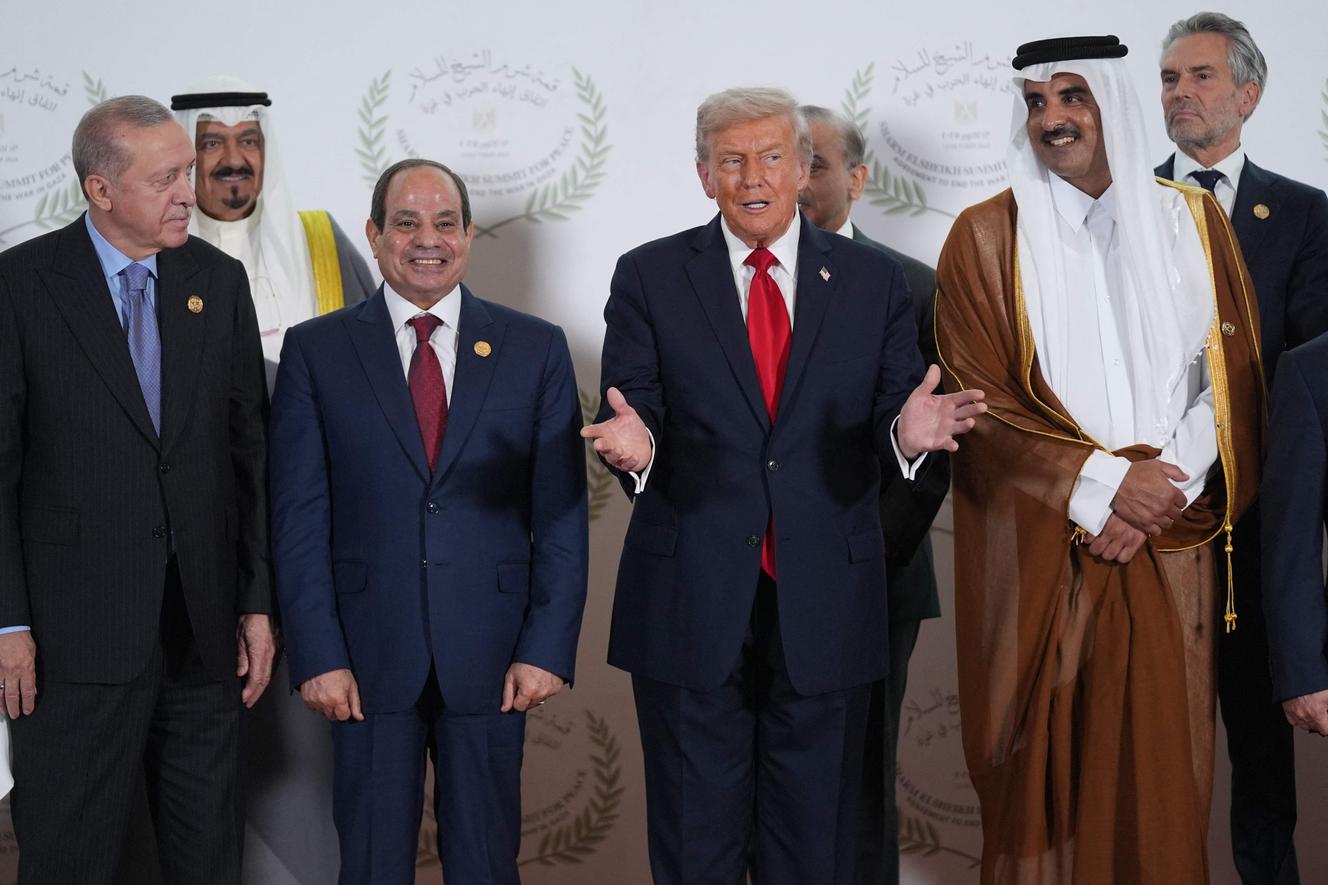
(Front L-R) Turkish President Recep Tayyip Erdogan, Egyptian President Abdel Fattah al-Sisi, US President Donald Trump, and Emir of Qatar Sheikh Tamim ben Hamad al-Thani and other leaders pose for a family picture at the Gaza summit in Sharm El-Sheikh on October 13, 2025. EVAN VUCCI / AFP.
The Middle East has entered a new age—one defined not by shifting borders but by tectonic realignments beneath the Arab political order. The old Saudi–Emirati axis that once dictated Sunni politics has collapsed under the weight of its own hubris. Rising in its place is a new power bloc—Turkey and Qatar—bound not merely by convenience but by ideology, ambition, and the enduring dream of the Muslim Brotherhood: the fusion of Islamism with political power.
Today’s battlefield is not Gaza or Beirut—it is the struggle over who defines the political heart of Sunni Islam. For decades, Riyadh and Abu Dhabi used oil wealth to suppress political Islam and brand themselves as “modernizers.” Yet while the Saudis built skyscrapers, Erdogan built mosques. While the Emiratis courted Western investors, Qatar built influence—through Islamist patronage, strategic partnerships with Washington, and a sophisticated campaign of media warfare.
At the center of this machinery stands Al Jazeera, the Qatari state-owned network whose anti-Israel and pro-Islamist rhetoric has long shaped the Arab street—to the point that Al Jazeera is indisputably the bee that spread the pollen of the 2011 “Arab Spring” across the region. But even Al Jazeera’s tone is shifting—subtly, but unmistakably. This is not a moral awakening; it is a strategic realignment. Doha’s goal is to secure a bilateral defense pact with the United States, even if that means momentarily softening its ideological edges. It is an astonishing transformation for a regime that once glorified jihad and broadcast Al-Qaeda communiqués—now seeking the embrace of the same superpower it once demonized.
The irony is staggering: Qatar, the sponsor of Hamas, now trains its pilots in Idaho. It is a surreal image—proof that Doha has not only bought influence in Washington but has also captured Trump’s transactional ear.
Even more revealing, Qatar—through its prime minister—is now suggesting that Hamas may be willing to “recognize the other side,” a rhetorical maneuver meant to legitimize Hamas politically and preserve Qatari influence in Gaza. This newfound moderation is not born of repentance but of calculation.
In my view, it mirrors the path once followed by Spain’s Basque terrorist group ETA: from relentless bombings to the creation of political parties; from temporary bans and returns to violence, to murky negotiations with Madrid; then a “ceasefire” without disarmament, followed by full political integration. Today, Spain’s prime minister governs thanks to the heirs of that same movement. Qatar appears to be applying the same formula—transforming terrorists into politicians to keep its hands on the levers of Gaza’s future.
Thus, the Sharm el-Sheikh Summit crystallized this new hierarchy. Around the main table sat Trump, Egypt’s El-Sissi, Turkey’s Erdogan, and Qatar’s al-Thani. Western political leaders present watched in confusion, unsure of the choreography—like freshmen stunned by the eccentricity of their first “crazy” college chemistry professor.
Conspicuously absent were the Saudis and Emiratis—the same monarchs who once bought proximity to Washington with petrodollars. During Trump’s first Middle East tour this year, Riyadh and Abu Dhabi pledged over one billion dollars in U.S. investments and arms deals over four years (the United Arab Emirates even pledged to invest more than $1.4 trillion over the next decade). Now, they have been replaced by rivals who offer not only money but also results.
Trump’s affection for Israel remains genuine but layered. Part of it is personal—anchored in Ivanka and Jared Kushner’s Jewish identity—and part of it is strategic. The U.S.–Israel intelligence partnership is one of history’s deepest, and Jewish influence in Washington is undeniable. Yet Trump is, above all, transactional. Israel’s economic weight cannot compete with Turkey’s NATO leverage, Qatar’s defense contracts, or Gulf financial pipelines. That reality may explain why, while rushing to Cairo, Trump complained that Netanyahu’s and Israeli Parliament Speaker Amir Ohana’s speeches “were too long.” In Trump’s world, if there is no money on the table, there is no reason to linger.
On the Gaza front, the new reality is equally paradoxical. Verified data shows Hamas retains control of roughly 47% of the Strip, while Israel holds 53%. Hamas has not been defeated—only recalibrated. Its networks, tunnels, and command chains endure. Hamas’s doctrine remains intact (“kidnap, bargain, survive”), and Qatar knows this.
The recent hostage release—marking the first time in eleven years that no Israeli captives remain in Gaza—was not an act of mercy but a masterpiece of propaganda by the terrorists. Hamas choreographed emotional video calls between hostages and families, parading cruelty as compassion. As Israel celebrated the return of its live hostages, only four Israeli bodies were quietly handed back—a grotesque reminder of Hamas’s mastery of psychological warfare and its failure to comply with the agreement, prolonging the pain of many Israeli families.
Behind the scenes, Trump’s envoys—Steve Witkoff and Jared Kushner—brokered a quiet understanding with Hamas’s Khalil al-Hayya: the U.S. would restrain Israel if Hamas honored a ceasefire. The deal, shepherded by Erdogan and Qatar, pushed Hamas into unprecedented discussions about demilitarization and even “recognizing Israel.”
Yet Trump—after declaring that Hamas must disarm and had “no power in Gaza”—eventually permitted them to “patrol” the Strip “for a transitional period”. This concession, almost unthinkable weeks ago, underscores Qatar’s pressure on Washington and Trump’s gradual acceptance that Hamas is not disappearing. Like ETA in its day, Hamas is shifting from terror to politics—not out of reform, but survival.
The newly signed Sharm el-Sheikh Agreement ties Gaza’s reconstruction to total demilitarization—a direct assault on Hamas’s identity. Despite losing nearly half its tunnel network—down to 300 kilometers from 500—Hamas remains operational. Yet compliance was coerced, not volunteered.
Qatar, rattled by Israel’s near miss in the Doha airstrike, now seeks shelter under an American defense umbrella. Turkey, meanwhile, is reviving nuclear cooperation with Washington to rebuild Western favor. Both understand Trump’s cardinal rule: to survive, one must be profitable to America.
Meanwhile, Saudi Arabia and the UAE, once the anchors of Sunni power, find themselves exiled from relevance. Their turn toward Moscow and Beijing reeks of desperation, not vision.
For Israel, this reshuffling is bittersweet. Netanyahu’s exclusion from the summit—reportedly due to Turkish and Spanish objections (ironic that the country they want to “make peace with” cannot be present during the event)—underscores his diplomatic isolation even amid military success. Domestically, however, he is reinvigorated: his Likud party is resurgent, and early elections now seem likely. Trump’s remarks aboard Air Force One were less an analysis than theater—a public acknowledgment that Washington, Doha, and Ankara now script the post-war order.
Reactions across the Muslim world have been swift. Indonesia canceled its goodwill visit to Israel after backlash at home (though it remains a promising sign that Indonesia is slowly opening to the Jewish State). Several Arab states are reopening dormant diplomatic channels. Trump is pressing regional holdouts to join the Abraham Accords 2.0. Some Syrian diplomats hint that a nascent “security pact” with Israel—including the long-delayed repatriation of Eli Cohen’s remains—could mark the dawn of this new era. Even Lebanon, some argue, may one day follow—if Hezbollah is fully demilitarized.
This evolving architecture does not render Trump a messiah or a menace—it makes him a broker, a man who sees diplomacy as business. And in that marketplace, Turkey and Qatar have mastered the art of the deal. Their ascent is both ideological and financial—a triumph of political Islam rebranded for Washington’s sensibilities.
The old Sunni establishment is gone. In its place stand the heirs of the Muslim Brotherhood, wielding cash, media, and geopolitical leverage. Israel may rest momentarily easier tonight—its living hostages home at last, while awaiting the return of the fallen. But make no mistake: the real victors are in Doha and Ankara, where the Islamists no longer whisper from tunnels.
They run the room.
Related Topics
- 2025 Hostage Deal
- Abraham Accords
- AJC American Jewish Committee
- Anti-Zionism
- Antisemitism
- Benjamin Netanyahu
- Constructive Conflict
- Donald Trump
- Egypt
- France
- Gaza
- Gaza Border
- Gaza Disengagement
- Gaza Rocket Attacks
- Gaza Strip
- Hamas
- Hezbollah
- Hostages in Gaza
- IDF
- Islam
- Israel At War
- Israel-Saudi Normalization
- Israel-US Relations
- Israeli Foreign Policy
- Ivanka Trump
- Jared Kushner
- Jewish history
- Jewish-Arab violence
- Jewish-Muslim Relations
- Knesset
- Lebanon
- Middle East
- Muslim-Jewish Dialogue
- Natural Gas
- Palestinian Authority
- Palestinian Statehood
- Palestinians
- Peace Builders
- Peace Process
- Peace to Prosperity
- Qatar
- Saudi Arabia
- Spain
- Syria
- Terrorism
- The Arab World
- Trump Peace Plan
- Turkey
- UAE - United Arab Emirates
- United Kingdom