
Brian McDonald

Turkey’s Gaza Flotilla: Why a military clash is unlikely
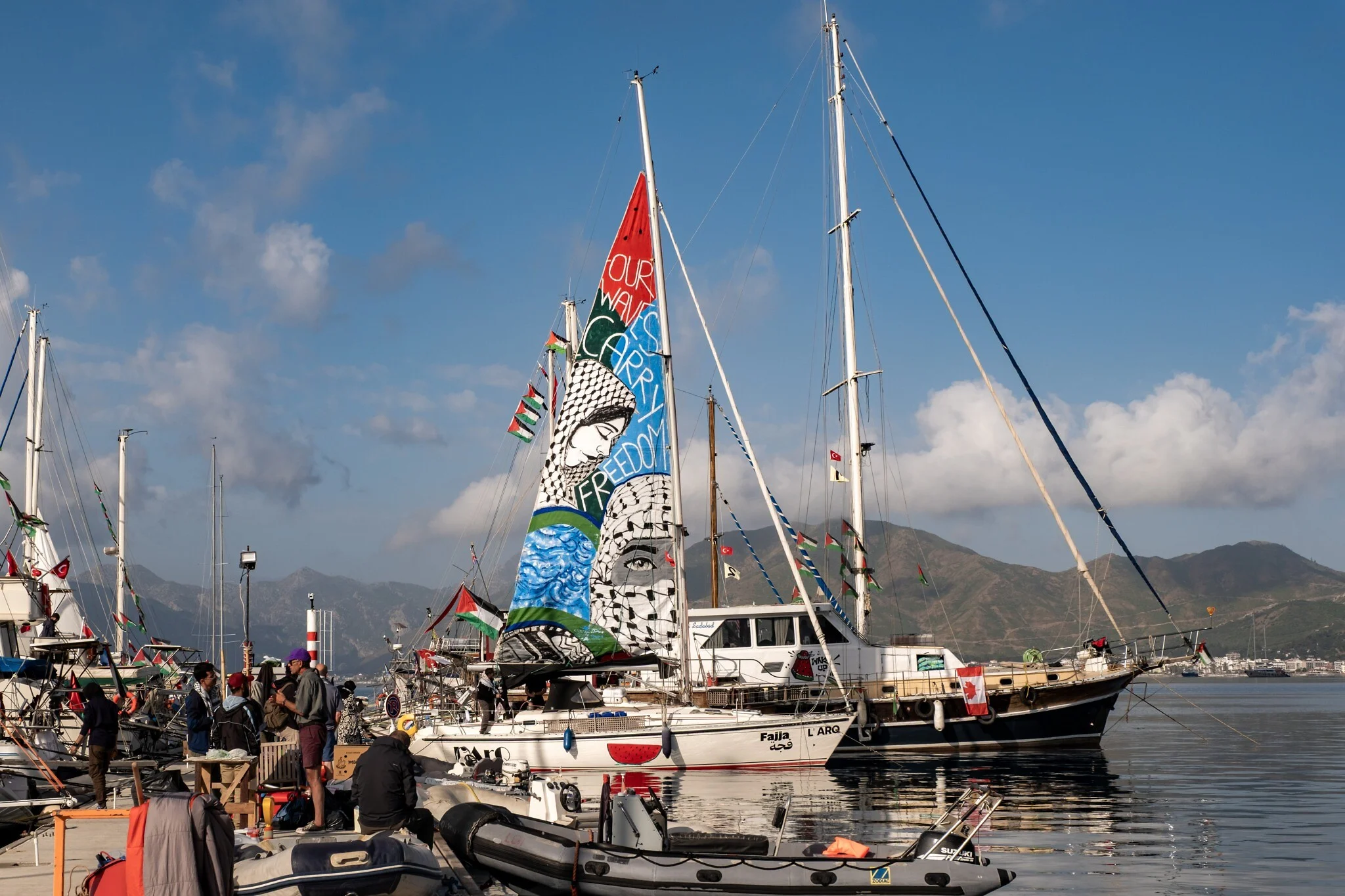
Boats belonging to the Global Sumud Flotilla, carrying activists and humanitarian aid, prepare to depart for Gaza from the port of Marmaris, Turkey, Thursday, May 14, 2026, in an attempt to break the Israeli naval blockade. (Times of Israel/AP Photo/Murat Kocabas)
As more than 50 vessels of the Global Sumud Flotilla departed the Turkish port of Marmaris on May 14 and are now sailing toward Gaza, Israeli media is sounding the alarm. Officials fear that any interception attempt could spark direct friction with the Turkish Navy, and Ankara may provide active naval escort. The alarm is understandable. But it is more tactical than strategic, focused on what could go wrong at sea rather than on the deeper architecture of incentives governing every actor’s choices. Most current commentary is fixated on boarding operations and worst case encounter scenarios while ignoring the structural forces that make deliberate military confrontation between Turkey and Israel highly improbable. This is not a bilateral crisis. It is a three player game, and the third player changes everything.
Most current Israeli coverage from Maariv to Ynet and beyond remains focused on tactical interception scenarios and expresses understandable concern about possible friction at sea. Valuable as that reporting is, it largely overlooks the deeper strategic architecture of incentives and the narrow window we are still in to prevent escalation altogether.

Erdogan’s Playbook: Words Versus Actions

Any serious analysis must begin with a fundamental distinction: what Erdogan says, and what his government actually does. Turkish officials have deployed maximalist rhetoric against Israel, with language reaching extraordinary levels of hostility. The operational reality tells a different story. Turkey simultaneously serves as a critical conduit for Azerbaijani oil flowing to Israel, and substantial bilateral trade persists beneath the political surface. A government that genuinely viewed Israel as an existential enemy would not maintain these commercial arteries. That gap between rhetoric and behavior is the most analytically reliable signal available, and it points firmly toward theater rather than war.
Erdogan’s consistent method across his tenure is to push hard, generate global headlines, claim moral victory, and de-escalate well short of actual conflict. The 2010 Mavi Marmara incident is the clearest template: a flotilla, an interception, Turkish outrage, international headlines, and then gradual de-escalation and quiet restoration of relations. Maximum political value extracted without paying the costs of real confrontation. The script has not fundamentally changed.

Turkey’s Constraints: Why Erdogan’s Hands Are Tied

Behavioral patterns aside, Erdogan faces concrete structural constraints that make escalation deeply costly. NATO membership offers no protection here. Escorting a civilian flotilla into a contested blockade zone does not trigger Article 5. Ankara would stand alone. Trump’s ambivalence toward NATO actually strengthens Washington’s leverage over Ankara rather than weakening it.
Economically, Turkey’s fragile finances and dependence on Western capital markets give Washington quiet coercive influence. Turkey’s shopping list of American weapons systems, upgraded F-16s, advanced munitions and intelligence platforms, remains conditional on Congressional approval. Erdogan needs Washington’s goodwill to keep that pipeline open.
On the military balance Turkey fields larger forces, but Israel’s military is more technologically advanced and far more battle hardened. Any naval incident near Gaza would not remain naval. Israeli air power would establish dominance rapidly, while Sa’ar 6 corvettes, Dolphin class submarines and layered missile defenses tilt the equation decisively. Turkey would be projecting power far from home while Israel operates from its own backyard. Turkish military planners will have assessed this calculus with sobriety.

Washington: The Player Most Analysis Is Missing

Most commentary treats this as a Turkey Israel bilateral. That framing misses the most consequential actor. Washington has more leverage and more urgency here than either of the other two parties.
US leverage over Turkey is real but not automatic. The relationship has been badly frayed by the S-400 purchase, Turkey’s removal from the F-35 program, and repeated Syrian clashes. A carrot and stick approach is more honest than assuming American pressure alone is sufficient. On the coercive side: weapons approvals and economic signals. On the incentive side: a less sensitive arms sale, a trade gesture, diplomatic cover on an unrelated Turkish priority.
But the critical variable is Washington’s urgency. The United States is managing an active military confrontation with Iran, with conventional forces already globally overstretched. Israel is indispensable to that effort. Washington cannot afford having Jerusalem forced to divert resources toward a Turkish naval confrontation, nor can it absorb the diplomatic implosion of NATO’s second largest military clashing with America’s primary Middle Eastern ally mid campaign. That urgency is what converts imperfect leverage into effective pressure. The naval blockade’s legal standing, upheld by the UN commissioned Palmer Report and mirrored by Washington’s own Hormuz blockade against Iran, further anchors US support for Israel’s position.

Prevention: Two Tracks, Working Together

Until the flotilla meets Israeli naval vessels there is still a window for prevention. And prevention should be the main effort. Now what is the best approach, as we identified in the prevention phase the key player is the USA so Israel should immediately pick up the phone to Washington and frame this as mutual strategic exposure. A direct Turkish Israeli clash is the last thing either capital needs during the Iran confrontation. Washington should pursue urgent carrot and stick pressure on Ankara, with two explicit red lines: No Turkish soldiers aboard flotilla vessels, and no Turkish naval escort all the way to Gazan waters and mentioned the USA can use as leverage/pressure points tariffs, economic measures and blocking armsales to Turkey. But at the same time it can offer incentives like approval of a less sensitive arms sale, a trade gesture, diplomatic cover on an unrelated Turkish priority.

Then secondly issue clear public assurances on activist treatment now. Non violent activists go home the next day. Violent ones face criminal prosecution. This removes Turkey’s ability to claim interception means harm to its citizens, sets behavioral expectations for the flotilla, signals Israeli responsibility to Washington, and gives Erdogan the face saving off ramp he likely needs. He can allow interception, deliver his condemnation speech, and tell his base the activists were treated with dignity.

Washington’s leverage is more credible when Israel behaves responsibly. Israel’s assurances are more credible when Washington is visibly engaged. 

If Prevention Fails: Israel’s Options

Israel faces three operational options if Turkey provides active naval escort, but they are not equally viable.

Backing off is not an option, not merely for strategic reasons but for the regional normative logic Israel operates within. In the Middle East, weakness does not preserve peace; it advertises exploitable limits to every actor watching. Capitulation would signal that sufficient naval escort nullifies the blockade entirely, inviting immediate replication.

Shadowing and waiting is equally dangerous. It risks Turkish vessels escorting the flotilla all the way to Gazan waters, at which point interdiction becomes far more complicated. Waiting cedes initiative.

Layered interception with boarding, the template successfully demonstrated twice near Crete, is the least bad choice, with one critical caveat. If Erdogan places uniformed Turkish soldiers aboard flotilla vessels, a deliberate escalation that would paralyze Israel’s boarding option, the calculus changes entirely. In that scenario Israel should maintain a physical naval barrier, forcing Turkey and the activists to decide whether to ram it, while sustaining businesslike, non aggressive communication with Turkish naval commanders. Give them an off ramp. Do not hand them an incident.

Throughout any interception, activist handling matters as much as the boarding itself. Non violent participants should be treated well, processed efficiently, and returned home promptly. Activists who engage in violence receive the same humane treatment but face criminal prosecution before deportation is considered. This sends a precise implicit message to Ankara: keep your nationals under control.


The Narrowing Window: From Prevention to Fog of War Risk

The moment this shifts from the prevention phase to open water confrontation, the risk profile changes sharply. Even when all sides plan not to escalate, high pressure cooker dynamics at sea can produce miscalculation, exactly as occurred in 1914 despite everyone’s pre war intentions. Once Turkish naval vessels and IDF commanders are operating under real time stress, no instruction from Ankara, Jerusalem, or Washington can fully guarantee the outcome.

Conclusion

The incentives for restraint are overwhelming on every side. Erdogan’s behavioral profile, above all the gap between his rhetoric and his government’s actual conduct, points toward theater not war. Turkey’s structural constraints leave little room for genuine escalation. Washington has both the tools and overwhelming urgency to apply preventive pressure. The most probable outcome is the familiar one: interception, condemnation, political points scored, region moves on.
But this analysis also points to where the danger lives. In the prevention phase we are currently in, Washington is the center of gravity. Everything depends on American pressure keeping Turkish naval forces from escorting the flotilla or placing soldiers aboard its vessels. If that prevention fails, the center of gravity shifts entirely to field commanders on both sides operating under stress in real time, and at that point no instruction from Ankara, Jerusalem, or Washington can guarantee the outcome.The window is measured in days. The tools exist. The question is whether the adults in the room use them in time.
About the Author
Brian McDonald, a columnist and geopolitical analyst who spent years in the Middle east, Singapore, Eastern and southern Africa and is currently based in Europe. He posts in various publications on current events and engages weekly in live geopolitical discourse, joining X Live Spaces. He holds an MA in global governance, politics, and security.
Related Topics
Related Posts
Sign in or Register
Please use the following structure: example@domain.com
Or Continue with
By registering you agree to the terms and conditions
Register to continue
Or Continue with
Log in to continue
Sign in or Register
Or Continue with
check your email
Check your email
We sent an email to you at .
It has a link that will sign you in.