
Geopolitical & Defense Analyst
Turkey’s Strategic Noose Around Israel
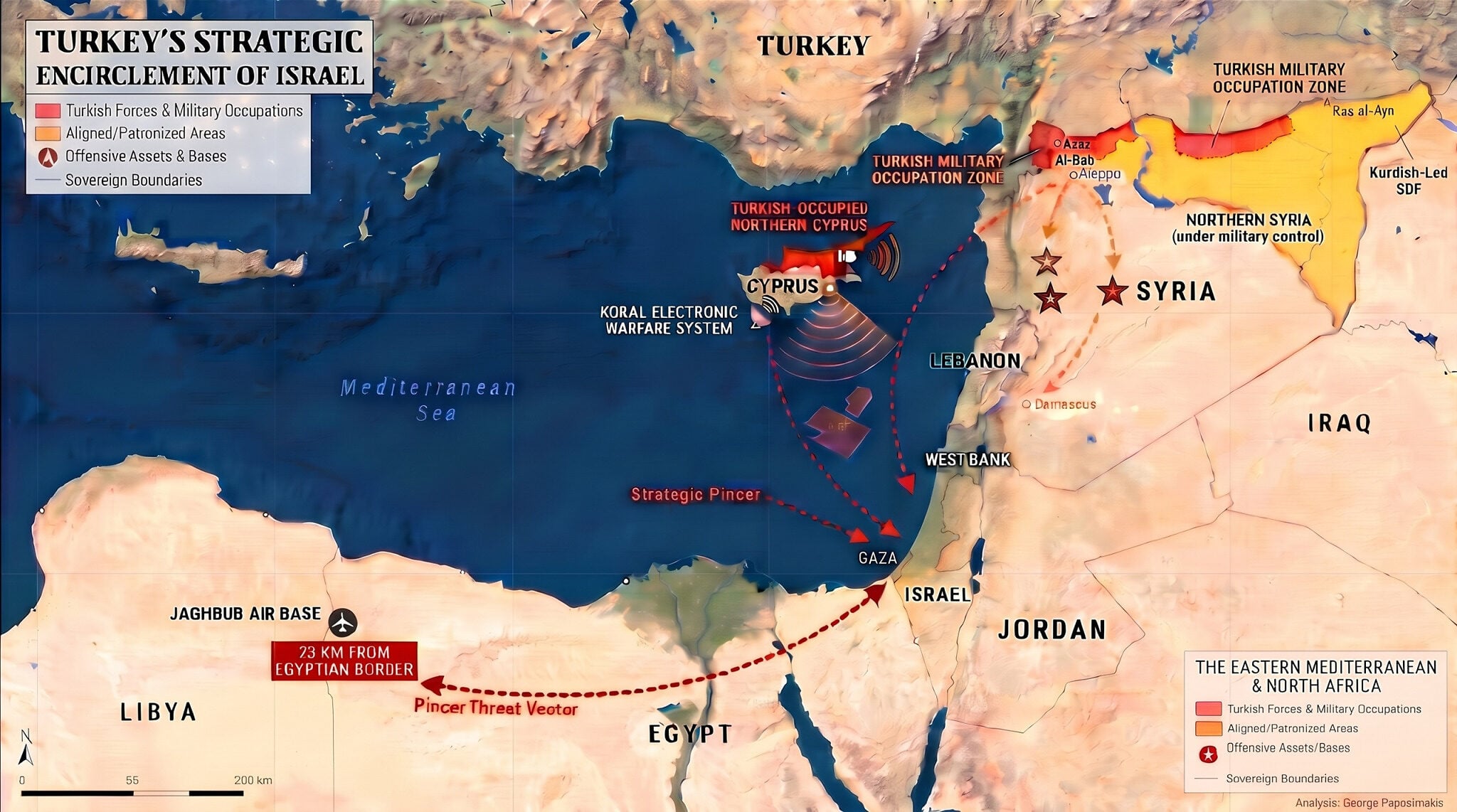
Map & Strategic Analysis: George Papasimakis
For decades, Israeli grand strategy has operated on the premise that existential and operational threats emanate primarily from the “Ring of Fire” cultivated by Tehran. Yet, an objective examination of current military movements in the Eastern Mediterranean and North Africa reveals a parallel, profoundly dangerous reality: Recep Tayyip Erdoğan’s Turkey is systematically constructing a multi-layered, operational encirclement of Israel.
This is not mere geopolitical posturing. It is a synchronized military deployment that integrates offensive air power, sophisticated electronic warfare, territorial proxy control, and ideological warfare.
The Electronic and Naval Chokepoint: Cyprus and the KORAL System
The northern, occupied territory of Cyprus has been quietly transformed from a frozen political conflict into an advanced Turkish offensive node. Beyond the deployment of naval assets and long-range unmanned aerial vehicles at Geçitkale (Lefkoniko), Ankara’s forward-basing of the land-based KORAL Electronic Warfare System directly challenges regional air dominance.
KORAL is not stationed in Cyprus solely to intimidate the Republic of Cyprus or Greek defensive assets. With an operational radar detection and electronic jamming range that sweeps vast swathes of the Eastern Mediterranean, it presents a direct threat to the Israel Air Force (IAF). It possesses the operational capability to blind radar systems, degrade communications, and disrupt missile guidance networks along Israel’s primary commercial and military maritime approaches. Jerusalem’s energy platforms in the Leviathan and Tamar fields, as well as the proposed Great Sea Interconnector (GSI), now sit squarely within this perimeter of electronic denial.
The Northern Vector: The Syrian Axis and Turkish Tutelage over Damascus
Simultaneously, on Israel’s immediate northern periphery, Turkey’s leverage across Syria has transitioned from border operations into strategic dominance. With the fall of the former regime and the ascent of the transitional authority in Damascus under Ahmed al-Sharaa (Abu Mohammad al-Julani) and Hay’at Tahrir al-Sham (HTS), Ankara functions as the primary patron, guarantor, and logistical lifeline of the new military and political order in Syria.
The Turkish Armed Forces do not merely maintain observation points; they orchestrate a subservient security architecture right on Israel’s northern doorstep. Reliable strategic assessments indicate Ankara’s persistent objective to permanently operate and upgrade air bases on Syrian soil, integrating them with advanced air-defense systems. The operational goal is unambiguous: to establish an anti-access/area denial (A2/AD) perimeter that curbs the Israel Air Force’s (IAF) historical freedom of maneuver, turning Syria into a forward Turkish outpost pointing directly toward the Golan Heights and northern Israel.
Ideology as Force Multiplier: Hamas and the West Bank
This territorial and strategic expansion is amplified by Ankara’s active patronage of violent extremism. President Erdoğan’s statements have repeatedly crossed into virulent antisemitic territory, questioning Israel’s legitimacy to exist and openly framing Jerusalem as a target for neo-Ottoman “liberation.”
Crucially, this ideological hostility translates directly into operational infrastructure. Following Hamas’s barbaric terror onslaught of October 7 against Israeli civilians, Ankara did not distance itself; it openly shielded the terrorist organization, granting full diplomatic immunity and sanctuary to its top command and financial architects. Through Hamas, Turkey asserts de facto proxy leverage on Israel’s southern flank. Concurrently, intelligence reports consistently trace financial facilitation, command coordination, and weaponization directives flowing from Turkish networks directly into militant terror cells across Judea and Samaria (the West Bank). Ankara is deliberately fanning the flames of internal conflict within Israeli territory.
The Southwestern Arc: The Jaghbub Airfield in Eastern Libya
Now, the strategic vise is closing from an unexpected direction: North Africa.
Recent satellite surveillance and reports from seasoned European diplomatic corridors—corroborated prominently by Italy’s Agenzia Nova—confirm that Turkish engineering and infrastructure firms are heavily engaged in upgrading a massive 3,600-meter military airstrip in the Jaghbub oasis, located in eastern Libya.
To military analysts, a runway of 3,600 meters in deep desert terrain carries an unmistakable signature. It is not built for civilian air traffic or regional turboprops. It is specifically engineered to handle heavy strategic airlifters (such as the Airbus A400M), aerial refueling tankers (KC-135 Stratotankers), and fully armed 4th- and 5th-generation strike fighters.
Crucially, Jaghbub is situated a mere 23 kilometers from the Egyptian border. By expanding its footprint into eastern Libya—traditionally the domain of General Khalifa Haftar—Turkey is pulling off a dual-target maneuver:
-
Neutralizing Egypt: It places Egypt’s western flank under direct surveillance and potential aerial interdiction, nullifying Cairo’s strategic depth and putting severe military leverage on the Egyptian Armed Forces ahead of critical maritime demarcation talks.
-
Enveloping Israel from the Southwest: A forward Turkish air node in eastern Libya, operating in tandem with Turkish naval and drone bases along the Libyan coast, extends Ankara’s power projection across the entire southern Mediterranean basin.
The Grand Strategy: A Closed Pincer
When these individual vectors are connected, the operational design is glaring:
-
Northeast: Direct military presence and patron-client dominance over the new authority in Syria.
-
North/Center: Electronic warfare (KORAL) and air denial assets deployed in occupied Cyprus.
-
Internal Front: Active operational, political, and material backing of Hamas in Gaza and the West Bank.
-
Southwest: A heavy strategic airstrip under Turkish construction at Jaghbub, flanking Egypt and threatening the southern Mediterranean approaches.
Erdoğan’s ambition is to confront Israel with a geographic and operational fait accompli. While Jerusalem has correctly committed immense military resources to dismantling the Iranian-backed axis, it cannot afford strategic blindness on its western and northern horizons.
Turkey is not merely a difficult NATO ally or a loud diplomatic adversary; it is methodically building the physical infrastructure necessary to restrict Israel’s strategic depth, blind its sensors, and challenge its operational dominance. The runway at Jaghbub, the radars on the Cypriot peaks, and the consolidation of power in Syria belong to the very same tactical blueprint. It is high time Jerusalem, Cairo, and Athens coordinate their deterrence frameworks accordingly.
Related Topics
Related Posts