Geopolitical Analyst: Bridging Somaliland & Israel to the world
Türkiye and Israel: The New Strategic Confrontation in The Red Sea
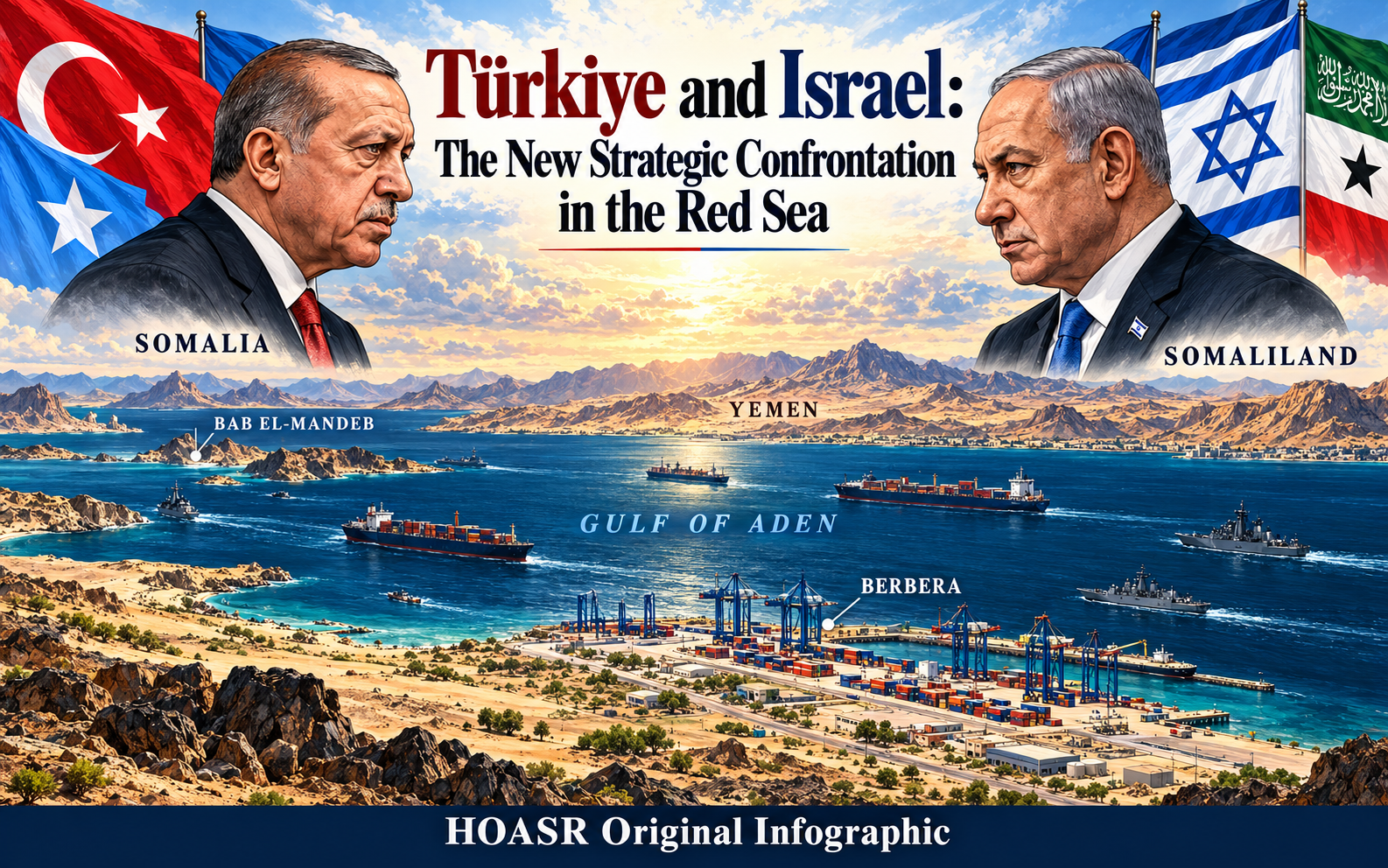
Türkiye’s partnership with Somalia and Israel’s engagement with Somaliland meet at the strategic crossroads of Berbera and Bab el-Mandeb. HOASR Original Infographic.
As Turkish military power expands through Mogadishu and Israel develops its partnership with Hargeisa, the Somaliland–Somalia dispute is being absorbed into a wider contest over Berbera, Bab el-Mandeb and the future security order of the Red Sea.
The emerging rivalry between Türkiye and Israel in the Horn of Africa is real, not speculation. It can now be seen in military deployments, diplomatic recognition, defense agreements and increasingly direct statements from officials in Hargeisa, Mogadishu, Ankara and Jerusalem. Middle East Eye brought these developments together in an important investigation published on 2 October, but the evidence extends well beyond a single report.
Türkiye has entrenched itself deeply inside Somalia’s military, maritime and political institutions. Israel has recognized Somaliland, begun training its security forces and opened the possibility of a future security presence. Between them lies the Gulf of Aden, where the Houthi advance along Yemen’s Red Sea coast has made Berbera more valuable—and more exposed—than at any time since the Cold War.
This is not yet a confrontation between two organized military blocs. The alignments remain fluid, interests overlap, and neither Ankara nor Jerusalem has announced a strategy of confronting the other in the Horn. But the architecture of competition is taking shape, and Somaliland is caught in between.
Türkiye’s position is no longer merely diplomatic
Türkiye’s Somali presence began with humanitarian assistance, infrastructure and political engagement. It has since developed into something much larger: an integrated relationship involving military training, counterterrorism, energy exploration, port and airport management, maritime security and influence over Somalia’s state institutions.
Ankara operates its largest overseas military training facility in Mogadishu and has trained thousands of Somali personnel, including elite units and senior officers. In 2024, Türkiye and Somalia signed a ten-year defence and economic cooperation agreement under which Ankara committed itself to strengthening Somalia’s maritime-security capacity. Turkish officials described the agreement as helping Somalia defend what it considers its territorial waters.
The wording in the agreement has direct implications for Somaliland. Mogadishu claims Somaliland’s coastline and economic zone even though it has exercised no authority over them for more than three decades.
A Turkish naval commitment based on Somalia’s internationally recognized boundaries therefore creates a potential collision between legal claims advanced by Mogadishu and the territorial reality administered from Hargeisa.
Türkiye’s role also extends below the seabed. Its energy agreement with Somalia covers offshore and onshore exploration, production, transportation and refining. Ankara has sent drilling and naval assets to Somali waters, establishing a combined commercial and security presence along one of the world’s most important maritime corridors.
The military component has meanwhile become more visible. Credible reporting has identified Turkish Bayraktar drones, attack helicopters, transport aircraft and F-16 fighters in Somalia. The full number, purpose and operating arrangements of these platforms have not been officially disclosed, but their presence gives Türkiye a level of operational reach in the Horn that no other outside power currently exercises through Mogadishu.
This is the cause for alarm expressed by Somaliland officials. Presidential foreign-affairs adviser Mohamed Osman Fadal told Middle East Eye that Somaliland needed air-defence systems because of Turkish aircraft and a possible drone facility in Somalia.
His blunt statement that Hargeisa wanted Israeli support “against Turkey” was more than ordinary diplomatic criticism. It suggested that at least some officials now view Türkiye not simply as Mogadishu’s political ally, but as a potential military enabler of Somali pressure against Somaliland.
Israel has entered through recognition, but security is following
Israel approached the Horn from the opposite direction. It did not spend years building institutions in Somaliland before recognizing it. Recognition came first, followed quickly by diplomatic, commercial and security engagement.
Israel formally recognized the Republic of Somaliland on 26 December 2025, becoming the first UN member state to do so since Somaliland restored its independence in 1991. The declaration referred publicly to agriculture, health, technology and economic development, but it emerged amid a far more serious security environment: Houthi attacks on shipping, Iranian influence around the Red Sea and the growing strategic value of the African coast opposite Yemen.
During President Abdirahman Irro’s state visit to Israel in June, President Isaac Herzog explicitly connected the relationship to extremism, regional stability and freedom of navigation. Somaliland’s official account said the discussions included security cooperation alongside trade, technology, agriculture and development.
The security relationship is not hypothetical. Somaliland Defense Minister Mohamed Yusuf Ali confirmed in June that Israel was training Somaliland’s military and police, although he denied that negotiations for an Israeli base were under way.
Since then, President Irro has moved the public position further. In an interview with Ynet during his Washington visit, he said there was no Israeli security presence in Somaliland yet, but that such a presence could emerge in the future. He described Israeli or American involvement as a source of protection and deterrence.
Even though a formal Israeli base has not been confirmed, Somaliland’s president is no longer excluding one. Training is already taking place, security cooperation has been acknowledged, and Hargeisa is publicly seeking the capabilities required to deter stronger adversaries.
Berbera is where diplomacy becomes military geography
Berbera connects the Somaliland–Israel relationship to the wider Red Sea contest. The port and airport sit across the Gulf of Aden from Yemen, close to Bab el-Mandeb and within operational reach of Houthi-controlled territory. The airport’s unusually long runway, deep-water port access and relative distance from densely populated areas make it suitable for surveillance, logistics, air defence and maritime operations.
A Le Monde investigation based on satellite imagery reported major construction around Berbera Airport, including trenches, protected storage facilities, aircraft infrastructure and raised positions assessed as possible air-defence sites. The report linked the work directly to the UAE while suggesting that the facilities could eventually support Israeli and American operations. It also reported visits by Israeli and AFRICOM personnel, although no public agreement identifies which foreign forces may ultimately use the site.
The UAE provides the material bridge between Somaliland and Israel. Abu Dhabi has invested heavily in Berbera through DP World, retains longstanding security interests around the port and has developed extensive defence cooperation with Israel since the Abraham Accords. Emirati capital, Israeli security technology and Somaliland’s geography create a natural—though still partly informal—alignment.
Ethiopia adds to its ambitious Red Sea access. Addis Ababa needs diversified maritime access, maintains close relations with Israel and the UAE, and sees Berbera as an alternative to dependence on Djibouti. Yet Türkiye also retains influence in Ethiopia and helped mediate the MoU with Somaliland dispute between Addis Ababa and Mogadishu. This illustrates why the emerging camps should not be treated as rigid alliances because the same actors can compete in one theatre while cooperating in another.
Nevertheless, the alignment visible around Berbera can definitely be described as an emerging strategic side: Somaliland provides geography and political access; the UAE supplies capital and logistical infrastructure; Israel offers recognition, intelligence and advanced security technology; Ethiopia supplies an enormous hinterland and commercial prospects. Washington remains interested but uncommitted, viewing Berbera as a possible alternative or supplement to Djibouti rather than as a formally declared American base.
The Turkish camp is also more complicated than it appears
On the other side, Türkiye’s partnership with Somalia overlaps with the interests of Egypt, Saudi Arabia and Pakistan, but they do not form a fully unified anti-Somaliland coalition.
Egypt supports Somalia’s territorial claims partly because of its own rivalry with Ethiopia over the Grand Ethiopian Renaissance Dam and Red Sea access. An Ethiopia–Somaliland maritime partnership, supported by the UAE and strengthened by Israel, would place Cairo’s principal Nile rival closer to the sea. From Egypt’s perspective, this could alter the military and economic balance surrounding both the Nile and the southern Red Sea.
Saudi Arabia’s position is more ambiguous. Riyadh supports Somalia’s territorial integrity and remains cautious about Somaliland’s relations with Israel. It is also building a closer defence relationship with Türkiye and Pakistan through the Mecca Joint Defence Agreement, under which an attack on one member is treated as an attack on all.
Yet Saudi Arabia and Israel share an interest in containing the Houthis, while Riyadh and the UAE remain commercially and strategically interconnected despite their rivalry. Türkiye itself is providing equipment and advisers for Saudi-backed efforts against the Houthis.
The Turkish camp is held together by overlapping concerns: Somalia wants to prevent Somaliland’s recognition; Türkiye wants to protect its investment and influence in Mogadishu; Egypt wants to constrain Ethiopia; Saudi Arabia wants to secure its southern border and Red Sea trade; and Pakistan wants to reinforce its strategic partnership with Riyadh and Ankara.
Bab el-Mandeb changes the value of Somaliland
The rivalry would be significant even without the current Yemen crisis. The Houthi advance has made it urgent.
Reuters reported that the Houthis seized the Red Sea coastline surrounding Bab el-Mandeb during their September offensive. On 4 October, Saudi Arabia started a major campaign involving Yemeni forces, Saudi airpower and American intelligence support to reverse Houthi gains. Türkiye and Pakistan are reportedly supplying equipment and advisers but are not expected to participate directly in combat.
The Houthi position affects more than Israel and Saudi Arabia. It threatens shipping between the Indian Ocean, the Red Sea and the Suez Canal, increases maritime insurance costs and places additional pressure on energy and food prices. Yemen imports roughly 90 percent of its food, meaning renewed conflict around ports and maritime routes also carries an immediate humanitarian cost.
The Financial Times has separately reported American concerns about growing cooperation between the Houthis and Al-Shabaab involving weapons, drone knowledge and explosives training. If that relationship develops, the security crisis could engulf both shores of the Gulf of Aden rather than remain divided between Yemen and Somalia.
This development strengthens Israel’s argument that Somaliland is part of the same security theatre as Yemen. Hargeisa and Jerusalem are aligned geographically on identical threat assessments. Somaliland wants recognition, deterrence and protection against Türkiye-backed Somali pressure. Israel wants surveillance, strategic depth and options against the Houthis and Iran.
Somaliland’s Threat Perception and the Limits of Evidence
Somaliland officials have legitimate reasons to monitor Türkiye’s military expansion. Turkish aircraft, drones, naval agreements and training programs have created a substantial imbalance between Mogadishu and Hargeisa. Somalia’s claim over Somaliland’s coastline gives that expansion a territorial dimension, while Ankara’s categorical opposition to Israeli recognition has destroyed much of Somaliland’s confidence in Türkiye as a neutral mediator.
Mogadishu’s political language has also hardened. President Hassan Sheikh Mohamud told Al Jazeera on 3 October that Somalia would not accept an Israeli presence “under any circumstances.” He claimed Israel intended to use Berbera’s port and airport and portrayed the relationship as an extension of wider Israeli ambitions.
Israel has not confirmed his claims, and Somaliland rejects Mogadishu’s authority over Berbera, but the statement demonstrates how the dispute is being recast from a constitutional question into a regional security confrontation.
No reliable public evidence currently proves that Somalia and Türkiye are preparing to invade Somaliland. Türkiye’s military assets can be explained by its counterterrorism mission, defence agreements and strategic investment in Somalia. The possibility of those assets being used coercively against Somaliland remains a major risk assessment, not yet an established operational plan.
But deterrence planning does not begin only after the fact an invasion order has been issued. Somaliland’s concern arises from capability, proximity and political intent. Türkiye is building Somali military power while rejecting Israel’s recognition of Somaliland and supporting Mogadishu’s claim over its territory and waters. Hargeisa cannot ignore that combination, even if it avoids presenting confrontation as inevitable.
The Türkiye–Israel Rivalry Extends from Syria to the Horn
The Horn is not the first place where Türkiye and Israel have encountered one another as competing security actors. Their rivalry has intensified in Syria, where both maintain military interests and sharply different visions for the post-Assad order.
In August, Israel struck a Syrian airbase that it believed could host Turkish forces. Türkiye denied planning a permanent deployment, but the episode produced unusually direct warnings between Ankara and Jerusalem. The United States subsequently began working on a deconfliction mechanism involving Israel, Türkiye and Syria to prevent their competition from escalating accidentally.
That experience is a lesson for the Horn. Rival powers do not need to intend war for military accidents to happen. Drones, radar systems, naval patrols, intelligence operations and proxy forces can create escalation through miscalculation, especially where territorial authority is disputed.
A Turkish aircraft operating under an agreement with Mogadishu and an Israeli-supported system operating from Somaliland could interpret the same airspace differently. A Turkish naval mission based on Somalia’s claimed economic zone could enter waters Somaliland considers sovereign. These are not abstract legal disagreements once military platforms are involved.
Emerging Alignments Without Strategic Cohesion
A useful way to understand the contest is as two emerging centres of gravity rather than two finished alliances.
The Berbera side brings together Somaliland, Israel and the UAE, with Ethiopia closely interested and the United States maintaining strategic optionality. Its advantages are geography, port infrastructure, technology, intelligence and access to the African side of Bab el-Mandeb.
The Mogadishu side is centred on Somalia and Türkiye, with varying support from Egypt, Saudi Arabia, Pakistan and Qatar. Its advantages are international recognition of Somalia’s borders, established military agreements, greater diplomatic acceptance and Türkiye’s operational capacity.
But this emerging model has limits. Türkiye and the UAE cooperate economically despite competing in several theatres. Saudi Arabia works with Türkiye against the Houthis but remains open to engagement with Israel. Ethiopia has relations with Türkiye while depending on the UAE and seeking access through Somaliland. Washington considers Türkiye a NATO ally, Israel a central security partner and Somaliland a potentially valuable but unrecognized regional actor.
The rivalry is real, but the region has not divided into two permanent camps. It is better understood as a competition among overlapping networks whose members cooperate on one issue and oppose each other on other issues.
Recognition is becoming part of the Red Sea security architecture
Israel’s recognition changed Somaliland’s diplomatic position, but its larger consequence may be strategic. It connected the question of Somaliland’s statehood to maritime security, Iranian influence, Türkiye’s military expansion, the UAE’s port network and Ethiopia’s search for access to the sea.
Recognition is no longer being debated only through history, law and self-determination. It is becoming part of the contest over who controls access, surveillance and military mobility around the southern Red Sea.
Berbera’s geography has attracted investment, defence cooperation and practical relationships that three decades of conventional diplomatic appeals failed to produce. Israel’s recognition has already ended Somaliland’s complete diplomatic isolation and forced regional powers to reconsider a territory they previously treated as “part of Somalia.”
Obviously, that opportunity also creates risk exposure. A foreign security presence could make Somaliland a target for Houthis, Al-Shabaab or other Iran-aligned actors. An explicitly anti-Türkiye position could provoke greater Turkish support for Mogadishu and damage Somaliland’s relations with Muslim-majority governments. Vague agreements could produce domestic suspicion and allow political opponents and anti-Israel camps to claim that recognition was exchanged for military access.
Somaliland’s strongest position is not to become an instrument of Israel against Türkiye or of the UAE against Saudi Arabia. Its value comes from functioning as an autonomous strategic actor: willing to cooperate with Israel and the United States, retain its partnership with the UAE, preserve working channels with Türkiye and Saudi Arabia and offer defensive maritime cooperation serving a broader international interest.
The Scoop: The Red Sea crisis is moving toward Berbera
The Houthi advance, renewed war in Ethiopia, instability in Sudan and Türkiye’s military consolidation in Somalia are merging conflicts that were once treated separately. Reuters has warned that Ethiopia’s renewed fighting could draw in Eritrea, Egypt, Sudan, the UAE, Saudi Arabia. Israel and Somaliland turning national crises into a connected regional struggle.
Berbera now is the center of gravity in those geopolitical rivalries. It faces Houthi-held Yemen, offers Ethiopia an alternative maritime corridor, anchors the UAE’s most important investment in Somaliland and provides Israel with possible strategic depth beyond the immediate Middle East. It is also located inside territory Mogadishu claims and Türkiye has committed itself to defending as “part of Somalia.”
The emerging Türkiye–Israel rivalry does not guarantee war in the Horn. However, Somaliland’s security, recognition campaign and maritime infrastructure can no longer be separated from the regional military balance.
Although the Middle East Eye investigation captured the warning, the broader evidence reveals something larger: The geopolitical competition between Israel and Türkiye is emerging inside the Red Sea power rivalry. Somaliland and Somalia are becoming two of the major locations through which that struggle will be organized.
Related Topics
Related Posts