


Welcome to the Ongoing Situation
Twenty-five minutes of applause is not a verdict
The filmmakers are not traitors. But Venice is not a court, and an ovation cannot establish what happened in Gaza
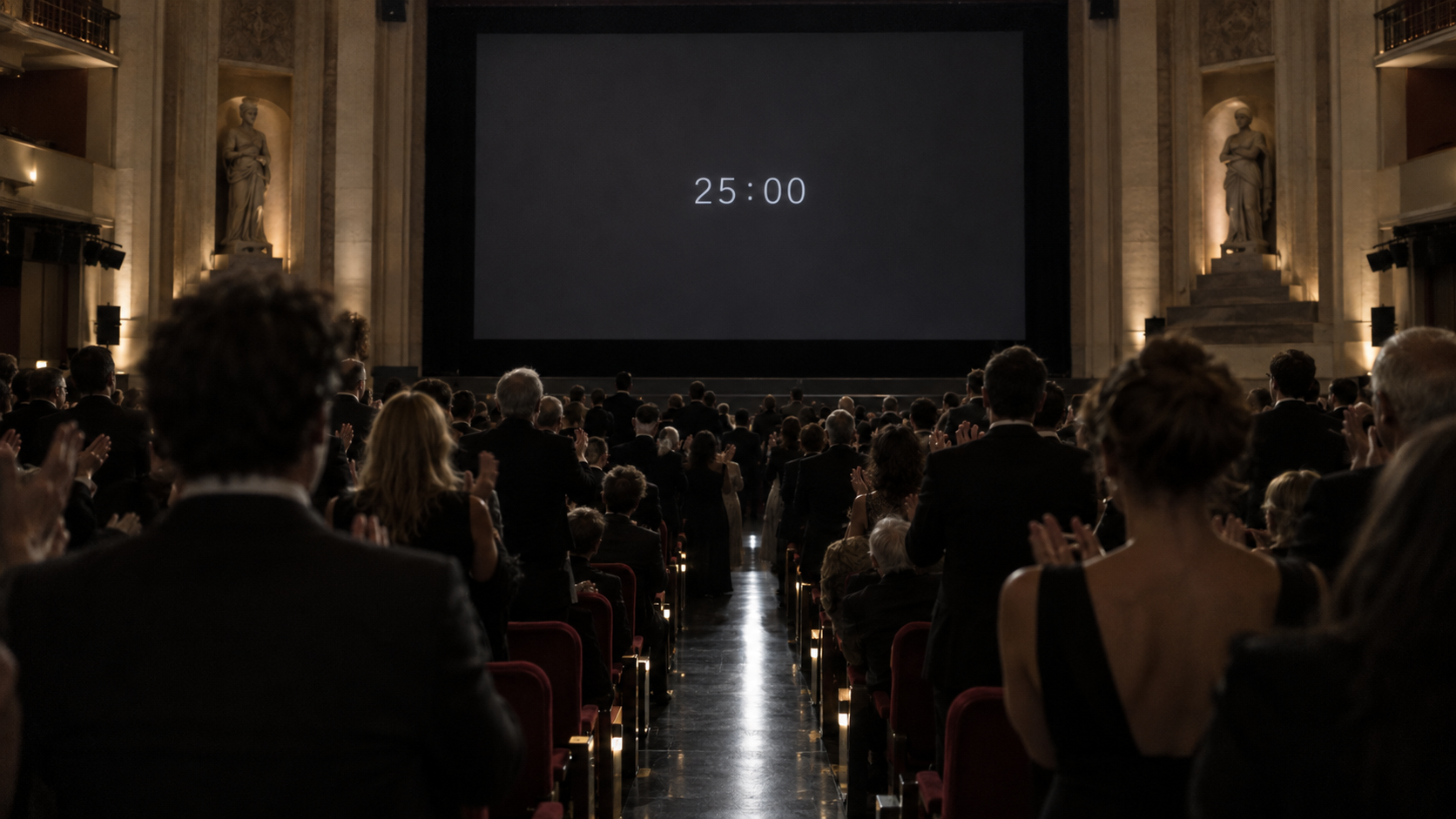
A crowd gives a standing ovation in front of a screen that reads '25:00.' (ChatGPT)
Twenty-five minutes is a long time to applaud anything.
It is enough time to make coffee, miss a bus and receive several unsolicited opinions about how you should be raising your child. At the Venice Film Festival, it was how long an audience reportedly stood and applauded ‘NAZA’, the new documentary by Israeli filmmakers Yuval Abraham and Rachel Szor about Israel’s conduct in Gaza.
Almost immediately, the reaction to the film became more important than the film itself.
For many outside Israel, the ovation seemed to confirm that ‘NAZA’ had exposed the truth about the war. For some Israelis, it confirmed that the filmmakers had betrayed their country before an audience already eager to condemn it. Culture Minister Miki Zohar reportedly went so far as to call for Abraham and Szor to be stripped of their Israeli citizenship.
The filmmakers were either heroes or traitors. The film was either the truth or propaganda. As usual, everyone reached a verdict before anyone had finished examining the evidence.
Making a film that accuses your government or military of wrongdoing is not treason. It is political expression, even when that expression is harsh, damaging or warmly received by people hostile to the country being criticized.
Citizenship is not a reward for making Israel look good. It does not expire when an Israeli embarrasses Israel abroad. If belonging to this country depends on defending its government in front of foreigners, then citizenship has become little more than a loyalty card.
A democracy is not tested by its willingness to protect flattering speech. Every government can tolerate praise. It is tested by what happens when citizens say something its leaders find infuriating, humiliating or dangerous.
Israeli politicians who call for the filmmakers’ citizenship to be revoked are not defending the country. They are attacking one of the principles that distinguishes it from the authoritarian states they regularly warn us about. A democracy that tolerates only government-approved opinions is not much of a democracy.
But the fact that ‘NAZA’ has a right to exist does not mean every conclusion it reaches is automatically correct.
According to reporting about the documentary, ‘NAZA’ is built around testimony from 24 Israeli military and intelligence insiders. They describe the use of artificial intelligence-assisted targeting systems, calculations of expected civilian casualties and military decisions they say resulted in mass civilian deaths.
These are extremely serious allegations. They cannot be dismissed as the inevitable misconduct of a few soldiers in a long war. The film reportedly argues that the problem was systemic and connected to broader methods of targeting and decision-making.
That could be true. Parts of it could be true. Some testimony may prove accurate, while other accounts may be impossible to verify. Policies may have been illegal, applied recklessly, misunderstood by those implementing them or presented without important context.
We do not yet know. That is why investigations exist.
Testimony is a reason to investigate. It is not a verdict. A documentary can uncover facts and force important questions into public view. It can also select, arrange and interpret its material in support of a particular argument. That is not necessarily dishonest. It is what documentaries do.
Someone decides whom to interview, which statements to include and how much context the audience receives. Someone decides where to cut and where to let the camera linger. A film can reveal something essential without showing everything.
Abraham and Szor were under no obligation to make ‘NAZA’ “balanced.” It is their film and their argument. They did not owe every accusation an immediate rebuttal or every Israeli official equal screen time.
The rest of us are still under no obligation to treat their argument as a final judgment.
This is where the Venice ovation becomes part of the story.
What was the audience applauding for 25 minutes? The quality of the film? The courage of its witnesses? Palestinian suffering? Israeli dissent? The condemnation of Israel itself? Presumably, different people were applauding different things.
Still, somewhere around minute 18, an ovation begins to feel less like appreciation for a film and more like a public demonstration of moral credentials.
The audience was not simply saying that it had watched something powerful. It was also showing that it knew the correct response.
Perhaps the applause reflected genuine horror at testimony that deserved horror. But there is something strange about watching a room full of people, many of whom had strong opinions about Israel before the lights went down, receive precisely the story they expected and then applaud it for nearly half an hour.
This is not evidence that the film is wrong. It is also not evidence that the film is right.
Applause can honor witnesses and express solidarity with victims. It can reward courage, artistry or political conviction. It cannot verify a military allegation.
The people in that theater did not examine targeting records or rules of engagement. They did not question commanders or compare conflicting accounts. They did not determine whether particular actions reflected individual failures, illegal orders or official policy.
They watched a film. Then they stood up.
The Israeli government’s response is just as removed from the facts. By calling the filmmakers traitors, politicians can avoid addressing what their witnesses actually said. If Abraham and Szor are cast as enemies of the state, their allegations no longer need answers. Their motives can be attacked instead.
The two reactions look like opposites, but they have something important in common. Venice turns the filmmakers into heroes. Israeli politicians turn them into villains. In both cases, the argument over who the filmmakers are threatens to replace an examination of what they found.
Israel should not strip Abraham and Szor of their citizenship. It should not threaten or silence them. Criticizing the IDF, even abroad and even in the harshest terms, is not the same as attacking Israel.
Israel should investigate their claims.
If Israeli personnel knowingly authorized unlawful attacks with enormous expected civilian casualties, those responsible must be held accountable. If targeting systems allowed civilian lives to become little more than numbers in a calculation, Israelis deserve to know. If testimony was presented without crucial context or used to support conclusions the evidence cannot bear, that should also emerge through a credible investigation.
No serious person should believe Israeli soldiers are incapable of committing crimes. They are human beings serving in a brutal, prolonged war, not saints protected from wrongdoing by the justice of their cause. The real measure of Israel is not whether misconduct can happen. It is what the country does when credible allegations arise.
Does it investigate them or threaten the people who expose them? Does it punish wrongdoing or explain it away? Does it follow the evidence or decide in advance that everyone involved must be either a hero or a traitor?
‘NAZA’ had the right to be made. Its allegations deserve serious examination. Its filmmakers deserve the protections of the citizenship some politicians would like to take from them.
But a documentary is not a courtroom. Venice is not a commission of inquiry. A standing ovation is not a finding of fact.
An accusation should begin an investigation, not replace one.
Even when the applause lasts 25 minutes.
About the Author
Marni Davimes is an Israeli-American writer, editor, and journalist based in Tel Aviv. Her work spans news, culture, identity, and the strange places where politics and private life overlap. She has written and edited across international media and is particularly interested in making sense of things that resist easy narratives.
Related Topics
Related Posts


Marni Davimes