Two rival AI videos. One flattened vision of freedom.
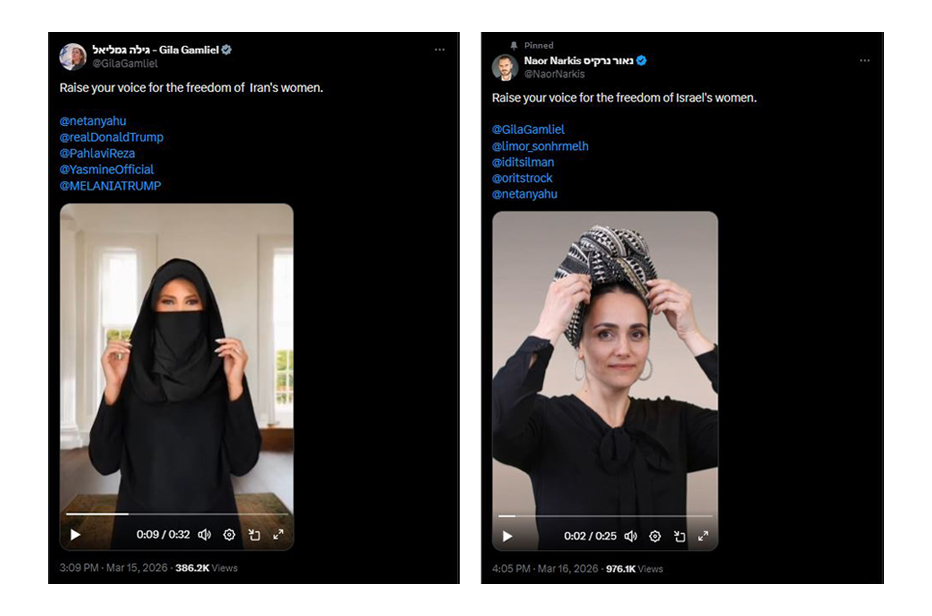
Last week, two AI-generated videos circulated in Israel and quickly ignited public debate. One was released by Israel’s science minister, Gila Gamliel, and presented as a call to liberate Iranian women. The other, posted as a direct response by liberal political activist and Democrats list candidate Naor Narkis, applied the same logic to religious women in Israeli politics. At first glance, the exchange looked like a familiar ideological clash. In practice, it revealed a shared blind spot.
Neither video required artificial intelligence. Look-alikes, costumes, and staged filming have long been available tools. What AI changed was speed. It shortened the distance between an idea and a finished image and reduced production costs to almost nothing. The issue, then, is not technological. It is conceptual. These videos reveal how political actors imagine freedom.
In Gamliel’s video, figures resembling Sara Netanyahu, Melania Trump, Yasmin Pahlavi, and Gamliel herself appear wearing a niqab before removing it in a dramatic gesture. The message is clear: this is what the liberation of Iranian women looks like. The niqab, a face veil that covers everything except the eyes, is almost entirely absent in Iran and has even been banned there. The struggle many Iranian women are currently engaged in concerns the compulsory hijab. Beyond the factual error lies a more fundamental failure: freedom is presented as something that can be staged from the outside.
Raise your voice for the freedom of Iran's women.@netanyahu @realDonaldTrump @PahlaviReza @YasmineOfficial@MELANIATRUMP pic.twitter.com/s7YYveE6jA
— גילה גמליאל – Gila Gamliel (@GilaGamliel) March 15, 2026
Iranian history makes clear how misleading such a portrayal can be. In the 1930s, women were forced to uncover as part of a state-driven campaign of secularization. Decades later, the same head covering became a symbol of resistance. After the 1979 revolution, it was imposed once again, this time as a legal obligation. The same garment has thus functioned as both an instrument of coercion and an act of defiance. Freedom does not reside in the fabric itself but in the ability to choose what it signifies.
Equally telling is who does not appear in the video: Iranian women living under the regime. The one Iranian figure present is Yasmin Pahlavi, wife of the exiled crown prince. She is herself a Western-based diaspora figure, not a representative of the women whose liberation is being performed. The oppressed becomes background, pretext, absence.
Narkis’s response video follows a similar logic. Several religious nationalist female politicians are shown removing their head coverings. Intended as political critique, the video nonetheless reproduces the same gesture it seeks to challenge. It constructs an image of women’s bodies without their consent and assigns them a definition of freedom imposed from the outside. These are separate problems, but both matter. One concerns consent and dignity. The other reflects the same underlying assumption: that the removal of a religious symbol automatically signifies liberation and that this meaning can be decided for others.
Raise your voice for the freedom of Israel's women.@GilaGamliel @limor_sonhrmelh @iditsilman @oritstrock @netanyahu pic.twitter.com/tYvrtVmKgY
— Naor Narkis נאור נרקיס (@NaorNarkis) March 16, 2026
Isaiah Berlin famously distinguished between two kinds of freedom. Negative liberty is freedom from, the absence of external interference: no wall, no officer, no law preventing you from acting. Positive liberty is freedom to, the capacity to be master of yourself, to realize your true will, to shape your life from within. Berlin did not determine which is superior, but he warned of a specific danger lurking in the second. When someone decides for you what your true will is, they are not liberating you but taking you over in your name. “Your true self wants to be free” is often merely a prelude to coercion. This is precisely the mechanism Berlin identified as the root of the justification for totalitarianism: if I know what you truly want better than you do, I am permitted to force you to want it.
Both videos operate within this logic. They do not say “we are removing an obstacle.” They say, “We know who you really are, and who you really are is not covered.” This is the appropriation of another’s voice for the sake of a political message. This is not merely simplistic. It is structurally anti-liberal. Whoever decides for another person what their true self is, and what they must remove in order to be free, is not liberating them. They are replacing one form of coercion with another.
Placed side by side, the difference between the two videos is smaller than it appears. A minister from the right and an activist from the left each made an AI video about freedom – and exposed the same assumption. The dispute is not about freedom itself but about the authority to define it for others. Both depart from the same premise: the religion of whoever stands opposite me is coercion, and its removal is liberation. There is no disagreement between them about what freedom is. There is a disagreement about who deserves it. Visually, both function less as arguments than as advertisements, presenting a desired reality as self-evident.
The episode reflects a broader global shift. In the age of generative media, political argument is increasingly replaced by visual performance. The most compelling image sets the agenda. Polarization does not weaken but intensifies. Each side produces its image, distributes it, and public conversation becomes a competition over representations rather than a debate over ideas.
Freedom exists in a space of competing choices, complex identities, and meanings that shift over time. It cannot be read from the outside, and certainly not from the presence or absence of a garment. Both videos erase that space in favor of a sharp, unambiguous image.
They thought they were talking about freedom. In reality, they were talking about themselves.