International Relations Expert
Featured Post
Two violins in Hiroshima
I began my stint as Israel's ambassador to Japan with a solemn encounter between memories, reminding me that diplomacy is more than negotiations
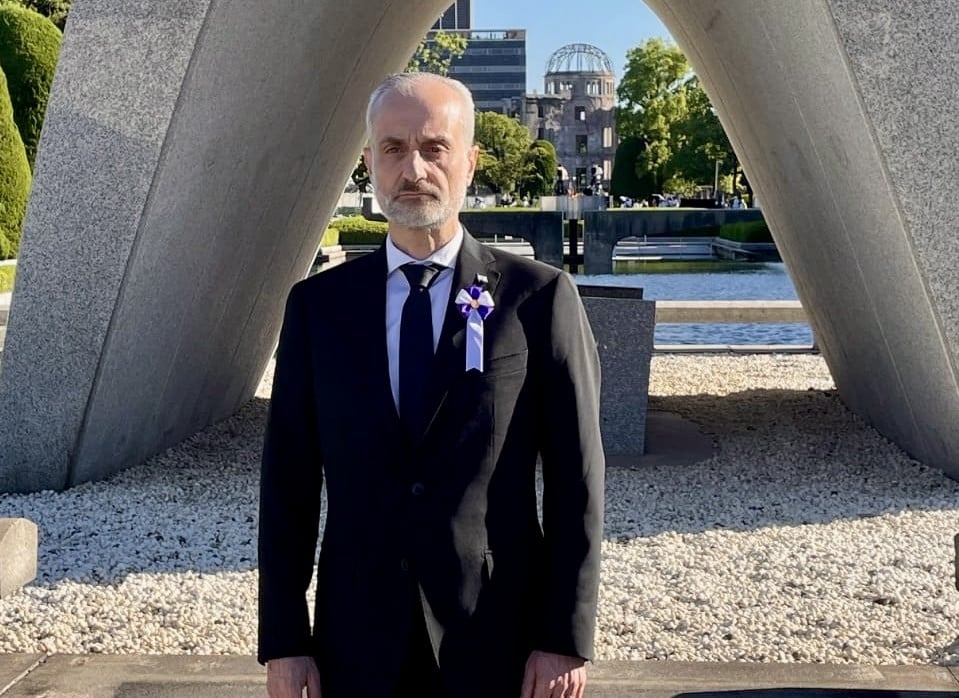
(courtesy)
My first official duty as Israel’s ambassador-designate became an encounter between memory and diplomacy
In Hiroshima’s Peace Memorial Museum, I learned that the Iranian ambassador was walking through the same rooms, only meters away.
I had landed in Japan barely a day earlier. There was no gradual transition: the next morning, I left Tokyo for my first official duty.
Almost overnight, I had gone from being a private citizen to being Israel’s representative under unusually heavy protection. The Iranian ambassador’s presence made that transformation tangible: representatives of two hostile states were walking through rooms devoted to the price of war. The tensions outside had followed me into a museum dedicated to peace.
The irony went deeper. At a press conference in Hiroshima, the Iranian ambassador had placed side by side a photograph of children killed in the atomic bombing and one of 168 Iranian schoolchildren whom he said had been killed by two American missiles in 2026. He thereby turned Hiroshima’s memory into an indictment of the American and Israeli campaign against Iran.
Every child’s death is a tragedy and must be mourned. But the comparison was cynical. The American and Israeli strikes were not atomic attacks designed to annihilate cities. They targeted the nuclear and military infrastructure of a regime that had accumulated uranium enriched to 60 percent and obstructed international inspections, and that actively pursued nuclear weapons while its leaders repeatedly called for Israel’s elimination. Those operations were meant to prevent another Hiroshima, not to cause one.
Yet what stayed with me most deeply was the city itself. The trauma of August 6, 1945 remains present in Hiroshima as a careful preservation of memory.
The museum evoked Yad Vashem for me, not because the histories are equivalent, but because personal objects, photographs, and testimonies restore immense tragedy to its human dimensions.
At the Peace Memorial Ceremony, I laid a wreath and met the mayor. Local high school students spoke of their commitment to peace. I explained that the Hebrew word shalom is both a greeting and the word for peace. For a Jew, remembrance is an obligation toward the dead and a responsibility toward the future. We must remember tragedy without allowing it the final word.
The most powerful moment came that evening, when two violins bearing memories of the Second World War were played together.
One had belonged to Sergei Palchikoff, a Russian musician who settled in Hiroshima in 1923, taught music there, and survived the atomic bombing. His violin survived as well and was eventually entrusted to Hiroshima Jogakuin University.
The other had belonged to Walter Vetter, a musician murdered at Auschwitz in 1944. Restored as part of the Violins of Hope project, it carries the memory of a Jewish life extinguished in the Holocaust.
As Japanese musicians played, the instruments resonated together without merging the distinct memories they carried. Two violins that had passed through two of the darkest chapters of the 20th century were producing beauty once more.
For me, as a Jew and as Israel’s representative, the symbolism was overwhelming. The violin carrying the memory of Auschwitz was no longer silent; the violin that survived Hiroshima was not an object behind glass. Both had been returned to life through human hands. Their music offered neither explanation nor consolation. It made a quieter but stubborn assertion: destruction need not have the last sound.
Later, my wife, Sima, and I joined the lantern-floating ceremony. On our lantern, we wrote a Hebrew prayer for the souls of the victims. As it drifted among thousands of other lights, I felt the intimacy of individual mourning within the immensity of collective remembrance. Each lantern carried its own prayer; together, they formed a river of memory.
During those days, I glimpsed what the Japanese call gaman: enduring the unbearable with patience, restraint, and dignity. In Hiroshima, it meant bearing the past without surrendering to hatred or despair.
It was a solemn way to begin my ambassadorship, but perhaps the most meaningful one. Hiroshima reminded me that diplomacy is not only about interests and negotiations. It is also an encounter between memories.
Those memories need not be merged for those who carry them to recognize one another’s humanity. Sometimes they can remain distinct and still resonate together. In Hiroshima, two violins did exactly that.
Related Topics
Related Posts