
Jewish values, leadership, and honest conversation
Tzedek Tzedek Tirdof: Two Reports, One Standard
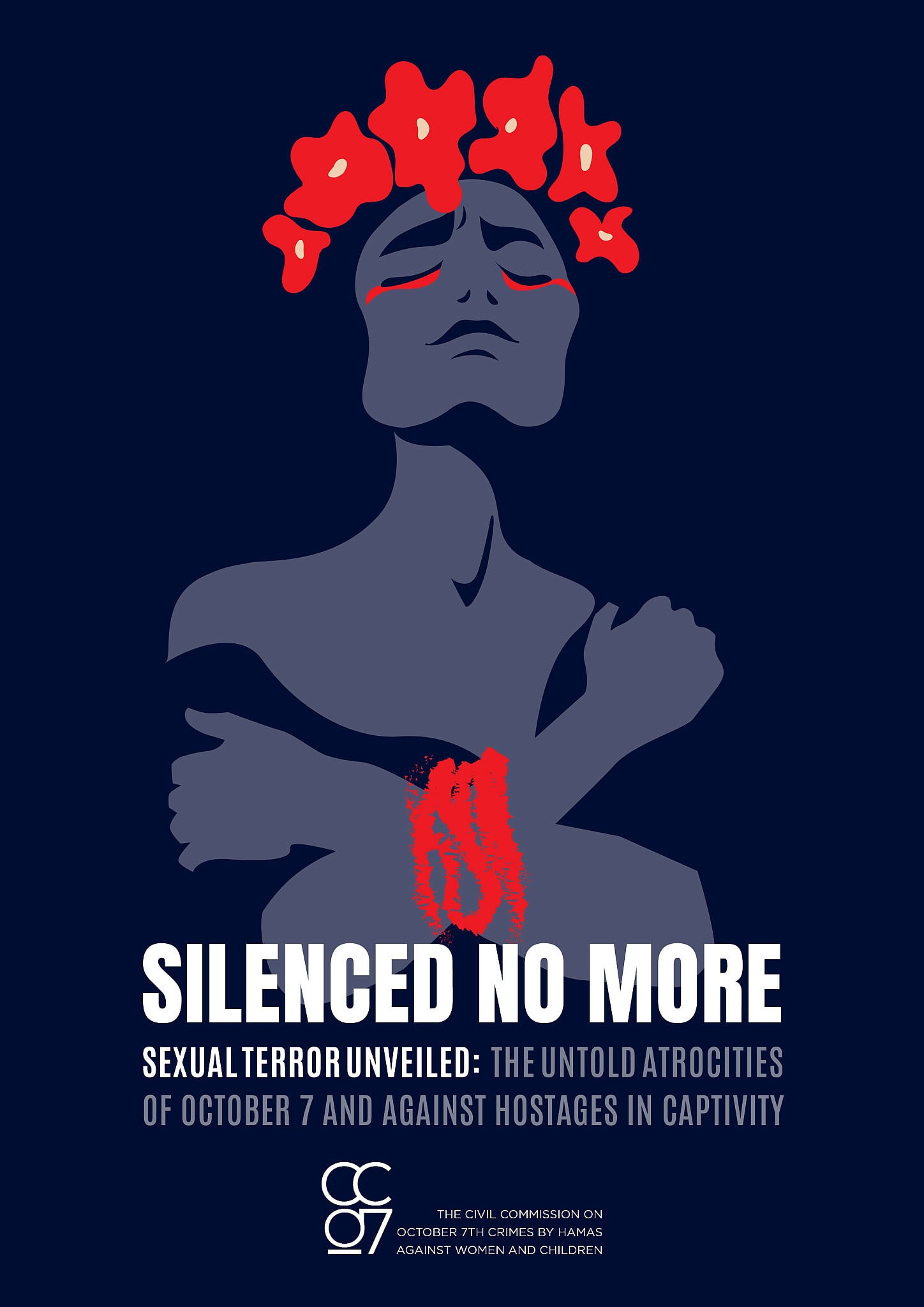
Used with permission from Dr. Cochav Elkayim Levy
Tzedek tzedek tirdof. “Justice, justice you shall pursue” (Devarim 16:20). The rabbis ask: why is tzedek doubled?
Because the pursuit of justice is not selective. Because justice for the powerful and justice for the powerless are the same justice. Because the means of pursuing justice must themselves be just. Because the doubling is the moral test — and most who claim tzedek fail it by stopping at one.
This week, two reports on sexual violence in this war appeared in the world on the same morning. They tested the doubling. And much of the public response has failed it.
The first was Silenced No More, the work of the Civil Commission on October 7th Crimes by Hamas Against Women and Children. Two years of investigation. More than 430 testimonies. Over 10,000 photographs and video segments. Thirteen documented patterns of sexual and gender-based violence across multiple sites and phases. Victims from fifty-two nationalities. A new legal framework — kinocide, the deliberate weaponization of family bonds — now entering international atrocity law. The report names the survivors who chose to be named: Romi Gonen, Amit Soussana, Ilana Gritzewsky, Rom Braslavski, Darin Komarov. It opens with Komarov’s testimony: “You hear it. It’s right next to you. You hear the screams… and then you hear silence.”
This is what serious documentation looks like. This is what Jewish moral seriousness produces when it refuses denial. Read the report. Say the names. The dead do not narrate; the survivors narrate for them; and we, who heard them, do not unhear.
The second was a New York Times opinion column by Nicholas Kristof alleging widespread Israeli sexual violence against Palestinian detainees — built on fourteen testimonies, leaning on an organization whose founder Israel identified in 2013 as one of Hamas’s “main operatives and institutions” in Europe, and including an allegation that Israeli prison guards have trained dogs to sexually penetrate prisoners. Eli Lake of The Free Press has now challenged that allegation as biologically implausible. Deborah Lipstadt — the Holocaust historian who taught the world how denial functions — asked whether the Times has “no sense of decency and journalistic responsibility.” She is not a person who asks that question casually.
I will not claim to know why these two documents appeared so near one another. I will say this: when a Jewish-led documentation of crimes against our people enters the world, and within hours a column whose most extreme allegations come from a Hamas-linked source appears beside it in the most prestigious newspaper in the English-speaking world, the effect is equivalence framing. Whether anyone intended that effect is between the editors and their consciences. The effect itself is observable, and we are entitled to name it.
And the structural shape of the dog allegation — an ancient slander about Jews and animals, sourced to a Hamas-aligned outlet, on the day Israel publishes the most rigorous documentation yet assembled of sexual atrocities against our people — is what “blood libel” exists to name.
A word about what I am doing in this piece and what I am not.
Serious voices — Matti Friedman among them — argue that the right response to a column like this is not to refute it line by line but to name the longer institutional pattern of which it is one symptom: the campaign, the narrative, the process that keeps producing such columns. They are not wrong. The pattern is real and Jewish leaders should name it.
But that is not the piece I am writing. I am a rabbi, and my work is the doubling.
And let me be precise about what the doubling is not. It is not moral relativism. It is not the claim that Hamas’s systematic, ideologically-driven, weaponized sexual terror against our people is morally comparable to whatever abuses occur in Israeli detention. It is not a “both sides” frame. It is a refusal of two failure modes at once: the failure to name what was done to us, and the failure to name what is done in our name when it is wrong. The categories are not the same. The obligation to confront each, in its own register, is.
Tzedek tzedek tirdof.
And yet.
There are real concerns about abuses in Israeli detention. They were not invented by Kristof. The Public Committee Against Torture in Israel — an Israeli organization, staffed by Israelis, accountable to Israeli courts — has filed hundreds of complaints. Breaking the Silence has collected testimony from former Israeli officers. Former Prime Minister Ehud Olmert, asked whether such things happen, said: “Definitely.” And Sde Teiman is not in dispute: a Gazan prisoner hospitalized in 2024 with a tear in his rectum, cracked ribs, a punctured lung; nine reservists detained; a politically pressured collapse of the prosecution; soldiers returned to duty. That is a wound in Israeli democracy independent of anything Kristof writes.
The first tzedek: name what Silenced No More documents. Teach the kinocide framework as the Jewish contribution to international law that it is. Refuse the equivalence framing that would dissolve this singular horror into a haze.
The second tzedek: insist that any credible allegation of abuse by Israeli forces be investigated by Israel — not because Kristof’s column met the standard, but because the institutional record produced by Israelis who love Israel enough to hold it to its own law does. Because Sde Teiman happened and the process broke. Because a democracy that cannot investigate itself loses the moral standing to defend itself.
These two pursuits of justice are not symmetric. The first is the documented record of crimes against our people, established by a methodology designed to withstand the most hostile scrutiny. The second is the ordinary, unglamorous work a democracy does on itself.
One is the deliberate weaponization of sexual violence by an ideological terror movement as an instrument of attack against a civilian population. The other is the documented possibility that some Israeli forces have abused some Palestinian detainees in ways that Israeli law forbids, and Israeli institutions are supposed to prosecute. The wrong of the second is real. The wrong of the first is categorical.
To collapse them into each other is a moral failure. To use the first as a reason to refuse the second is also a moral failure.
The Civil Commission has done its work. Now we do ours.
Tzedek tzedek tirdof.
Both.
Always both.
Related Topics
Related Posts