The views expressed herein are solely mine.
U.S. Bases in Israel Will Deter the Next October 7
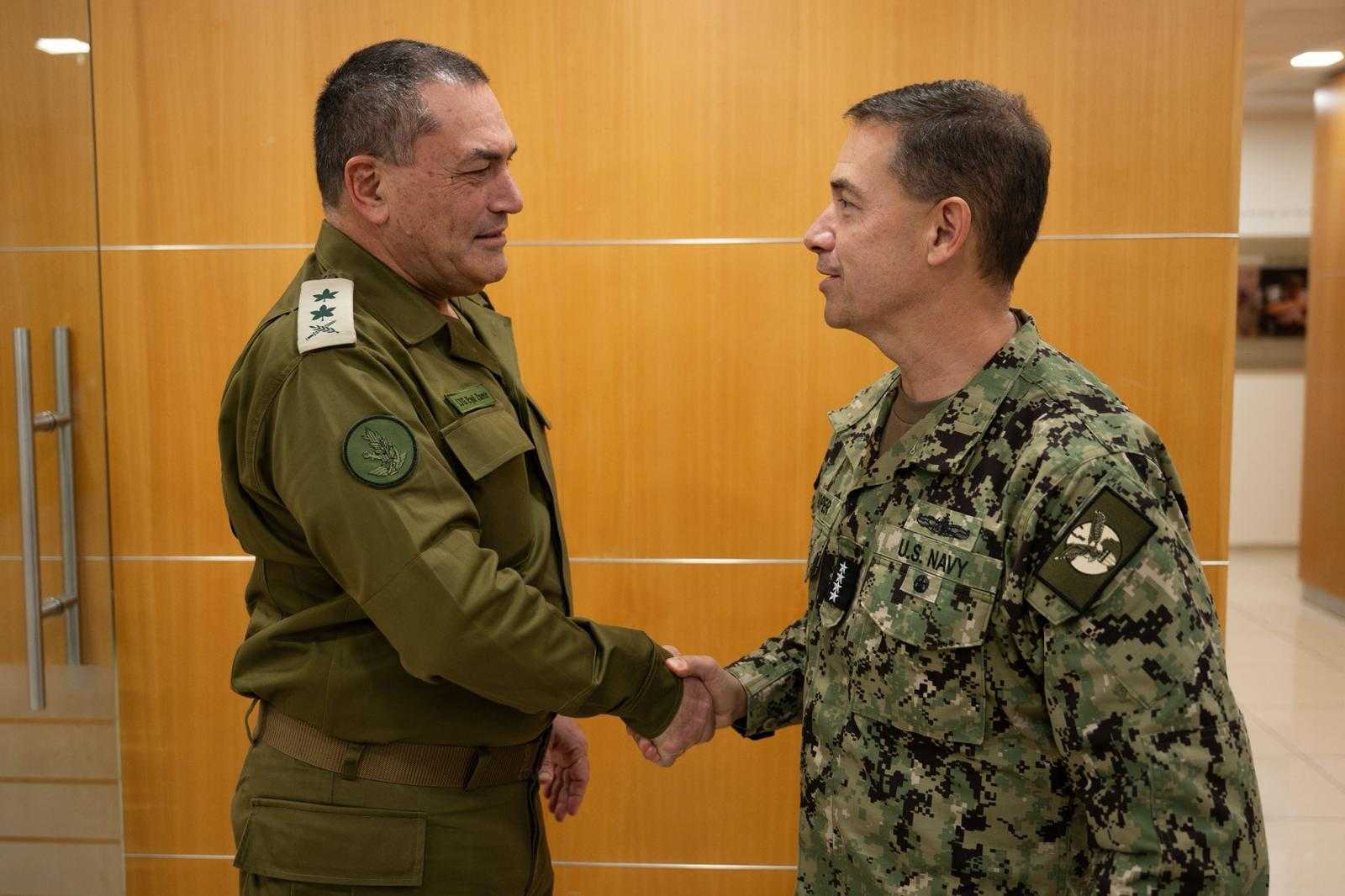
IDF Chief of Staff Lt. Gen. Eyal Zamir (left) meets with US CENTCOM chief Adm. Brad Cooper at the Israeli military's headquarters in Tel Aviv, January 24, 2026. (Israel Defense Forces).
The State of Israel has proposed that the United States plant permanent military bases on its territory. Jerusalem wants Washington to relocate existing installations from elsewhere in the Middle East and construct new facilities amid the war with Iran. Establishing those bases, especially in southern Israel along the Gaza border, could potentially deliver the ironclad deterrence that has already raised the cost of mass attacks and forces Iran’s scattered terrorist allies to think twice before launching anything larger.
The numbers from October 7, 2023, still shock. Hamas gunmen killed 1,200 people—828 civilians and 367 security forces—and seized 251 hostages. They exploited weak forward presence and slow response times. A United States base hugging the Gaza trench changes the equation.
American troops, sensors, and rapid-reaction forces sit directly in the path of any mass breach or rocket swarm. History proves the point: since October 2023, Iranian-backed groups have hit U.S. positions in Iraq, Syria, and Jordan more than 180 times, wounding more than 180 personnel and killing three. They have carefully avoided the kind of direct strike that triggers full U.S. retaliation. Thus, placing American forces on the front line raises the cost of every Hamas (and its Gaza servants) attack from manageable to existential.
The timing is no coincidence. American bases deeper in the Gulf have already proven vulnerable. Qatar’s Al Udeid Air Base, home to roughly 10,000 troops, has absorbed missile and drone strikes from Iran and its partners. American troops have literally been forced to sleep in hotels for safety. Israel offers something those locations cannot: a stable, high-tech ally whose own layered defenses, proven in combat, shield United States assets while sharing real-time intelligence. Relocating here is not retreat; it is consolidation. It puts the United States power where it actually deters rather than absorbs pinprick harassment.
The ripple effects reach every Iranian proxy. Hezbollah once fielded an estimated 150,000 rockets and missiles. Even after Israeli strikes cut that arsenal to between 11,000 and 25,000, the group retains thousands of short- and medium-range weapons capable of saturating Israeli skies. The Houthis in Yemen and Shiite militias in Iraq have launched hundreds of attacks on shipping and Israeli targets. A visible United States garrison in Israel guarantees that the next barrage draws direct United States blood on Israeli soil. Proxy leaders already calibrate their violence to avoid that threshold; permanent bases lock in the restraint.
Geostrategically, the proposal cements a deeper truth. For decades Iran has bled the United States through distant, deniable proxies while keeping its own territory safe. Bases inside Israel flip the script. They anchor the United States commitment in the region’s most reliable partner, shorten supply lines, and integrate with Israeli early-warning systems that have repeatedly intercepted Iranian salvos. They also enable tighter enforcement of any Gaza ceasefire, choking off the tunnels and sea routes that have fed Hamas rearmament for years.
Critics call it entanglement. The facts say otherwise. October 7 proved that distance breeds weakness. Iran’s war exposed scattered Gulf bases as sitting ducks. Southern Israel offers proximity, partnership, and punch.
The United States already has a military footprint in Israel, and CENTCOM personnel were deployed to help monitor the Gaza ceasefire. U.S. aircraft have also operated through Ben-Gurion Airport during the current conflict. But this proposal would formalize that presence, make it permanent, and lock the U.S.-Israel alliance into an unmistakably official strategic framework.
If Washington accepts the offer, it will redraw the map of deterrence. Hamas will lose its next massacre before it begins. Iran’s proxies will face the one force they have learned to fear: U.S. soldiers standing shoulder to shoulder with Israelis on the front line. That is not symbolism. That is a strategy that works.
Related Topics
- 2025 Hostage Deal
- Donald Trump
- Gaza
- Gaza Border
- Gaza Strip
- Hezbollah
- Hostages in Gaza
- Iran
- Islam
- Israel At War
- Israel-US Relations
- Lebanon
- Middle East
- October 7 anniversary
- Palestinian Authority
- Palestinian Statehood
- Palestinians
- Qatar
- Terrorism
- The Arab World
- Trump Peace Plan
- UAE - United Arab Emirates
- US Politics
- Yemen
Related Posts