Former Jewish Prison Chaplain / Co-Founder: L’chaim
U.S. Firing Squad Execution Violates the Spirit of Hanukkah
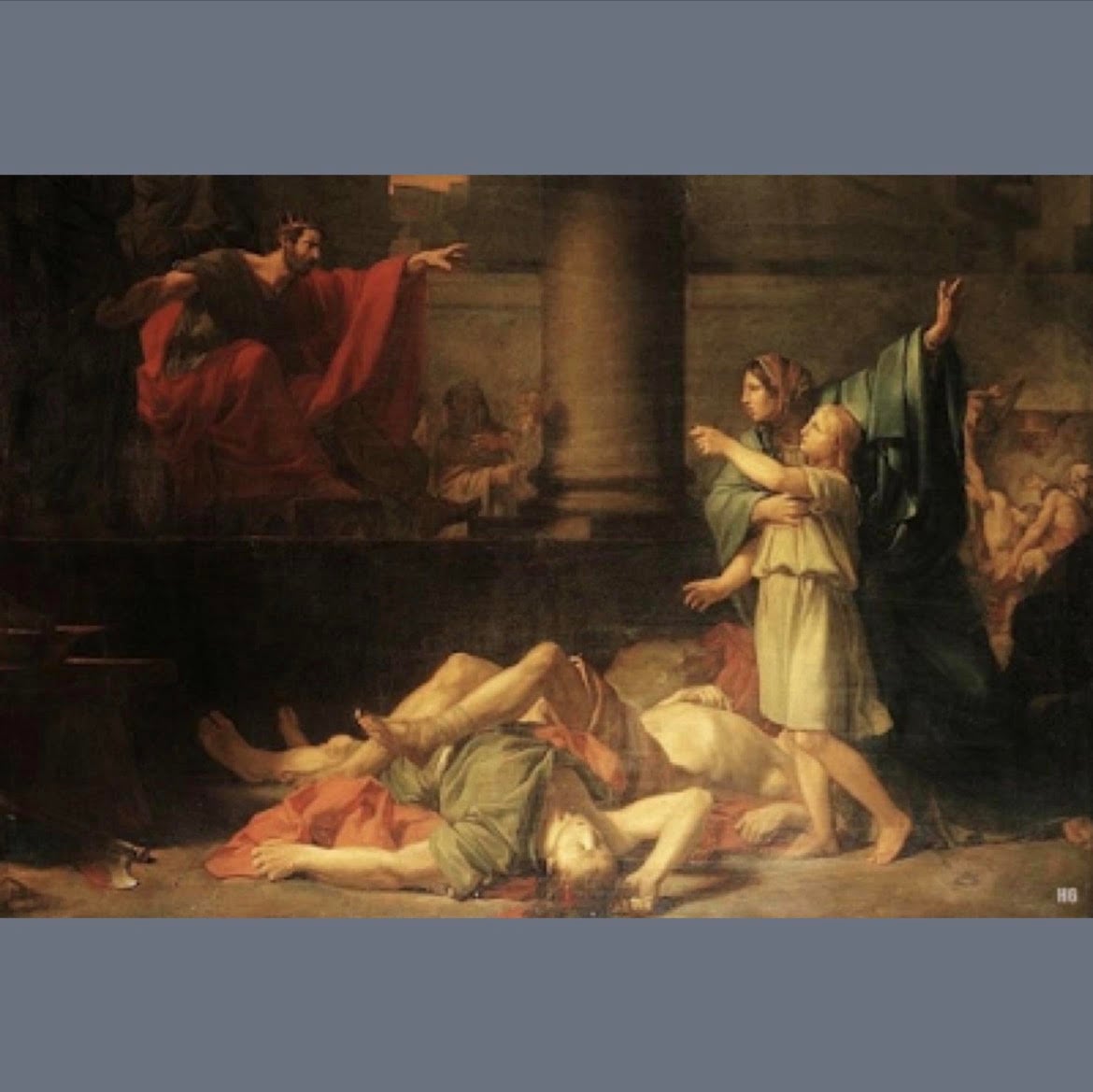
Image: The painting “The Martyrdom of the Seven Maccabees” (Le Martyre des sept frères) by Jean-Baptiste de Vignaly (1781). Based on II Maccabees 7, as retold on Hanukkah, it depicts a Jewish mother named Hannah and her seven sons facing King Antiochus IV Epiphanes. The sons are executed one by one after refusing to violate Jewish law.
The thousands of members of “L’chaim! Jews Against the Death Penalty” from across the USA, Israel, and the world unambiguously condemn the U.S. military firing squad execution slated to take place the day before the kindling of Hanukkah’s first lights this year. Nidal Hasan is the former Army psychiatrist who opened fire at a medical processing center on the Fort Hood, Texas army base on 5 November 2009, killing 13 people and wounding dozens more. A military jury sentenced him to death in 2013, and he has been held at Fort Leavenworth in Kansas ever since. He exhausted his appeals last year, allowing U.S. President Donald J. Trump to approve his execution warrant earlier this fall. That decision came on a recommendation from Secretary of War Pete Hegseth, who declared that Hasan’s killing would be a public, live-streamed event. Mercifully, the federal government has since rescinded the live-stream order and walked back its politically motivated thirst for public bloodlust. Hasan’s legal team recently filed a habeas corpus petition on his behalf in the hope of delaying and ultimately staying his upcoming date with death. For the moment, however, the execution is still set to take place at 1 pm on Thursday, 3 December, just one day before the start of Hanukkah, the Jewish Festival of Lights.
When L’chaim members highlighted this horrific synchronicity, critics pointed out that the Hanukkah story is indeed chock-full of celebrated killings. While that is true, it is crucial to distinguish between killings in the context of war and self-defense and judicial executions, which Jewish tradition indeed goes out of its way to demonize in retellings of the Hanukkah narrative. Carrying out this abject abomination on the eve of the joyous holiday of Hanukkah across the Jewish world is a slap in the face of life-affirming Jews everywhere. Indeed, judicial executions of Jews are inseparable from the Hanukkah story.
Judicial Executions vs. Wartime Killings in the Hanukkah Story
There can be no doubt that Hanukkah was born of violence and war in Israel millennia ago. The Hanukkah story—drawn from the books of Maccabees and related Jewish texts—centers on a violent revolt and religious persecution, involving several notable killings. When a Syrian-Greek officer ordered sacrifices to Greek gods in the town of Modi’in, a Hellenistic Jew stepped forward to comply. The priest Mattathias (Mattityahu) promptly killed both him and the royal officer, and led his sons and followers in killing the remaining soldiers before destroying the altar. Battle casualties abounded during the ensuing Maccabean revolt. Judah Maccabee and his rebels fought and killed enemy commanders and soldiers in battle—including figures such as the commanders Apollonius and Seron, along with large numbers of Seleucid troops—as they campaigned against Antiochus’s forces and reclaimed Jerusalem. Another notable story involving a Hanukkah killing is that of Judith (Yehudit), a brave Jewish widow who saved her besieged town by infiltrating the enemy camp and seducing and beheading its commander, Holofernes. Although the apocryphal Book of Judith records her triumph rather than the core Hanukkah text, medieval Jewish tradition linked her victory to Hanukkah’s theme of the few overcoming the many.
When reviewing the above accounts of Hanukkah killings, it is essential to remember that they all occurred in the context of self-defense and war. None of them were judicial executions. Jewish tradition reserves that abomination only for Greek persecutors of Jews refusing to comply with the violation of their religious rights. From a very young age, Jewish children (including this writer decades ago) learn in religious schools how the Syrian-Greeks under Seleucid King Antiochus IV Epiphanes made the practice of Judaism —including observing Shabbat (the Sabbath), studying Torah, or circumcising boys— punishable by death, leading to executions of Jews who refused to comply. One particularly renowned tale is the harrowing saga of a Jewish mother named Hannah and her seven sons. In accounts associated with the Maccabean literature (and later retold in rabbinic traditions), one Greek ruler ordered Hannah and her seven sons to violate Jewish law by eating forbidden food or worshiping idols. They refused, leading the authorities to torture and kill all seven of Hannah’s sons. Hannah herself passed not long afterward, with versions stating she either died of grief or took her own life.
It is highly unlikely that Pete Hegseth and Donald Trump knew of the legacy of these Hanukkah executions when scheduling Nidal Hasan’s firing squad just ahead of the Festival of Lights. Their ignorance, however, highlights the fact that humanity continues not to have learned a vital lesson that history continues to teach and preach: namely, that no government should have the right to kill individuals who are in violation of the law and who no longer pose a threat.
Another crucial point to consider when measuring the litany of violence in the Hanukkah narrative is this: just as Judaism has evolved over the centuries, so too has Hanukkah. In the modern era, it has become the Festival of Lights, focusing on the story of a tiny amount of oil that miraculously lasted long enough to keep the Temple’s lamp lit for eight days and nights. L’chaim members celebrate Judaism’s evolution into the spiritual/cultural tradition that it is today: a 21st-century Judaism that marches for life and peace and absolutely rejects the death penalty without exception in all forms. The knowledge that the United States government will be extinguishing that proverbial light by mimicking the Angel of Death just before the kindling of the first candle of the Hanukkiah is incomprehensible and nauseating. One can only imagine what might have been the reaction of death-penalty abolitionist Elie Wiesel, Z’L (1928-2016), who likened state killings to the very same Malakh HaMavet (Angel of Death) when he stated:
“With every cell of my being and with every fiber of my memory I oppose the death penalty in all forms. I do not believe any civilized society should be at the service of death. I don’t think it’s human to become an agent of the angel of death.”
Other Reasons for Jews to Oppose a Firing Squad
Beyond the awful Hanukkah timing, there are countless other reasons why Jews must stand against the upcoming firing squad danse macabre. When Hegseth announced his subsequently aborted plans for a live stream of the forthcoming firing squad execution, he stated of Hasan: “It was a radical Islamist attack in uniform inside the ranks, and so he’s going to get a firing squad of soldiers, as it should be, and we’ll make sure that people can watch it, that it’s public, because people need to understand there are serious consequences for these types of things.” Hegseth’s implied reference here to the deterrence delusion that abounds in popular culture regarding the death penalty is one of many reasons why this development marks an insane and dangerous moment for America.
L’chaim has publicly stated on multiple occasions how the use of a firing squad itself, like lethal injection and gassing to death, is a Nazi legacy and ghastly trigger in the collective Jewish consciousness in the wake of the Holocaust. While the use of firing squads indeed predates the Holocaust, the US Holocaust Memorial Museum illustrates in detail how Nazi Germany’s Einsatzgruppen – mobile killing units operating under the command of the Schutzstaffel (SS) – shot and summarily executed more than a million Jews and tens of thousands of other people during the Second World War in German-occupied Europe. At the notorious Babi Yar massacre alone, about 34,000 Jews were murdered in two days of such firing squad killings near Kiev. Any post-Holocaust use of a firing squad for state-sponsored murder is forever tainted by the cold blood with which these ancestors were targeted. It is unconscionable for the thousands of Jews who say “Never Again!” to the state-sponsored murder of prisoners. For Israelis, the firing squad serves as a stark reminder of that nation’s wrongful 1948 firing squad execution of Israel Defense Forces (IDF) officer Meir Tobianski, who was posthumously exonerated. His state murder continues to haunt that sacred land.
The decision to shoot Hasan to death only further connects the United States to other regimes, such as the Third Reich and Iran, that have glorified death and wielded executions as a political tool. It is a barbaric spectacle that seems more befitting of the ancient Roman Colosseum where countless Jewish sages were publicly executed, or open-air stadiums in Iran and other countries where state murder is celebrated and wielded as a political tool.
Affirming Life with the Hanukkah Lights
On this Hanukkah, rather than glorifying another high-profile execution, L’chaim members ask Jews everywhere to recall the words of Elie Wiesel, whose views encapsulated the stance of L’chaim. When questioned about his feelings on capital punishment toward the end of his life, Wiesel resolutely stated, “Death should never be the answer in a civilized society.” Twenty-first-century Judaism must hold by the red line that Wiesel set forth. It cannot lower itself to the status of Hamas, Iran, Saudi Arabia, Yemen, and others by violating its moral obligations and ethical standards and engaging in state-sponsored killings of defenseless prisoners. With Wiesel’s neshama – spirit – in mind and heart, Jews everywhere must align with civilized humanity this Hanukkah and recommit to abolishing the death penalty once and for all from the USA, Israel and across the world.
Three Hanukkahs ago, L’chaim released its interview with Sister Helen Prejean, famed death penalty abolitionist and author of Dead Man Walking. Sister Helen thanked L’chaim at that time for keeping the torch of Elie Wiesel lit with the light of abolition. Members of the Jewish world should find it in their hearts to do the same this season while lighting the Hanukkah candles, which should serve as a reminder of Judaism’s emphasis that the power of creating – and extinguishing – the light of life ultimately rests with HaShechinah – the Divine Presence.
May the abiding neshamot/spirits of all the murder victims of Nidal Hasam, and in all cases, be loving guides for us all.
May their loved ones be comforted among all the mourners of the world.
May no more blood be shed in their sacred names.
May the cycles of violence and killings end.
Cantor Michael J. Zoosman, MSM, BCC
Former Jewish Prison Chaplain
Co-Founder: L’chaim! Jews Against the Death Penalty
Advisory Committee Member: Death Penalty Action
Related Topics
Related Posts