
President of Shahvand Think Tank
Why the IRGC Needs Israel
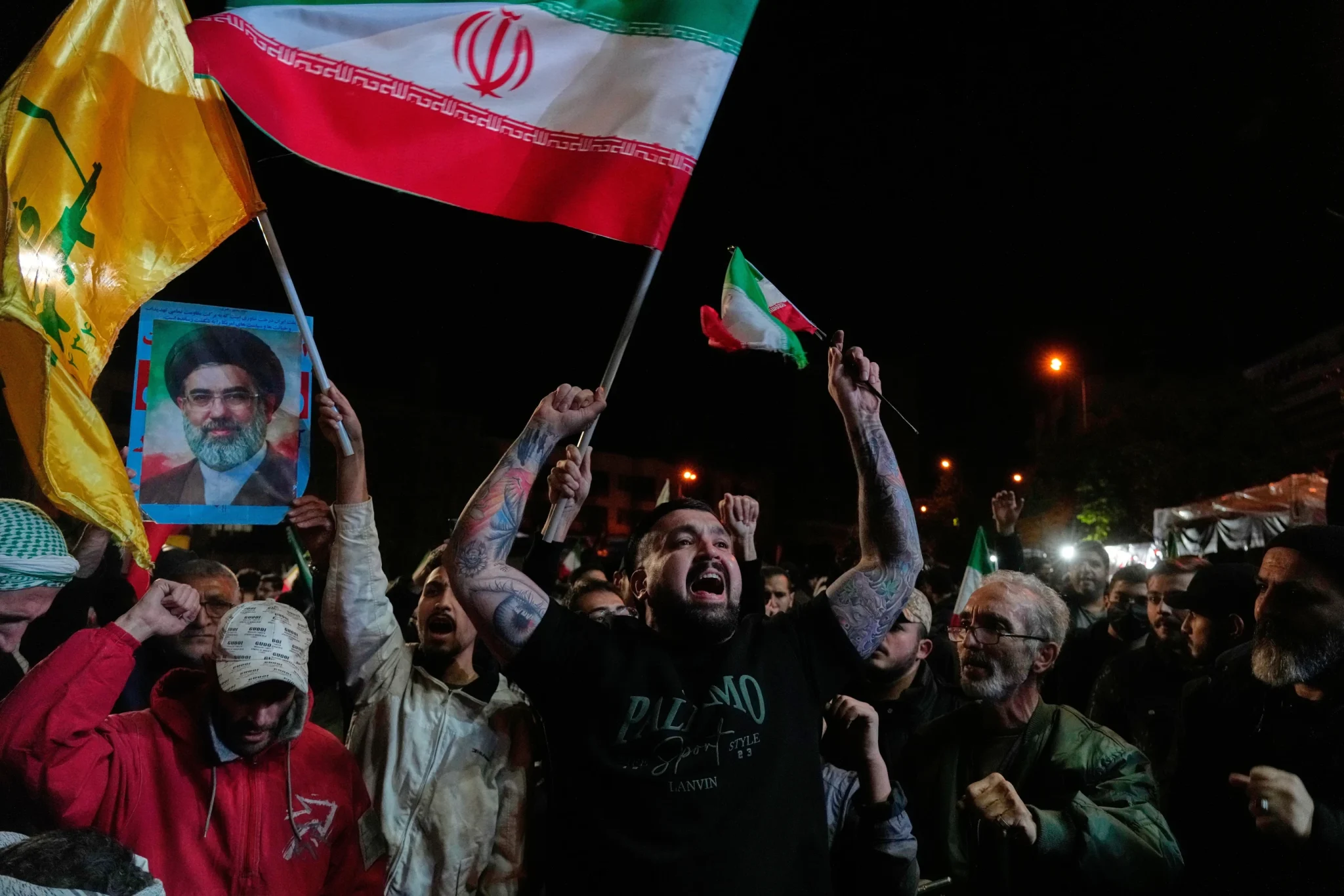
Pro-government demonstrators chant slogans as they hold Iranian flags and a poster of the Supreme Leader Ayatollah Mojtaba Khamenei in a gathering after announcement of a two-week ceasefire in the war with the United States and Israel, at the Enqelab-e-Eslami, or Islamic Revolution, Square, in Tehran, Iran, Wednesday, April 8, 2026. (AP Photo/Vahid Salemi)
The Islamic Republic Needs External Conflict to Preserve Internal Power
Many analyses of Iran’s confrontation with Israel focus on ideology, military strategy, or regional influence. While these factors matter, they often overlook a deeper structural reality: the Islamic Republic’s survival has historically depended on external crises that reinforce internal cohesion.
The Iranian regime is not a conventional state. It functions through what can be described as an “onion structure” of power—a system of multiple protective layers built around the preservation of the ruling core. At the center stand the Supreme Leader and the security establishment, particularly the Islamic Revolutionary Guard Corps (IRGC). Surrounding this core are political institutions, economic networks, ideological organizations, and proxy forces that collectively protect the regime from both domestic and external threats.
This structure is designed not merely to govern but to survive.
One of the most important lessons learned by the Islamic Republic came during the Iran-Iraq War. In the years following the 1979 revolution, the new regime faced severe internal challenges, including political fragmentation, economic instability, and widespread opposition. The Iraqi invasion in 1980 transformed the political environment. The war enabled the regime to redirect public attention from internal disputes to national defense. Under wartime conditions, dissent could be portrayed as disloyalty, opposition groups could be suppressed more easily, and revolutionary institutions such as the IRGC gained legitimacy, resources, and influence.
The war became not only a military struggle but also a mechanism of political consolidation.
Today, the strategic environment is different, but the underlying logic remains remarkably similar.
The Islamic Republic faces mounting domestic pressures: economic decline, corruption, demographic change, declining ideological legitimacy, and recurring waves of public protest. Large segments of Iranian society increasingly question the political system itself rather than merely its policies. For the regime’s security apparatus, particularly the IRGC, these trends represent long-term threats to its authority.
In such circumstances, external confrontation can serve an important political function.
Tensions with Israel, as well as the cultivation of proxy organizations such as Hezbollah, help sustain a narrative of permanent external danger. This narrative reinforces the regime’s claim that national security must take precedence over political reform. It also strengthens the position of security institutions that portray themselves as the nation’s defenders against foreign enemies.
This does not mean that every confrontation is deliberately manufactured. Israel and Iran possess genuine strategic disagreements, and both sides respond to real security concerns. However, it would be a mistake to view Iranian escalation solely through the lens of foreign policy.
For the IRGC, regional conflict can also generate domestic political benefits. External crises create opportunities to rally nationalist sentiment, justify increased security measures, marginalize critics, and shift public attention away from economic hardship and governance failures. In this sense, conflict becomes not merely a response to external events but a tool of regime maintenance.
This perspective also helps explain why sanctions alone have often failed to produce political transformation. Economic pressure undoubtedly weakens the state’s resources, but it does not necessarily penetrate the inner layers of the regime’s survival structure. On the contrary, prolonged confrontation can strengthen the narrative that Iran is under siege, allowing the security establishment to justify tighter control.
Understanding the Islamic Republic therefore requires looking beyond ideology and military capabilities. Its actions are shaped by a system whose primary objective is self-preservation. External conflict, whether through direct confrontation or proxy warfare, can become part of that survival mechanism.
The challenge for policymakers is to recognize that the regime’s greatest vulnerability may not lie on the battlefield but within the internal crises that external conflicts are often designed to overshadow. Only by understanding this layered architecture of power can observers accurately assess the motivations behind Tehran’s regional behavior and its continuing confrontation with Israel.
Beyond strategy, the IRGC’s hostility toward Israel also carries an ideological function. Anti-Israel rhetoric is embedded in the regime’s revolutionary identity and serves as a unifying narrative that links domestic opposition to foreign enemies. This framing helps legitimize internal repression by portraying dissent as aligned with hostile external forces, reinforcing the system’s cohesion under conditions of internal stress.
Related Topics
Related Posts