
NAnews - Nikk.Agency Israel News
Ukraine’s Fiber-Optic Drone War Is Already Reaching Israel
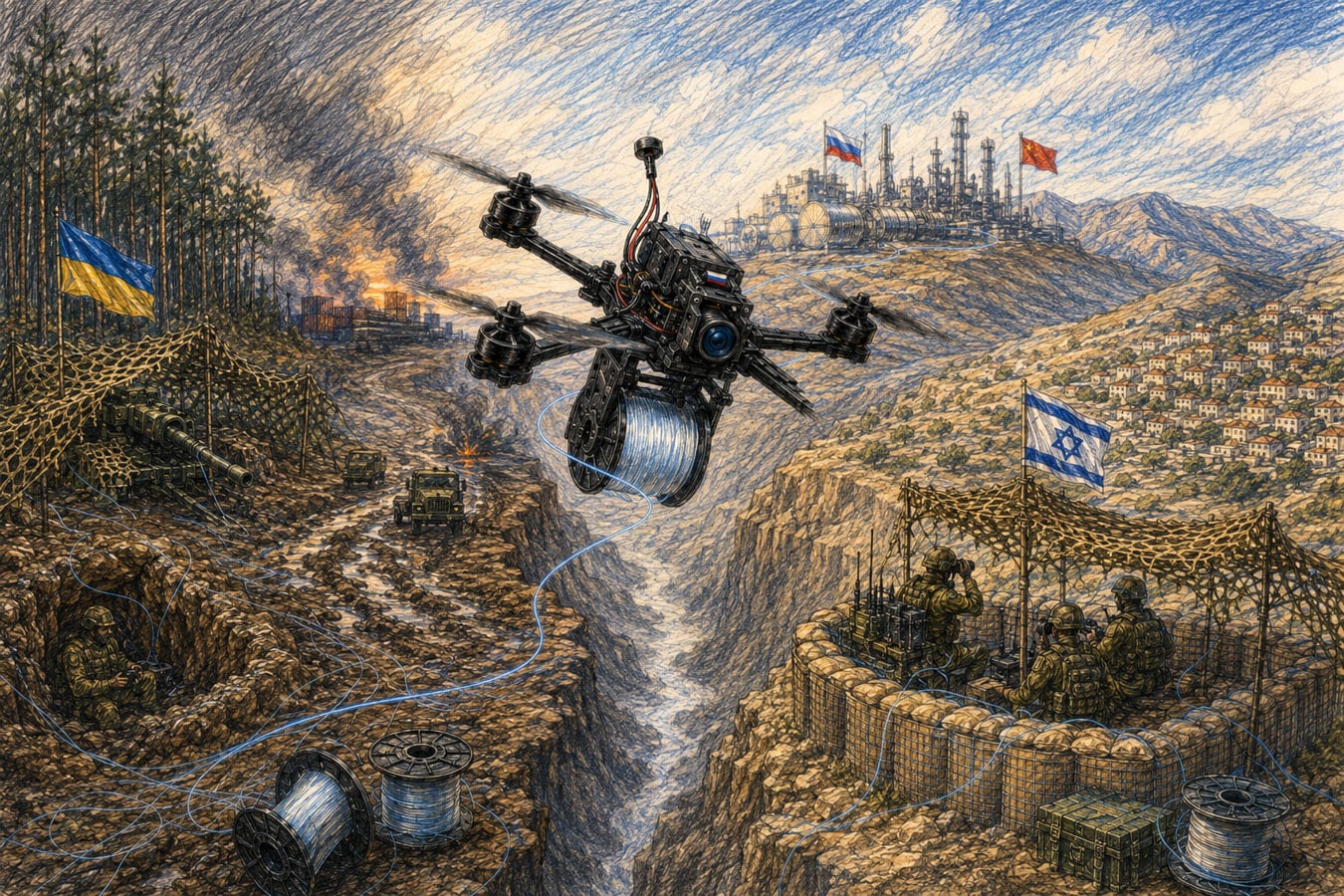
Drones that are not jammed by electronic warfare: how Chinese fiber optics strengthen Russia and how this threatens Israel. Illustration created with AI.
A Ukrainian investigation shows how Russia scaled FPV drones that cannot be stopped by ordinary electronic warfare. China supplies the industrial ecosystem behind them — while Hezbollah is already applying the same battlefield logic against Israel.
A battlefield covered in almost invisible strands of glass may sound like science fiction. In Ukraine, it is already a military reality.
Fiber-optic FPV drones are physically connected to their operators by a thin cable that unwinds during flight. Because the commands and video signal travel through this cable rather than over radio frequencies, conventional electronic warfare cannot simply jam the connection.
Russia has rapidly expanded its use of these drones against Ukraine. At the same time, Hezbollah has begun employing fiber-optic-guided FPV drones against Israeli forces.
The two countries are fighting on different fronts and against different enemies. But the technological threat is increasingly similar.
A 23-page report reviewed by NAnews and prepared by the Center for Defense Reforms, a Ukrainian non-governmental security and defense research organization, examines the industrial foundations of Russia’s fiber-optic drone program: production capacity, imported raw materials, Chinese suppliers, specialized reels and Russia’s efforts to build a complete domestic manufacturing cycle.
The organization is chaired by Ukrainian security expert Oleksandr Danylyuk. The Center for Defense Reforms works on national security, defense-sector reform, Russian hybrid threats and the development of practical responses to modern military challenges.
The report’s most important conclusion is that Russia has achieved considerable battlefield scale, but its production system remains heavily dependent on imported technology and, above all, China.
The drone that electronic warfare cannot jam
A conventional FPV drone receives commands and transmits video through a radio link. Once that connection is disrupted, the operator may lose both control and the live image needed to guide the drone into its target.
The report cites rough estimates suggesting that between 70% and 90% of conventional FPV drones may fail to reach their targets because the radio connection is lost or jammed. The saturation of the Ukrainian battlefield with electronic warfare systems therefore created a powerful incentive to develop a different control method.
A fiber-optic drone solves that problem through a physical connection.
The cable provides stable communication and a high-quality video feed even in an environment filled with radio interference. The technology does not necessarily require an entirely new drone: existing FPV platforms can be modified to carry the additional reel and transmission equipment if they have sufficient payload capacity.
The first known open-source report of a Russian fiber-optic FPV drone appeared in March 2024. After the battles in Russia’s Kursk region in late 2024, their use began to expand much more rapidly.
By July 2025, such systems may have represented approximately 15% to 20% of Russian FPV platforms. According to Russian claims cited in the study, their share may have reached as much as 60% in certain frontline sectors by early 2026. The report stresses that this figure cannot be generalized to the entire front.
Most fiber-optic drones are believed to operate at ranges of up to 20 kilometers. Yet in November 2025, Ukrainian officials confirmed that Russia had begun deploying models with cables extending up to 50 kilometers.
In February 2026, one reportedly reached the northern outskirts of Kharkiv, approximately 23.4 kilometers from the Russian border.
That development expands the danger beyond frontline trenches. Supply roads, artillery positions, warehouses, command posts and civilian infrastructure deeper behind the line can all become targets.
Fifty thousand drones a month — according to the manufacturer
The best-known Russian fiber-optic drone is the “Prince Vandal of Novgorod,” commonly abbreviated as KVN.
According to claims made by its manufacturer and cited in the report, production increased to approximately 50,000 units per month in 2025. This figure has not been independently verified and should be treated as a Russian claim, but it offers a basis for estimating the scale of demand.
If each KVN carries a ten-kilometer reel, that model alone would consume approximately six million kilometers of optical fiber annually. If twenty-kilometer reels are used, annual consumption could approach 12 million kilometers.
And KVN is only one platform.
Russian sources also mention the VT-40, Gortenzia, Ovod-Pro, Veles, Piranha and Skvorets series, although the report notes that the battlefield use of some models has not been independently confirmed.
One customs case provides a more concrete indication of the material involved. Rustakt LLC, identified in the report as the manufacturer of the VT-40, imported fiber-optic cable worth approximately $660,000 in February and March 2025.
Based on the average weight of the identified shipments, the researchers estimated that the three consignments may have contained about 300,000 kilometers of fiber.
They explicitly caution that this cannot be treated as a precise figure without invoices and technical specifications. Nevertheless, the transaction demonstrates how much disposable cable may be required by even a single drone producer.
How many millions of kilometers does Russia consume?
The report offers an upper analytical estimate of approximately 50 million kilometers of optical fiber used for Russian FPV drones in 2025.
This is not an official statistic. It is a model based on serial production, experimental and semi-artisanal assembly, longer reels, training, testing and stockpiling. The authors repeatedly describe it as an approximate benchmark rather than a verified consumption figure.
They also discuss a much lower Russian estimate.
In March 2026, Russian cable-market participants claimed that total annual fiber consumption in Russia amounted to about 15 million kilometers, with approximately two million used by cable manufacturers and up to 13 million used for drones.
The report’s authors do not accept those figures as a reliable basis for calculation because they conflict with earlier official estimates of civilian telecommunications demand. Yet even the lower estimate demonstrates that drones have become a major independent consumer of optical fiber.
The higher estimate produces a striking global comparison.
Russia may have purchased or consumed nearly 60 million kilometers of fiber in 2025 — approximately 10.5% of global output. Before the explosive growth of fiber-optic FPV systems, its share reportedly did not exceed 1%.
Under the report’s upper model, drones could have accounted for more than 80% of Russia’s total demand for the material.
The reason is simple.
In telecommunications, optical fiber is installed as infrastructure expected to function for years. On a drone, ten, twenty or fifty kilometers of fiber become a disposable consumable during a single flight.
Russia has one critical industrial hub
Russia has several companies and research institutions with expertise in photonics and specialized optical fibers. Most, however, produce niche materials for lasers, sensors, gyroscopes, medical equipment or scientific systems.
They cannot supply the mass market with cheap, lightweight, single-mode fiber for long disposable FPV reels.
The Center for Defense Reforms identifies Optic Fiber Systems JSC in Saransk, Mordovia, as Russia’s principal — and effectively its only major — industrial producer of telecommunications-grade optical fiber.
The company was founded in 2008 and began actual production in 2015. Its factory was built with foreign assistance: Finland’s Nextrom Oy supplied a technology license and constructed the plant, while German Sikora equipment was used on the production line.
In 2019, the facility underwent a modernization program worth 950 million rubles. Of that amount, 500 million came from Russia’s state-backed Industrial Development Fund.
By 2023, the plant operated six lines with a combined stated capacity of approximately 4.3 million kilometers per year.
Even before the plant was damaged, this capacity was far below the tens of millions of kilometers potentially required by Russia’s expanding drone industry.
The Saransk production site was struck in the spring of 2025. Russian sources subsequently reported that production had stopped and could not be restored quickly.
The wider industrial consequences revealed the plant’s strategic importance. Russia postponed until 2028 a requirement that domestic cable products use Russian-made fiber. Critical equipment damage and the rapid depletion of inventories were cited among the reasons.
A strike on one facility therefore affected not only military drone production, but also Russia’s civilian cable and telecommunications sectors.
The real bottleneck is not the factory building
Russia’s deepest vulnerability is the absence of a mature domestic production cycle for high-quality quartz preforms.
A preform is the highly purified quartz blank from which optical fiber is drawn. Russia possesses scientific expertise in specialized optical materials, but the report found no evidence that it has mastered large-scale industrial production of telecommunications-grade preforms with consistent quality.
Russian efforts to solve the problem date back at least to 2018.
In 2023, the Ministry of Industry and Trade announced the “Quartzite” research and development tender, allocating approximately one billion rubles to create domestic preform technology. No company submitted a bid, and no contractor was selected.
Russia has nevertheless moved ahead with an infrastructure project for a Saransk Optical Preform Plant.
The company was registered in December 2024. Its authorized capital initially stood at 500,000 rubles, but in September 2025 it was increased to 4.377 billion rubles — evidence that the project had progressed beyond general declarations.
Its founders include the Development Corporation of the Republic of Mordovia and the regional Ministry of Land and Property Relations.
In March 2026, the company launched a construction tender at 13 Lodygina Street in Saransk, the same address as the existing Optic Fiber Systems facility.
Moscow-based PSK Vysota was selected as the contractor, while the total project cost was estimated at approximately 12 billion rubles.
Russia may be able to construct buildings and install equipment. That does not mean it can immediately produce high-purity preforms of stable, mass-market quality.
The report concludes that creating the physical infrastructure is likely to be easier and faster than achieving a functioning technological cycle.
China replaced Japan — and became much more than a supplier
Before Russia’s full-scale invasion of Ukraine, the Saransk plant’s main raw-material supplier was Japan’s Sumitomo Electric Industries.
In 2021, imports from Sumitomo exceeded 61 tonnes and were worth approximately $5.8 million. From April 2022, the Russian company began replacing Japanese supplies with Chinese imports.
After the shift to Chinese suppliers, Optic Fiber Systems imported nearly 96 tonnes of raw materials worth approximately $15.3 million. The last identified shipment in the customs database was recorded in February 2025.
Among the companies appearing in the records were Shanghai Immi Import Export, Golden Rings Technologies, Beijing Qi Yi Technologies and Hangzhou Jinxingtong Optical Fiber Technology.
At the national level, the supply chain is much larger.
Between 2022 and 2024, Russia imported approximately 1,330 tonnes of optical fiber from China, valued at more than $72 million.
This estimate excludes finished fiber-optic cables and preforms, meaning it represents only part of the actual Chinese supply chain. Dozens of companies and intermediaries were involved.
China is difficult to replace because it accounts for more than 60% of global optical-fiber production. Russia’s dependency is therefore not merely a result of Beijing’s political willingness to continue trade. It also reflects the concentration of global manufacturing capacity inside China.
The report cites a sharp rise in Chinese cable shipments after the Saransk plant stopped operating: approximately 119,000 miles in May 2025, 130,000 miles in June and 328,000 miles in August.
More importantly, China supplies an entire ecosystem rather than one commodity.
That ecosystem includes raw fiber, preform materials, specialized reels, lightweight cables, reinforced and Kevlar solutions, winding machinery, testing equipment and small-scale commercial channels that are difficult to block through conventional sanctions.
Beijing formally maintains export controls on drones and dual-use products. Yet those restrictions have not prevented Chinese components from supporting Russia’s expansion of fiber-optic FPV production.
Why this matters to Israel
The Center for Defense Reforms report focuses on Russia, Ukraine and Chinese supply channels. The following Israeli and Iranian context is NAnews’ analysis and is not presented as a conclusion of the Ukrainian report.
The technology described in Ukraine is no longer confined to the Ukrainian battlefield.
On April 29, 2026, Israel’s Institute for National Security Studies reported that Hezbollah had begun using explosive FPV drones inspired by lessons from the Russia–Ukraine war.
INSS highlighted a fiber-optic-guided strike that killed Sgt. Idan Fuchs of the IDF’s 77th Battalion.
The institute noted that these drones can fly at low altitude, exploit complex terrain, penetrate small openings and avoid communications jamming. Their low cost also makes large-scale deployment possible.
The Alma Research and Education Center went further in a report published on May 11, 2026. It described fiber-optic-guided FPV drones as a prominent Hezbollah weapon during the fighting in southern Lebanon.
According to Alma, more than 80 explosive drones had been launched against IDF forces during the preceding weeks. Approximately 15 reached their targets, killing four soldiers and one civilian and wounding dozens of soldiers.
Ukraine and Israel are not fighting on one common battlefield. But they are confronting a shared technological evolution.
Ukraine has years of operational experience with the rapid adaptation of cheap commercial components into mass-produced weapons. Israel now faces an adversary learning from the same global pool of technology, tactics and combat experience.
The Russia–Iran connection: a risk, not yet proof
The Ukrainian report does not demonstrate that Russia transferred fiber-optic FPV technology to Iran or Hezbollah. Open sources also do not allow every Hezbollah drone to be traced to a Russian design or supply chain.
That distinction matters.
There is, however, a documented and expanding military relationship between Russia and Iran.
The U.S. intelligence community stated in its 2025 Annual Threat Assessment that Iran had become a critical military supplier to Russia, particularly in UAVs, in exchange for Russian technical support for Iranian weapons, intelligence capabilities and advanced cyber operations.
This relationship creates a credible risk of two-way technological learning.
Iran initially supplied Russia with Shahed-family drones and related production knowledge. Russia then accumulated extensive operational experience in mass launches, navigation, targeting, electronic warfare and adaptation under battlefield conditions.
It would be irresponsible to claim without evidence that every Russian innovation is automatically transferred to Tehran. It would be equally irresponsible to ignore the possibility that tactics, components and engineering solutions may circulate within this partnership.
Iran also relies on international procurement networks strikingly similar to those used by Russia.
In February 2025, the U.S. Treasury sanctioned entities in China and Hong Kong for procuring UAV components for Iranian military suppliers. It later targeted additional multinational networks obtaining technology and aerospace materials for Iran’s military drone and missile programs.
Russia and Iran therefore draw on an overlapping environment of Chinese suppliers, intermediaries, front companies and nominally civilian dual-use products.
Export controls must follow the entire chain
The Ukrainian report argues that sanctioning one large importer is not enough.
When dozens of manufacturers, traders and intermediaries participate in the supply network, closing one company merely redirects purchases through another.
The authors recommend extending export controls to:
- single-mode optical fiber meeting the G.652D, G.657A1 and G.657A2 standards;
- specialized FPV reels;
- lightweight fiber-optic cable;
- Kevlar and reinforced cable solutions;
- winding and testing equipment;
- machinery and technology used to produce quartz preforms.
They also call for greater scrutiny of Chinese manufacturers and online trading platforms openly marketing fiber, reels and equipment for FPV drones, as well as close monitoring of the Saransk preform project and other attempts to create a complete Russian production cycle.
For Israel, export control must consider not only direct shipments to Iran. It must also account for transshipment, concealed end users and the possible onward transfer of components to Hezbollah and other Iranian-backed armed organizations.
Ukraine’s experience should be studied now
Israel cannot rely exclusively on electronic warfare against fiber-optic drones.
The communication link cannot be severed by jamming. That places greater importance on early visual and acoustic detection, physical interception, short-range protection, hardened positions, camouflage and new technologies capable of disabling the drone’s electronics or optics.
Ukraine has already been forced to test many of these approaches under battlefield conditions.
Closer Israeli-Ukrainian cooperation should therefore include the exchange of operational information on detection, protection of supply routes, unit-level defenses, industrial vulnerabilities and the changing tactics of drone operators.
The central lesson of the report is not simply that Russia has built a dangerous weapon.
It is that a civilian telecommunications material has been transformed into a mass-consumed instrument of war. The resulting system depends on industrial chokepoints, foreign raw materials and complex international supply networks — but it can spread rapidly once combat experience, components and production knowledge become available.
For Ukraine, this threat is already reshaping the front.
For Israel, it is no longer a prediction.
It has arrived.
Related Topics
Related Posts