A Jew from Texas, who knew?
Undaunted: The Sixth Rebbe in the Jewish Civil War
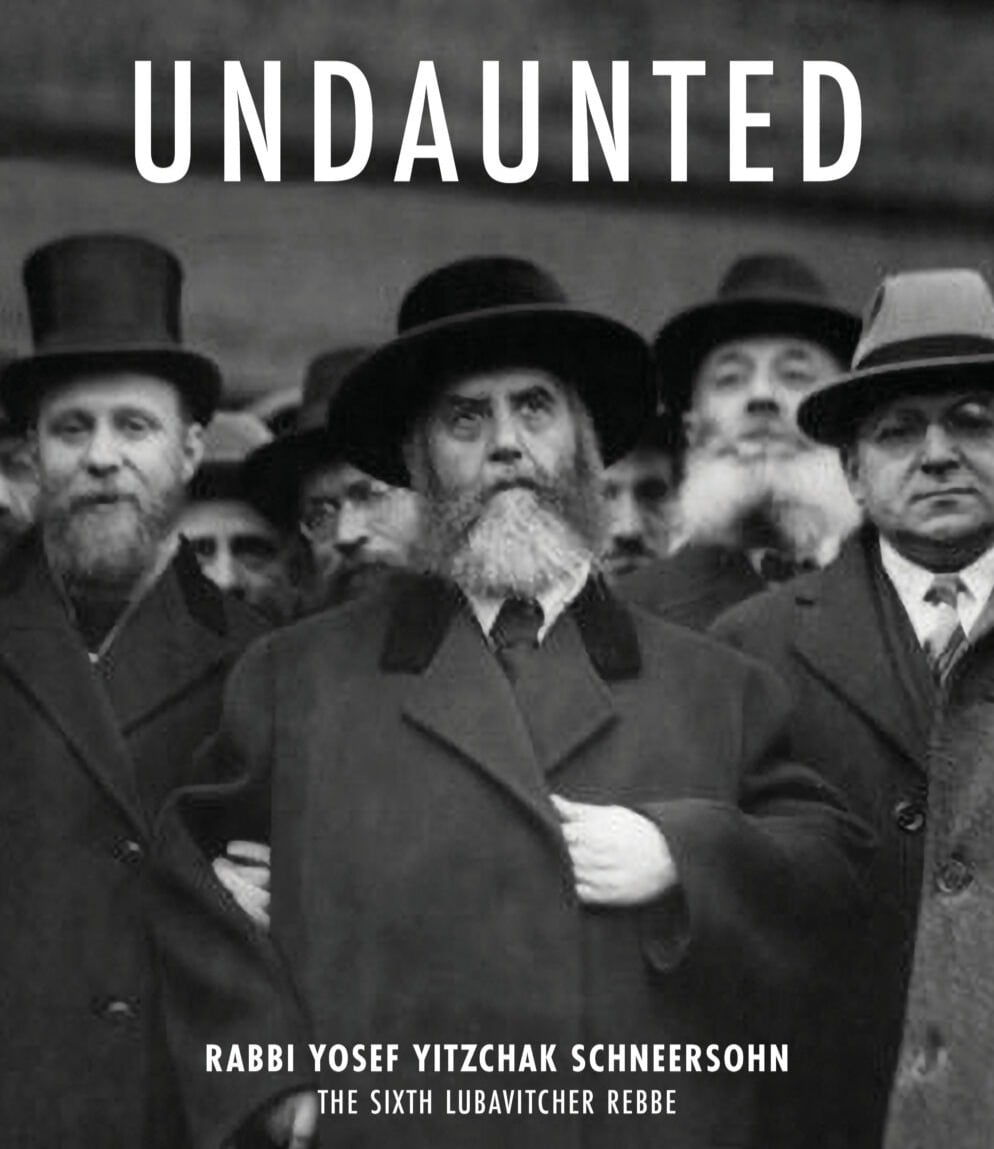
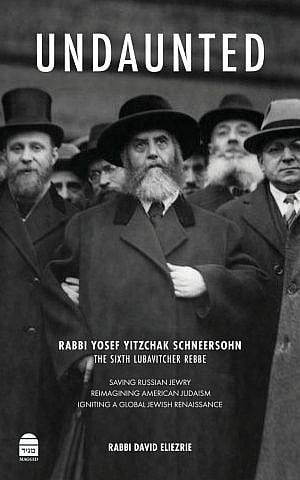
The Sixth Rebbe on the cover of "Undaunted."
The 2025 book Undaunted: How the Sixth Lubavitcher Rebbe Rabbi Josef Yitzhak Schneersohn Saved Russian Jewry, Reimagined American Judaism and Ignited a Global Jewish Renaissance, covers an enormous amount of ground, all of it backed by extensive endnotes. Rabbi David Eliezrie, senior Chabad shliach in Yorba Linda, Cal., combines biography, politics, diplomacy, revolutions, religious trends and more in this life of the Rebbe (the sixth Rebbe, Josef Yitzhak Schneersohn, not to be confused with his son-in-law, who became the seventh Rebbe, Menachem Mendel Schneerson).
Sections about the Rebbe’s life in the aftermath of the Russian Revolution of 1917, when the Bolsheviks seized power, especially interested me. The book shows how the three million Russian Jews, released from the antisemitic restrictions of Czar Nicholas II, responded to the promising but savage new world. They splintered in wildly different directions.
The tragic result of those bitter divisions: The Russian Revolution resulted in a Jewish civil war, more deadly than any disputes among Hasidim and Haskalah supporters, Yiddishists and Hebraists, Orthodox and secular, Zionists and their opponents. The Rebbe’s life intersected with every faction of that internecine conflict—an ongoing Jewish civil war.
Diverging paths after the 1917 Russian Revolution
Besides those who remained traditional, others immigrated or transitioned to more secular identities and moved to cities for economic and social opportunities. Some, intoxicated by revolutionary zeal and malice, formed the Yevesektzia, the anti-religious Jewish section of the Communist Party. Others became operatives of the secret police, known as the Cheka, that was executing the Bolsheviks’ Red Terror strategy and still others became leaders of the Communist Party itself, such as People’s Commissar of Military Affairs Leon Trotsky (Lev Davidovich Bronstein).
According to R’ Eliezrie, the Chabad leaders recognized the threat—but had the vision to see what the future held for those leading the revolution and its new wave of oppression. He writes,
The Rashab (the shortened acrostic name of the fifth rebbe; his son was known as the Rayatz before he became the sixth rebbe) understood that Communist rule would begin an oppressive period for the Jews. Still, he said, the regime would not last forever, forecasting the eventual disintegration of the Soviet Union. . . .
The Rashab also predicted to his son that the Communist Jews who had formed the Yevesektzia . . . would be the greatest threat to their fellow Jews. But he also foresaw their eventual fate. “The Jewish group that combats Judaism will be broken and their leaders killed. In the meantime, we will suffer from their evil actions and denunciations.” Their downfall began in 1930, when Stalin dismantled the Yevesektzia, killing and exiling many of its leaders and activists.
Rebbe in the claws of the Jewish chekists
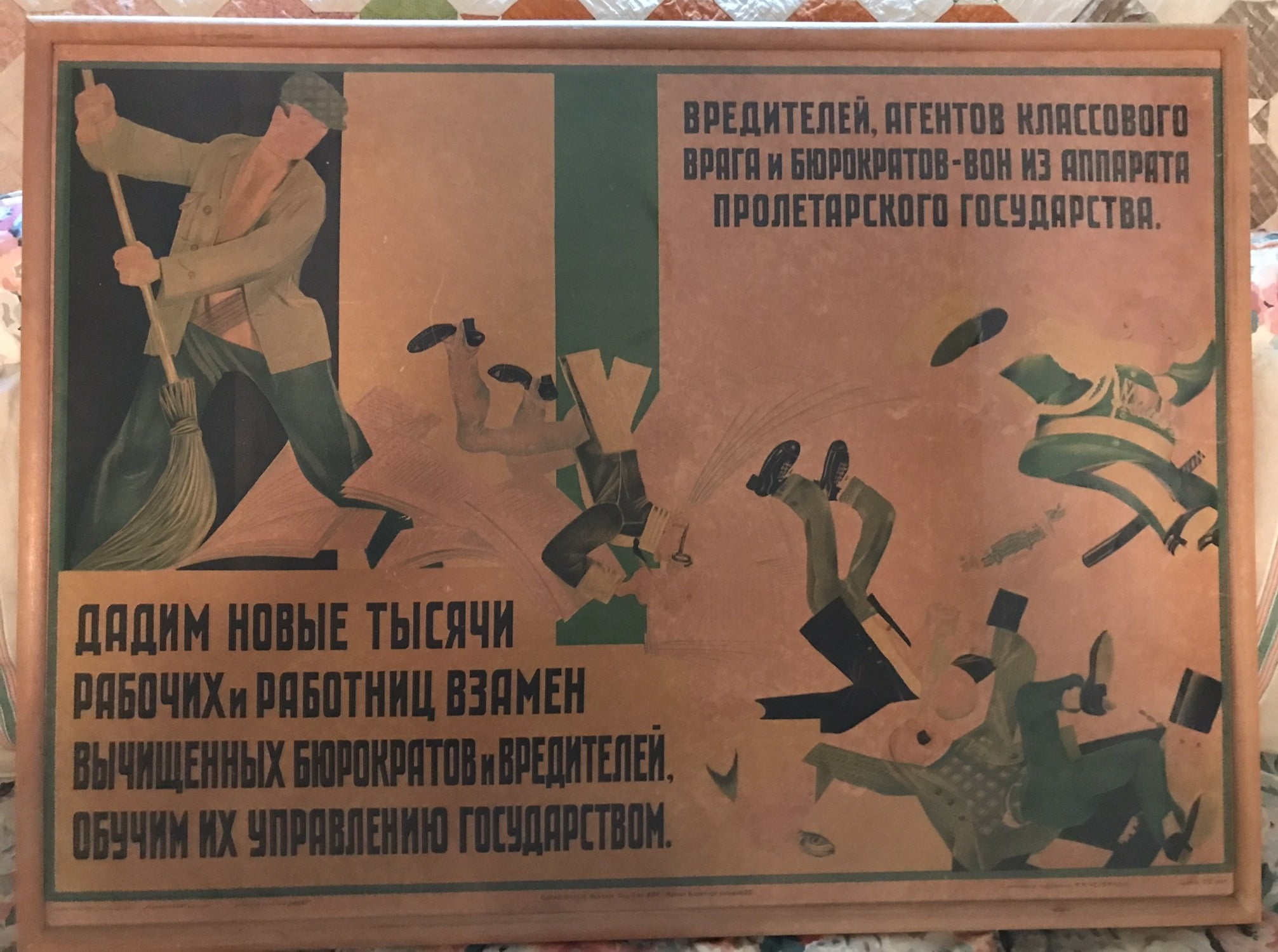
The sixth Rebbe’s interactions with the secret police, known as the Cheka until 1922, then the GPU in 1922-1923 and the OGPU 1923-1934, often involved Jewish “chekists,” as the agents called themselves. In one incident, an official named Bashkov met the Rebbe at his hotel room. Bashkov revealed he had studied at a yeshiva until he was 14, then dropped out to become a socialist and then, after time in England, involved in a board overseeing the secret police in the area of Chelyaninsk. Even more, his great-grandparents had been followers of the Alter Rebbe, the founder of Chabad; his grandfather had followed the third Rebbe known as the Tzemach Tzedek.
Then three men entered the compartment with one, named Krotov, saying he was arresting the Rebbe. The men started searching the Rebbe’s luggage. Bashkov called the search illegal, to which Krotov responded, “I am a member of the Yevesektzia and I am responsible for surveillance of this hotel.” They then demanded Bashkov’s papers.
Bad move.
Bashkov then presented documents revealing him to be a senior member of the OGPU. The Rebbe writes, “Krotov’s face turned white. They all recoiled and stood like blocks of wood, as if thunderstruck.”
The three men fled the scene. Afterward, Bashkov attempted to console the Rebbe. “This is an overreaction of young people who lack judgment.” There were some officials who acted with greater consideration as Bashkov did, partly out of nostalgia for their own family backgrounds. Still, the Yevesektzia had a free hand in pushing the Soviet anti-religious policy to the edge.
One chapter, “Armed Men at Midnight,” details the Rebbe’s arrest in Leningrad on June 15, 1927. It brings together the dual forces of the Yevesektzia and Jewish members of the GPU aligned against Chabad and Jewish interests. The Rebbe and Yevesktzia had been clashing over a conference on Russian Jewry and the Rebbe’s call for Jews to resist the Yevesektzia.
Stalin’s government was already cracking down on religious leaders, so the Yevesektzia decided the time had arrived to deal with the Rebbe forcefully. The two arresting agents both “came from Chabad families who were familiar to the Rebbe.” Mikhail Nachmanson had been born in a chasidic town and his father was a Chabad Chasid. Splitting from his heritage at the age of 16, in 1919, Nachmanson joined the Bolshevik party. He became involved in the GPU, which became the NKVD. He was arrested in 1936 and was sent to a labor camp in Siberia. He survived into the 1990s.
The second arresting officer, Gregory Lulov, had a more conventional fate of chekists under Stalin. “He joined the secret police in 1919. At the end of 1938, he was arrested and shot by order of the Supreme Soviet.”
R’ Eliezrie masterfully tells how the Rebbe and his family asserted themselves against the aggression of the Jewish chekists, who threatened to arrest the Rebbe’s daughters. Something must have shifted in Nachmanson’s hard positions, since he allowed the Rebbe to take tefillin and books to prison, and to receive food packages from his family.
Lulov also softened his heart in the moment, or at least attempted to ingratiate himself with the arrestee. R’ Eliezrie writes:
Before they left the house, Lulov, who came from a Chabad family, offered to carry the Rebbe’s bag. “My grandfather once carried your grandfather’s bag,” he said. “Chasidim remain Chasidim and I, too, will carry your belongings.” The Rebbe clutched his bag and said, “Your grandfather was a Chasid of my grandfather, so he was privileged to carry those bags to the place of my grandfather’s choosing. You, however, desire to carry it so that I should go to a destination of your choosing. This is not happening. I will not follow your way.” With these words, the Rebbe took his bag and gave it to one of the guards to carry. . .
Intimidation tactics began immediately [at the Shpalerka prison]. While the Rebbe was still at the entrance of the prison, he asked for permission to pray with his tefillin. Nachmanson barked, “Forget that you are Schneersohn! You are now an ordinary person who is being punished!” Then, alluding to the Rebbe’s refusal to bow to the Yevesektzia, he said, “Now you pay for everything.” In Shpalerka, Nachmanson took on the personality of the prison. “This was a GPU official whose primary task was to frighten prisoners, confuse them, and render them submissive,” the Rebbe wrote later. “I resolved to remain strong and not to fear, to speak clearly and to be unaffected by the intrigue in which they sought to immerse me.”
Nachmanson, Lulov and others interrogated the Rebbe, attempting even more to intimidate him with accusations that he was “abetting reactionary forces in the USSR and counterrevolution. You are a religious authority and rule over the Jews of the Soviet Union.”
Sentenced to death, the Rebbe finally was released and allowed to leave the USSR after worldwide pressure on the Soviet government.
Chekist Lulov’s name appears later in the story, in relation to the marriage of the Rebbe’s daughter Chaya Mushka to the Ramash (seventh Rebbe), in 1928. R’ Eliezrie writes,
Three days after the wedding, the family returned to Riga, where the week of sheva brachot (post-wedding celebrations) continued. One of the Chasidim who hesitated to join the Shabbat celebrations was Noach Lulov, whose son had arrested the Rebbe two years earlier. He shared with Rabbi Avraham Goldin that when the Rebbe heard he was not coming, “he invited me personally.”
And the Yevesektsia, which so tormented Russian Jews and the Rebbe? It shut its doors in 1930 and its leaders found themselves fed into the Stalinist meatgrinder.
Stalin’s regime turned on many of its own activists, including Yevesektzia leader Semyon Dimenstein, who was killed by the Soviets in 1938. Editors of the Yevsektzia paper Der Emes were targeted; Moshe Litvakov was executed in 1937 and Esther Frumkin was arrested a year later. She died in a prison camp in Kazakhstan.
German soldiers search for the Rebbe in Warsaw, 1939
The Rebbe was living in Warsaw when World War II began with the German attack on Poland. For diplomatic reasons, the German government wanted the Rebbe evacuated from Warsaw, as a way to prevent a world war by currying favor with the US government.
The search became the responsibility of Lt. Colonel Ernst Bloch, a World War I veteran with a Jewish father (in 1939 he was declared an Aryan). Warsaw was already bombed and occupied, with Jews subject to German restrictions and terror.
Bloch headed to Warsaw to find the Rebbe and his family. Joining him for this secret mission were other soldiers of Jewish descent (now that’s a story worth exploring in more detail). Much of Warsaw had been severely damaged during the bombing. The Chasidim in Latvia could not locate the Rebbe’s whereabouts. Neither could the American Embassy in Warsaw.
Bloch and his military searchers ultimately located the Rebbe and put him under their protection. He finally left for Riga, Latvia in December 1939, first passing through Berlin. In March 1940 the Rebbe and his entourage flew to Sweden, where they left on the SS Drottningholm in June 1940 for New York.
Coda, 50 years later: The Seventh Rebbe and the Last Jewish Stalinist
The Chabad essay “When is a Jew No Longer a Jew?” provides a sublime closing thought for Undaunted. While beyond the scope of that book, the essay shows the undaunted mindset in action. The interactions between Rebbes and Jewish authorities of Stalin’s USSR never ended. They continued to the collapse of the USSR in 1991. The essay describes the seventh Rebbe’s thoughts on Lazer Moiseyevich Kaganovich, a Politburo member who held senior positions across Stalin’s era and directly authorized untold killings. Unlike other Politburo members, he survived the 1930s purges, survived Stalin, and survived Nikita Khrushchev, although he fell out of favor, was demoted to a mining and processing plant management job and finally thrown out of the Communist Party in 1961. If any Jew reached and surpassed the 49th level of spiritual impurity, Kaganovich did.
But the Rebbe didn’t think that way:
In the late 1980s, Israel Singer, Secretary General of the World Jewish Congress, met with the Lubavitcher Rebbe upon returning from the Soviet Union. Singer related that he had met with a longtime, stalwart member of the Communist Party, Lazar Kaganovich, who at that point was already in his 90s. Notably surprised to learn that he was still alive, the Rebbe commented that the old Politburo member must indeed be an “alter Yid”—an old Jew, before asking: “Is Kaganovich doing teshuva [repenting]?”
Singer’s perception was that there was no indication of this, to which the Rebbe responded by encouraging him to follow up with Kaganovich on his next visit, and tell him that as a Yid, he still had a chance to return. It is unclear whether Singer ever had any follow-up contact with the old Politburo member, nor is there any indication of the latter having returned to his roots. What is clear, however, is the Rebbe’s unequivocal recognition that Kaganovich was still a Jew.
I found myself musing on an imagined encounter of the Seventh Rebbe and the Last Jewish Stalinist, two very old men of world-historical importance, for diametrically opposite reasons. Like the documented stories of the Sixth Rebbe standing up to his chekist tormenters, this fantasy scene brings together two of the diverging paths of Jewish life in post-revolutionary Russia. What would the two Ukrainian-born “alter Yidden” talk about, from shtetl days to revolution and teshuva? What a twilight moment in Moscow that would have been to observe.
And who knows, maybe it is happening right now in some parallel dimension, with Lev Davidovich Bronstein (AKA Leon Trotsky) thrown into the mix to join a spirited discussion, heightened by rounds of l’chaim, of the process of rising upward from the 49th level of spiritual impurity. Some stories will remain untold, while Mashiach tarries.
Related Posts