
"I'm the spokesman for the OK Boomer generation"
University: A Reckoning by Lee C. Bollinger
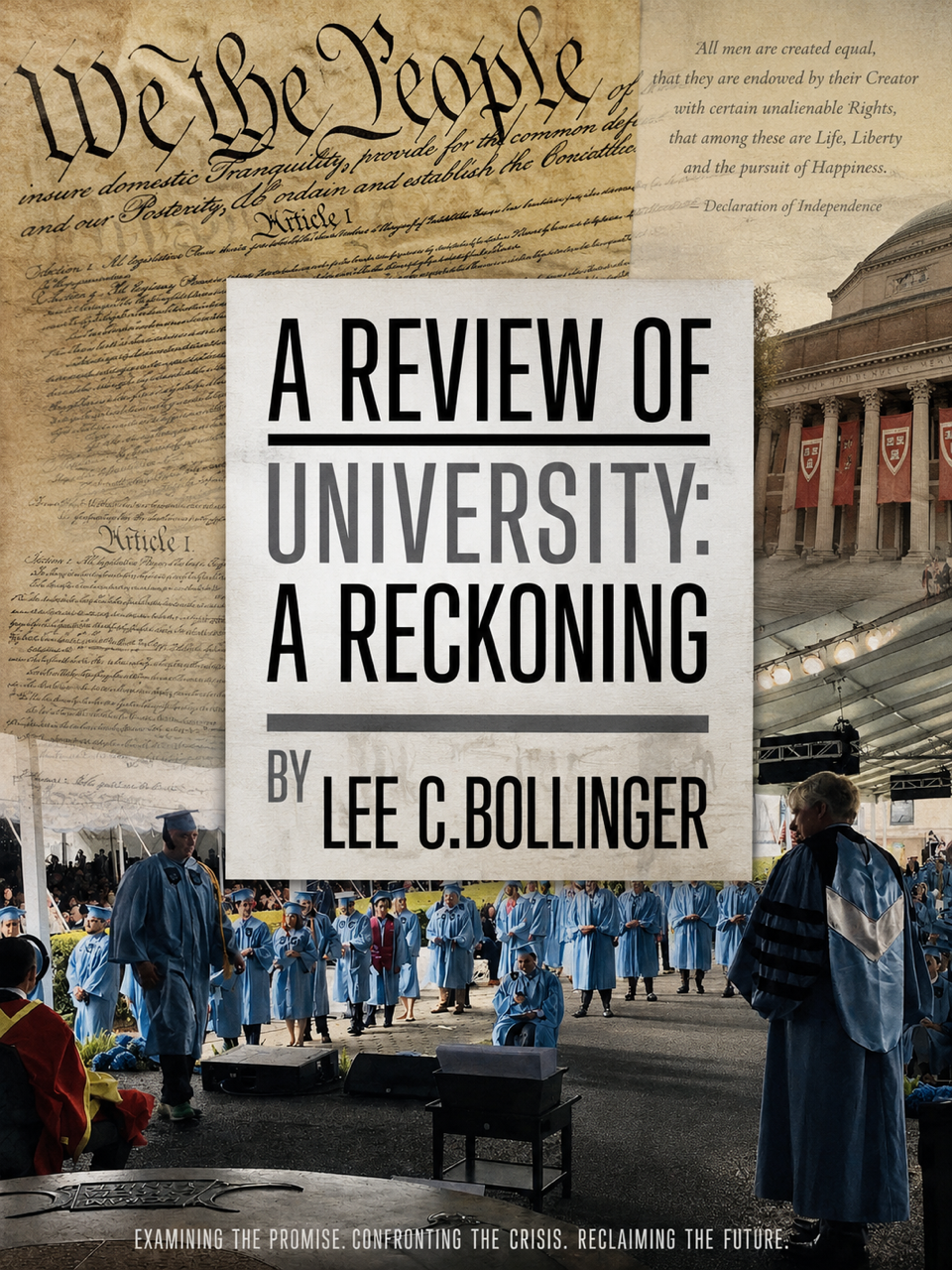
Photo: Tony Senatore: all rights reserved
My years at Columbia University from 2013 to 2017 remain the most significant accomplishment of my life and among my most cherished memories. To be accepted was not simply an academic milestone, but a formative experience that shaped how I think about education, civic life, the responsibilities of institutions in a free society, and the place where I learned to back up my beliefs with academic rigor. Most notably, Columbia was the place where I became a conservative after a lifetime of liberal thought and voting patterns. For these reasons, it has been especially painful to watch Columbia in recent years come under scrutiny as a symbol of the radicalism, activism, and antisemitism that many believe now plague American higher education. Whatever the precise causes, something is clearly wrong in academia, in America, and in the institutions upon which it is built.
When I learned that American attorney and former president of Columbia University, Lee Bollinger, had written University: A Reckoning, I was eager to read it. Bollinger’s deep attachment to Columbia and to the university system seemed to mirror my own. Because I remembered him speaking at orientation about the virtues of Aristotle, I expected a thoughtful and balanced account of the crisis facing American colleges. However, after reading only the introduction, it became clear that Bollinger and I could not disagree more, not only about the turmoil on today’s college campuses and who is responsible, but also about the broader condition of America itself and how to remedy it. I found it best for my purposes to skip the book introduction, as President Trump was, as in every liberal treatise about all that ails America and the world, presented as the central threat. I knew at page two where the book was going, but I pressed on.
Bollinger is at his best when he talks about the true purpose of a university, how it actually works, and why universities are important. He initially offers a simple definition: “Universities are intended to preserve and advance human knowledge about the human condition, about life and about the natural world, and to pass human knowledge and the capacities to pursue it on to succeeding generations.” Bollinger portrays a proper university as a place where professors, experts in their respective fields, possess a
“scholarly temperament,” and are so engaged with their students after lectures, they need hours of recovery.
“scholarly temperament,” and are so engaged with their students after lectures, they need hours of recovery.
Tenure, the guarantee of lifetime employment, is the reward for professors who choose to pursue truth and academic freedom rather than more lucrative employment. Although he admits that, in his former role as nineteenth president of Columbia University, he often felt compelled to resist this phenomenon, universities work because “true power or authority over its core functions resides at the base of the institution, with the faculty first and with the school secondarily.” It sounds counterintuitive, but according to Bollinger, centralized faculty-driven power, combined with weak central control within a networked national university system, is precisely what enables universities to succeed.
Bollinger is also excellent from a rhetorical perspective when speaking about free speech and the First Amendment, and about how, with the press weakened by President Trump’s attacks, American universities now serve as the primary institutional bearers of the First Amendment’s ideals, dedicated to reason, inquiry, and truth-seeking. Bollinger soon builds on his earlier definition of universities as merely educational organizations. By the end of the book, Bollinger asserts that universities are actually a democratic infrastructure as essential to democracy as the press and the judiciary. The structure of a university mirrors democracy itself, and the “closest match to the modern American university is America.” Thus, Trump’s attacks on universities are attacks on knowledge itself, as the university, a pillar of democratic society, is being destabilized. As a result, universities must be seen as quasi-constitutional institutions, a veritable “fifth branch” of democracy.
The final chapter reveals Bollinger’s ideas about a new age of “soft authoritarianism”: a one-size-fits-all narrative that is very popular in academia. I outlined the basic ideas of this alleged authoritarianism in a book I reviewed for Merion West entitled Backsliding. First, political polarization and dysfunction undermine support for mainstream or centrist candidates, opening the door to autocratic electoral appeals. Second, elected self-styled autocrats initiate a “colapse in the separation of powers between branches of government, as the executive gains control of other branches through the appointment of loyalists and sycophants. Third, political norms are shredded incrementally, namely in the protection of basic political rights and liberties, as well as the rule of law.
Bollinger presents the university system and the press as the institutions that can and must stand up to authoritarians, hold the Aristotelian center, and guide the discussion in his presentation of the press and university academics, as the modern-day version of the philosopher kings as depicted in Plato’s Republic, dedicated to a life in pursuit of truth and knowledge. In short, Bollinger’s book idealizes academic institutions far more than it scrutinizes them, and it argues that universities and democracy are under threat from external political power, specifically President Trump, and must be protected. Lee Bollinger and I share some common ground. We both view universities as extremely powerful institutions. We are both dedicated to the virtues of the academic mindset in a day and age when people can only compose or understand derogatory social media tweets. We also agree that President Trump’s punishment of Columbia University was perhaps excessively harsh. Where we diverge is what is broken, who is responsible, and how to fix it. In a poignant section of the book, Bollinger tells a story about a student and his professor’s after-class conversation. After the student finished, his professor turned to the student and said, “But have you considered…?” obviously referring to the professor’s counterargument to the student. I was in that very position many times as a Columbia University student. Bollinger asserted, and I agree, that this is the essence of a great education. That said, I have a few of my own “Have you considered” questions for Lee Bollinger, and anyone who agrees with the arguments presented in his book without question, in a manner reminiscent of a Soviet Politburo making a party-line declaration.
The “crisis” Bollinger conveys in his book did not begin with President Trump or the government. It started with internal protest movements, conflicts over speech, identity, and institutional values. A reflection of the protest events reveals that American universities lost the ability to enforce neutral standards. Despite Bollinger’s claims, in my opinion, universities are no longer neutral institutions; they generate ideological movements. This weakens his claim that threats to academic freedom and freedom of speech are external. Bollinger argues that we are “witnessing a tectonic shift in America toward the use of authoritarian tactics that threaten our form of government… long-established norms, hard-won over decades and centuries, are being cast aside.”
But, despite all his lofty talk about tradition, the First Amendment, the Supreme Court, the United States Constitution, and President Trump incrementally shredding norms, Bollinger seems to be loath to discuss the decades-long push among campus activists to abolish the study of Western civilization, the very foundation upon which Columbia University and most Ivy League universities are built. This matters because it suggests that the threat to academic freedom does not come only from politicians seeking leverage over universities, but also from activist subcultures that pressure universities to subordinate scholarship to ideological activism. The events at Stanford University in 2016 made evident the fact that opposition to restoring a Western civilization requirement was not simply a curricular disagreement, but framed by activists as a moral struggle in which defenders of canonical texts and Western Civilization studies are not treated as participants in a legitimate debate, but as defenders of racism, colonialism, and white supremacy. This is just as corrosive to free inquiry as overt political attacks, because it disguises soft coercion as enlightenment and partisanship as institutional neutrality.
Moreover, when it comes to soft authoritarianism, it is disingenuous to portray it as a solely right-wing phenomenon. Bollinger underestimates and downplays the relationship between academia, mass media, and partisan politics. Despite his protestations about Donald Trump being an authoritarian bent on destroying democracy, it is important to remember that the federal government has a democratic mandate to ensure that universities are not violating the civil rights of students, encouraging antisemitism, or promoting exclusive ideologies. The so-called “independent institutions” Bollinger champions have become ideological monocultures. Thus, government intervention is not repression but rather an attempt to restore ideological diversity and hold unelected elites accountable to the public. In many ways, President Trump is using his constitutional authority to rein in American institutions that reflect the values of the voters who elected him.
On the other hand, major outlets such as CNN and elite universities share a common cultural worldview with progressive activists and segments of the Democratic Party. Via selective framing, moralized political narratives, and the portrayal of conservative dissent as morally suspect, these institutions help create the social conditions for voters to support candidates who promise to enact those same ideological priorities through law. Looking at it from this perspective, danger to democracy may not arise only from a single elected leader like President Trump challenging institutions, but from a broader alliance of unelected cultural elites and left-leaning news organizations that toil away at the behest of political candidates who reinforce one another’s power. If Lee Bollinger wants to truly understand why so many Americans have lost faith in our bedrock institutions, perhaps he had better look a bit closer to home.
In the end, what makes University: A Reckoning so disappointing is not that Lee Bollinger defends universities; it is that he defends them selectively, as though their failures can be explained only by external political enemies and never by their own choices. That framing asks readers to believe that institutions that have spent decades reshaping curricula, tolerating ideological intimidation, and rewarding activism over scholarship somehow remain neutral guardians of democracy. They are not. Institutions do not become vulnerable to political scrutiny in a vacuum; they invite it when they abandon the very principles that once justified public trust.
I still believe in the university as Bollinger describes it: a place where serious people pursue truth, where disagreement is not feared, and where the response to any argument is the simple but profound question, “Have you considered…?” That was the Columbia University I knew and loved. But if universities wish to reclaim that role, they must first reckon honestly with their own contribution to the crisis they now lament. The greatest threat to higher education may not be a president willing to challenge elite institutions, but the institutions themselves, when they forget that their legitimacy rests not on moral prestige, but on their willingness to remain open to the very dissent they increasingly condemn.
Related Topics