
Writer covering Israel–Africa, Jewish affairs, and Israel worldwide
UNRWA and the Shock of Consequences: The Illusion That Was Demolished
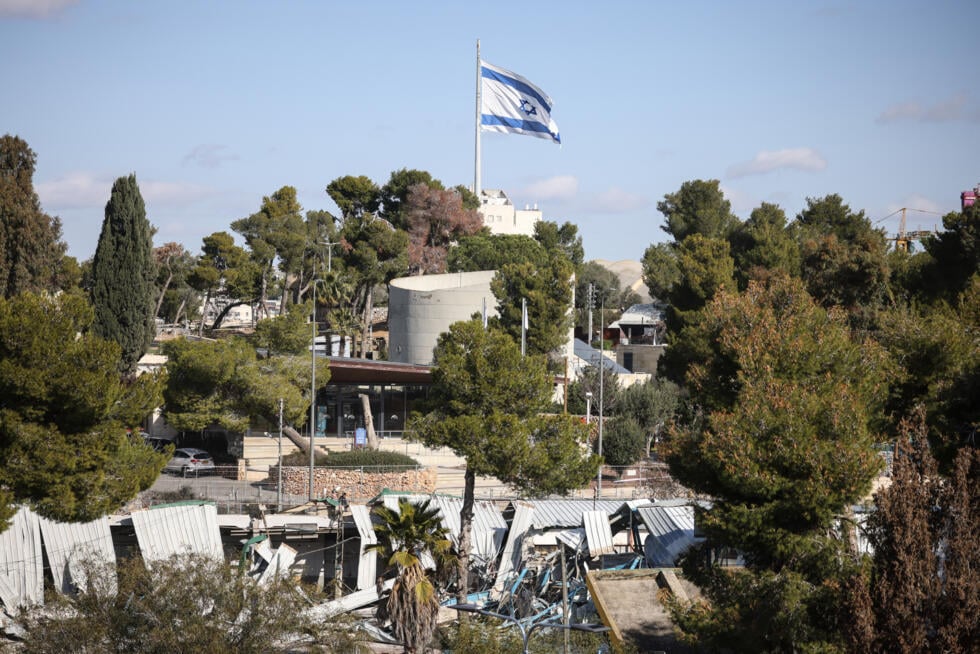
An Israeli flag fluttered above the demolished structures inside the UNRWA headquarters © ilia yefimovich / AFP
When a “neutral” agency starts acting like a terror accessory,
don’t be shocked when neutrality loses its office space.
The Outrage Arrives Before the Facts
The bulldozers hadn’t even cooled before the outrage achieved full operating capacity.
Within hours of Israel demolishing UNRWA’s headquarters in East Jerusalem, the international community sprang into action—not to ask why, of course, but to do what it does best: condemn first, contextualize never. Statements flew in faster than facts. “Shocking.” “Unacceptable.” “A grave violation.” Somewhere in New York, a UN press officer likely dislocated a wrist typing the word outrage for the fiftieth time. The demolition, we were told, violated the “inviolability” of United Nations premises—a phrase so sacred it apparently nullifies geography, sovereignty, and the small inconvenience of reality. Once a building has a UN logo on it, it is no longer a structure; it is a shrine. Questions are prohibited. Bulldozers are heresy.
Saudi Arabia condemned it. Jordan condemned it. Indonesia condemned it. The condemnations stacked neatly on top of each other like IKEA furniture assembled from the same instruction manual. Not a single one paused to ask the embarrassingly unglamorous question: why would a state demolish the headquarters of a UN agency it had already designated as hostile? Instead, the story was framed as vandalism against humanitarian innocence—Israel, once again, cast as the delinquent teenager smashing windows for sport, while the UN played the role of the wronged librarian whose only crime was shelving books and handing out moral bookmarks.
What was missing from the flood of statements was not nuance. It was curiosity. No appetite to examine Israel’s stated reasons. No interest in the mounting evidence that UNRWA had long stopped being a neutral humanitarian actor and had instead become something closer to a diplomatic squatter with ideological tenants. But in the international outrage economy, facts are not required at the point of sale. They can be examined later—preferably never—once the headlines have been written, the condemnations issued, and Israel has been duly reminded of its permanent role: defendant in a trial where the verdict is always preloaded.
UNRWA’s Sacred Cow Status
UNRWA occupies a rare and enviable position in global politics: it is not merely an organization, it is a sacrament.
According to its own mandate, UNRWA exists to provide relief, services, and protection to Palestinian refugees until a “just and lasting solution” is reached. That phrasing is doing heroic levels of work. “Temporary,” in UNRWA’s case, has now stretched comfortably across generations. Seventy-plus years on, the emergency is still ongoing, the solution still pending, and the institution still expanding—proof that nothing lasts longer than a temporary UN arrangement. But UNRWA’s real power is not logistical; it is symbolic. It has been carefully framed as untouchable. Criticizing it is treated not as scrutiny, but as sacrilege. Questioning its conduct is portrayed as an attack on humanitarianism itself, as though food distribution, schooling, and healthcare were fragile glass ornaments that would shatter the moment accountability entered the room.
The UN logo functions here like a diplomatic force field. Once applied to a building, a budget, or a classroom, it confers instant moral immunity. Intentions are assumed pure. Neutrality is taken on faith. Evidence is considered rude. This is how UNRWA became less an aid agency and more a narrative institution—the international custodian of grievance, permanence, and expectation. It doesn’t just assist refugees; it preserves the refugee condition indefinitely, institutionalizing statelessness as inheritance rather than tragedy. Refugee status is no longer a problem to be solved, but an asset to be maintained.
And because UNRWA has been elevated into this moral stratosphere, it enjoys a privilege few organizations ever attain: the presumption that it cannot be wrong, only misunderstood. If something goes wrong, it’s blamed on “context.” If staff misbehave, they are anomalies. If facilities are misused, it’s unfortunate. If ideology seeps in, it’s someone else’s fault. UNRWA is treated not as an actor with agency, choices, and responsibility—but as a humanitarian weather system. It simply exists, and whatever happens beneath it is beyond its control.
This sacred-cow status explains the shock that followed the demolition. You don’t bulldoze holy objects. You don’t ask hard questions of moral mascots. And you certainly don’t treat a UN agency like what it actually is: a human institution, run by people, operating in a conflict where neutrality is not declared—it is proven. That illusion, carefully maintained for decades, is what cracked when the bulldozers arrived. And for the first time, UNRWA was confronted not with reverence, but with something far more threatening: consequences.
October 7: When the Mask Slipped
Every myth eventually meets a date it can’t survive. For UNRWA, that date was October 7.
What followed Hamas’s massacre was not just the collapse of Israeli border defenses or the shattering of a fragile ceasefire fantasy—it was the sudden and irreversible collapse of a narrative. The carefully curated image of UNRWA as a neutral humanitarian bystander didn’t crack; it face-planted. Documentation released in the aftermath showed that UNRWA staff were not merely adjacent to the violence, not passive witnesses caught in the wrong place at the wrong time, but active participants. Employees of a UN agency—paid, credentialed, and entrusted with humanitarian responsibilities—took part in the Hamas attacks themselves. This was not a failure of oversight. This was ideological alignment wearing a staff badge.
At that point, the phrase “bad apples” stopped being a defense and became an insult to basic intelligence. When teachers, aid workers, and administrators moonlight as terrorists, the problem is no longer personnel—it’s culture.
The facilities told the same story. UNRWA schools, warehouses, and compounds—supposedly sanctuaries of neutrality—were repeatedly found to be integrated into Hamas’s terror infrastructure. Weapons storage. Command activity. Operational cover. The humanitarian emblem didn’t deter terror use; it enabled it. A UN logo turned out to be less a shield for civilians and more a camouflage net for militants. This is where the mask truly slipped. Because neutrality is not something you announce in a mandate—it’s something you demonstrate under pressure. And when October 7 applied pressure, UNRWA didn’t bend toward humanitarianism. It leaned into the same ecosystem that planned, executed, and celebrated mass murder.
The response, predictably, was institutional amnesia. Investigations were promised. Contracts were reviewed. Statements were issued expressing “shock” that staff members might have acted in ways fundamentally consistent with everything their environment had been teaching them for years. The organization acted as though it had just discovered gravity. But October 7 did something no press release could undo: it collapsed the distance between UNRWA’s rhetoric and its reality. Once staff are indistinguishable from combatants and facilities indistinguishable from terror assets, the argument that this is merely a humanitarian organization becomes not just false, but unserious.
At that point, the question was no longer whether UNRWA had crossed a line.
It was how long the world had pretended the line wasn’t there.
“Some Bad Apples” — The World’s Favorite Excuse
Once the evidence became impossible to ignore, the language shifted—because it always does.
UN officials acknowledged that some UNRWA staff members—at least nine, by their own admission—may have been involved in the October 7 attacks. The word may did a lot of heavy lifting here, bravely standing between documented participation and institutional embarrassment. Still, the damage was done. The denial phase ended. The minimization phase began.
Enter the most overworked phrase in modern moral laundering: a few bad apples.
It’s a comforting expression. Folksy. Disarming. It allows institutions to concede wrongdoing without conceding responsibility. The problem, of course, is that the saying doesn’t end there. The full version warns that bad apples spoil the barrel. But in UNRWA’s case, the barrel was immediately declared innocent, the orchard beyond reproach, and anyone pointing at the rot accused of politicization. Nine staff members, we were told, were an aberration. A rounding error. A tragic fluke. As though participation in a coordinated mass-casualty terror attack is the sort of thing that just happens when HR gets a little sloppy.
This is where the excuse collapses under its own absurdity. In no other profession on earth would this defense survive contact with reality. If nine airline pilots joined a terror cell, no one would argue the airline’s safety culture deserved patience. If nine teachers participated in a massacre, no education board would be allowed to shrug and promise retraining. Yet when a UN agency discovers that its employees moonlighted as Hamas operatives, the world nods solemnly and asks for calm. Worse still, these weren’t janitors wandering into extremism on lunch breaks. These were individuals embedded in an organization that operates schools, youth programs, and community institutions—exactly the environments where ideology is transmitted, normalized, and reinforced. The question is no longer how these staff members slipped through the cracks. It’s how the cracks became structural.
The insistence on “bad apples” is not an act of analysis; it’s an act of self-preservation. It allows UNRWA to continue operating as if October 7 were a public relations inconvenience rather than a moral indictment. It reframes complicity as coincidence and ideology as accident. But at some point, repetition stops being denial and becomes confession. When the same patterns recur—staff radicalization, facility misuse, educational indoctrination—the problem is no longer individual misconduct. It is institutional tolerance.
Calling that a few bad apples doesn’t save the barrel.
It just confirms no one bothered to check what it was fermenting.
Hosting Your Own Enemy: A Truly UN Proposal
There are many bold ideas in international diplomacy. Hosting an organization tied to your enemy while it operates freely inside your borders is among the boldest—and easily the dumbest.
Yet this is precisely what Israel was expected to do with UNRWA.
Even after mounting evidence of collaboration with Hamas, even after staff participation in mass murder, even after facilities were implicated in terror logistics, the expectation remained unchanged: Israel should continue to accommodate UNRWA, protect its premises, facilitate its operations, and absorb the security risks with polite gratitude. The logic here is remarkable. Israel is told it must tolerate—indeed enable—an organization that educates hostility, incubates grievance, and employs individuals aligned with a group sworn to its destruction. Not temporarily. Not reluctantly. Indefinitely. Because humanitarian optics demand it.
No other country on earth is subjected to this standard. The United States is not asked to host organizations linked to Al-Qaeda in the name of dialogue. France is not pressured to subsidize ISIS-adjacent institutions for the sake of social cohesion. Britain is not shamed for dismantling hostile networks operating under charitable cover. Somehow, only Israel is expected to finance and protect the infrastructure of its own destabilization. And when Israel finally refuses—when it decides that sovereignty includes the right not to host an openly adversarial entity—the reaction is disbelief. Shock. Condemnation. As though the state had violated a sacred hosting agreement written in invisible ink.
This is where the moral inversion becomes impossible to ignore. Israel is not judged for what UNRWA does, but for noticing it. The crime is not collaboration with terror, but the audacity to draw boundaries. The offense is not ideological warfare disguised as aid, but the refusal to pretend otherwise. Hosting your enemy is not humanitarianism. It is negligence dressed up as virtue. No state is obligated to provide office space, legitimacy, and operational freedom to an organization that demonstrably undermines its security. Expecting otherwise is not compassion—it is fantasy.
And fantasies, like sacred cows, tend to survive only until reality shows up with paperwork and bulldozers.
The ‘Right of Return’ — A Trailer Was Released
For decades, UNRWA has not merely administered aid; it has curated an idea.
That idea is the so-called “right of return”—a phrase polished to sound legal, humane, and inevitable. UNRWA has served as its institutional custodian, ensuring that the concept is preserved, transmitted, and insulated from the inconvenient realities of demography, sovereignty, and consequence. Refugee status is not resolved; it is inherited. Hope is not directed toward coexistence; it is stored for later retrieval. In theory, the right of return is framed as justice deferred. In practice, it has functioned as a promise without a plan and a grievance without an expiration date. UNRWA’s role has been to keep that promise alive—not by clarifying what it would actually entail, but by ensuring it remains emotionally potent and politically untouchable.
Then October 7 happened.
What crossed the border from Gaza that day was not a diplomatic claim or a UN-sanctioned legal argument. It was armed men. It was mass murder. It was civilians slaughtered in their homes. And in a grimly literal sense, it was a form of “return.” This is the part that makes everyone uncomfortable, so it’s usually skipped. But symbolism has consequences. When generations are raised on the idea that return means reclamation, erasure, and revenge, eventually someone takes the metaphor seriously. October 7 was not an anomaly; it was the logical endpoint of a narrative that replaced compromise with inheritance and peace with patience for violence.
UNRWA can insist that this is a misinterpretation. That its mandate is humanitarian, not militant. That the right of return is aspirational, not operational. But aspirations taught without limits eventually test those limits. And on October 7, we saw exactly what that aspiration looked like when stripped of slogans and carried out by men with guns. This is why the insistence on preserving UNRWA as the moral steward of the right of return rings hollow. The organization has already demonstrated—through the environment it sustains and the actors it employs—what that return translates to when ideology outruns accountability.
The world likes the phrase because it sounds righteous. Israel sees the footage because it was real. And once a trailer has been released, no amount of press statements can pretend the audience doesn’t know what the full feature looks like.
Consequences Are Not Collective Punishment
I’ll end this politely—before turning polite into absurd.
Israel didn’t demolish UNRWA’s offices because it hates aid, bureaucracy, or the color beige. It demolished them because a “humanitarian” organization had long stopped being humanitarian and started moonlighting as a terror facilitator. Staff actively participated in attacks. Facilities were used for logistics. Children were educated in hate. And the world pretended none of it mattered—as long as the logo remained intact. Consequences, it turns out, are not collective punishment. They are the inevitable reply when one party chooses to host, enable, and excuse the enemies of another. Israel didn’t target civilians. It didn’t fire rockets. It removed a hostile institution from its borders. That is not revenge. That is management. That is restraint. That is basic sovereignty.
Meanwhile, UNRWA, and the international chorus shocked by “violations of inviolability,” can continue to issue statements, condemn, and moralize. But the October 7 reality doesn’t care about press releases. Decades of enabling violence don’t disappear because a building was taken down. Words, logos, and mandates do not absolve action. The lesson is simple, though unpopular in diplomatic circles: if you invite your enemy in, groom the next generation to hate your neighbor, and provide them the tools to act, don’t act surprised when the consequences show up. And when those consequences come, let them be measured, precise, and restrained—because that, unlike ideology, is civilized.
UNRWA can continue to frame itself as neutral, sacred, and untouchable. Israel just proved that reality—bulldozers included—does not negotiate with myths.
Related Topics
Related Posts