
News Analyst
US-Saudi defense security agreement: Risks to Israel
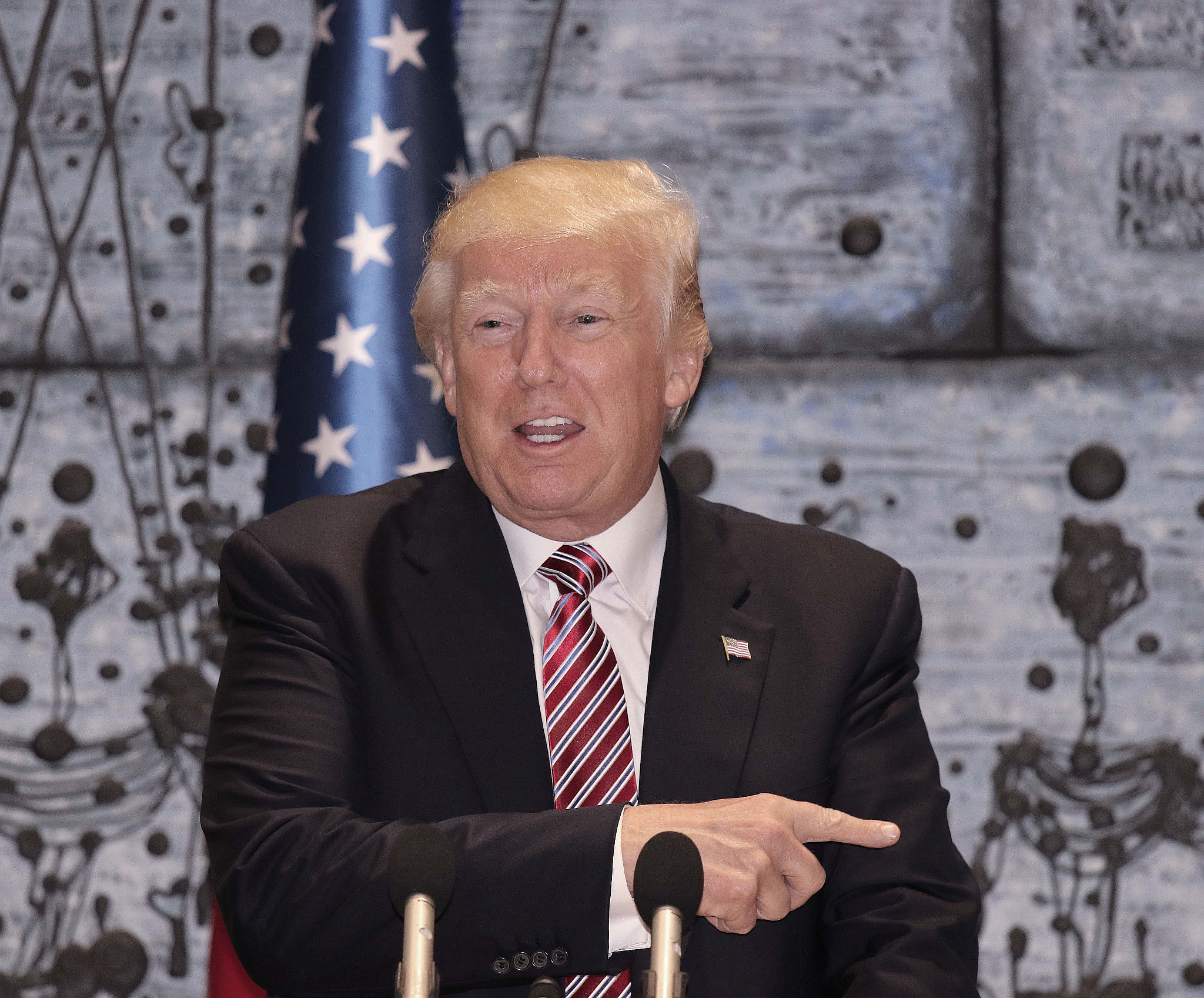
Donald Trump in Israel during his first term as U.S. President. Photo by Carrie Hart.
Reporters and analysts have been fixated on the recent U.S. military deal with Saudi Arabia, specifically regarding the American sale of F-35 fighter jets to the Kingdom.
As far as the F-35s are concerned, an Israeli military official recently commented that Israel knows how to deal with that problem, though it became a major issue for pro-Israel activists.
During the Reagan years in the White House, in the early 1980s, a similar issue of concern existed. At that time, it was over the sale of AWACS aircraft to Saudi Arabia, with sophisticated airborne warning and control systems. The same dangers of the planes being sold to Israel’s enemies, which might threaten Israel’s military superiority, were expressed then. However, it did not affect the balance of power in the Middle East.
While US President Donald Trump has now promised to downgrade the sale of the F-35s to Saudi Arabia, the F-35s did become the major attention-grabber in the media, without much focus given to other issues of regional apprehension for the Israeli government.
Trump’s aim has been to encourage Saudi Arabia to join the Abraham Accords and to do more business with the United States, while also looking for a normalization agreement between the Saudis and Israelis. The Saudis, however, have only agreed to deals with the US, which are closely linked to a major strategic defense agreement between the two countries.
The Saudi issue with Israel has been, and continues to be, an assurance that the Jewish State will agree to a Palestinian State – something that does not have majority support within the Israeli population.
Currently, the Saudis and Israelis are discussing their red lines through US channels. But, normalization ties, publicly, seem far off.
The recent visit of Saudi Crown Prince Mohammed bin Salman to the White House was built on friendly relations with the Trump Administration in Trump’s first term as president. Trump’s goal now, as the major powerbroker in the Middle East, has been to secure Saudi Arabia as a strategic ally, to reduce the possibility of Riyadh choosing to do more business with China and Russia.
Announced during the meetings in Washington, Saudi Arabia’s commitment to future investments in America is expected to reach almost one trillion dollars.
A Trump Administration document, posted by the White House, outlines specific categories that are meant to strengthen new Saudi defense capabilities, overall, to meet current US military criteria. In that document, the categories of this partnership are divided into five main areas: missile defense; air and space forces; land and border forces; maritime and coastal security; and advanced communications and information platforms.
Over a dozen US defense contractors are involved in building new military systems for the Saudis, as well as upgrading older systems to meet American standards of efficiency.
Contrary to some reports, the sale of the F-35s to Saudi Arabia does not threaten Israel’s Qualitative Military Edge (QME). But, if major world powers were able to get ahold of sensitive technologies within America’s advanced weapons systems, this could be a problem for the US, especially in Saudi dealings with China.
As far as Israel’s own F-35 capabilities, when Israeli engineers receive the fighter jets from America, they change the configurations in the communication systems, and they make overall adjustments to the planes to meet Israel’s specific and unique standards. The results have contributed to Israel’s overall air superiority in the region. This, along with highly trained Israeli fighter pilots, has kept Israel’s QME in place.
Additionally, Israel has its own defense agreement with the US, secured by Congress, that assures Israel’s QME will prevail over other countries in the Middle East.
Of more concern is what else the Saudis will receive from the US in their new defense pact, in terms of sophisticated air defense systems. Also, there is the question of whether the US will successfully build a nuclear plant in Saudi Arabia for so-called “peaceful” means. How “peaceful” will that nuclear plant remain?
According to the Israeli Institute for National Security Studies (INSS), the American Congress has refused to approve an agreement that would allow local enrichment in Saudi Arabia, but Mohammed bin Salman still wants control over all components in the nuclear fuel cycle.
There is uneasiness that overall local control in building a nuclear reactor in Saudi Arabia will lead to other countries in the region issuing the same demands – resulting in a Middle East nuclear arms race.
Whatever agreement is decided between Saudi Arabia and the US, it will be under the cover of Civil Nuclear Energy Cooperation, including a multi-billion-dollar nuclear energy partnership between the two nations, as outlined in the White House document.
Meanwhile, there is great uncertainty on the part of Israelis regarding the “behind the scenes” financial and military deals the US is making, not only with Saudi Arabia, but with Qatar and Turkey, as well. These deals seem to ignore Israel’s security needs, diffusing the strong alliance between America and Israel. Making Saudi Arabia a strategic ally within the American axis in the Middle East has had mixed reviews in Jerusalem.
The most dangerous deals that some Israelis perceive Trump may be working on are those which are pushing for agreements that result in the future division of the land of Israel. This follows declarations by Trump, Vice President Vance, and other officials in Trump’s circle, who have claimed they will not allow Israel to annex the West Bank. This can be interpreted to mean that the U.S. president and his close partners refuse to allow Israel to declare sovereignty over Judea and Samaria.
There are indications that the Palestinians could receive a reward, a promised gift of statehood, on the heels of the October 7, 2023, Hamas massacre, if the recent Trump 20-point peace plan gains traction. However, this “peace plan” was already in the works during Trump’s first term in the White House. It was carried forward, quietly, during the Biden Administration. It was, reportedly, about to be presented to the public when the October 7 massacre happened. Now, in Trump’s second term, this plan is showing signs, by his administration, of determined implementation.
Furthermore, those countries that voted in the United Nations to recognize Palestinian statehood in September 2025 have gained their own momentum in challenging Israel’s claim to sovereignty over Judea and Samaria.
In the midst of what appears to be a grave foreign policy geo-political shift in Washington, it’s important to remember these changing winds symbolize that supporting Israel, by partners and friends, is not always a “given.” Pro-Israel leaders and lobbyists should be applying pressure and engagement in every area of potential policy advancement, at the highest levels possible, to influence decisions on the part of governments.
Hopefully, Israel supporters are recognizing where the changing winds are coming from and will do more to preserve the delicate alliance between the U.S. and Israel, now and in the near future, as the stakes are high.
Related Topics