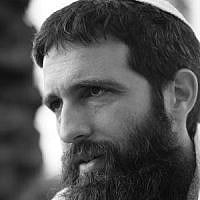
Uzzi Ornan, between Canaanism and Israeli Identity
Uzzi Ornan, Between Ratosh the Canaanite and Israeli Identity
Uzi Ornan passed away on the very day the results of the new Knesset elections were published. These results revealed a growing trend toward affirming Jewish identity, at the expense of the Israeli identity that Ornan had been one of the key advocates for. He was the one who filed a legal petition seeking recognition of an Israeli nationality. In 2013, Israel’s Supreme Court rejected his petition on the grounds that there was “no evidence of the existence of an Israeli nation.”
Ornan was the brother of the poet Yonatan Ratosh (Uriel Halperin), founder of the Canaanite ideology. From the age of thirteen, young “Uziel” was torn between two ideological camps within his own family. His older sister, who would later become the poet Miri Dor, embraced socialist Zionism, the labor movement, and the Haganah. In contrast, their older brother Uriel, in a spirit close to Revisionist Zionism, was a fierce critic of official Zionism. As early as 1930, following his encounters with Adia Gurevitz Horon (1907–1972), Ratosh formulated the idea of founding a Hebrew state and forging an alliance with the descendants of the ancient peoples of the Levant.
Uzi was deeply attached to his sister and influenced by her political stance. It was only in 1936, when she left for Paris with her partner Menahem Dor to pursue her studies, that Uriel, accompanied by their brother Gamliel (later known as Svi Rin, a specialist in Ugaritic texts), set out to reshape young Uzi’s worldview. For his bar mitzvah, Uriel gave “Uziel” a map of the “Land of the Euphrates,” inscribed with the dedication: “May you contemplate it day and night.” Both Miri and Uriel, writing from Paris, continued to exert a constant influence on his thinking through their correspondence.
Uriel’s path ultimately prevailed when Uzi, during high school, joined the Irgun youth movement known as the “National Cells.” This marked the definitive break with Miri. At sixteen, after joining the Irgun, Uzi was tasked—with his commander Aryeh Yitzhaki—with manufacturing four bombs intended to explode in British mailboxes. The explosive, prepared in an apartment on Lilienblum Street, detonated prematurely, severely injuring both young men.
To evade the British Mandate police, who were actively pursuing him, Uzi moved repeatedly from one hideout to another. He changed his name from Halperin to Ornan, in reference to Aravnah the Jebusite mentioned in the Book of Chronicles. During this clandestine period, he began a deep study of Hebrew grammar and developed innovative teaching methods for the language. When his brother Uriel began publishing his first poems, he would submit them to Uzi for grammatical and prosodic corrections.
Upon arriving in Jerusalem, Uzi began meeting secretly with Uriel, who introduced him to biblical criticism through the Hebrew translation of Julius Wellhausen’s work. During his time in hiding, Uzi diligently adopted the pronunciation of the letters ḥet and ʿayin as used by the local population.
In 1940, Ze’ev Jabotinsky published his book The War Front of the People of Israel. At the age of seventeen, Uzi was disappointed by the mediocrity of the work and the nature of its arguments, and he decided to distance himself from the Revisionist movement. That same year, the Irgun split into two factions, and the Lehi (Stern Group) was founded. Seizing the moment, Uriel—who had meanwhile changed his last name to Shelah—created the “Committee for the Formation of Hebrew Youth.” He believed that only highly educated young intellectuals could free themselves from institutional Zionism and replace it with a revolutionary doctrine centered on Hebrew identity.
Uzi, barely recovered from his injuries, joined the committee founded by his brother, to the deep dismay of their sister Miri. Among the first fifteen members recruited by Uriel was Moshe Giora (Elimelekh), a poet from the Hatikva neighborhood and native of Bulgaria, who wrote sonnets and translated Spanish folk songs into Hebrew. The group immersed itself in the study of the ancient peoples of the Euphrates region, under Uriel’s direction.
Uzi brought into the committee his classmate and close friend Eliyahu Beit-Tsuri. Upon his admission, Uzi sent him a note written in ancient Hebrew script: “Blessed be your entrance into the covenant.” Eliyahu obtained Uriel’s approval to join the Lehi and his blessing to carry out a mission—which turned out to be the assassination of Lord Moyne in Cairo. Before being hanged, Beit-Tsuri declared before his judges: “It is a mistake to think we represent Zionism. We are children of the Hebrew Land of Israel, and we have decided to win the independence of our homeland from the power that rules it. The issue of the Land of Israel is a conflict between the Hebrew children of the land, its rightful owners, and the British regime.” Uriel’s message had been well understood.
Aviva (Regulant), Eliyahu’s sister, studied in the same class as Binyamin Tammuz. As a result, Tammuz and his friend Yosef Ovadiah also joined the Committee for the Formation of Hebrew Youth. Tammuz met Aharon Amir, who was already ideologically well-formed, and gave him a copy of Ratosh’s collection Ḥuppah Sheḥorah (Black Wedding), strongly encouraging him to meet the author.
Moshe Giora placed great importance on recruiting members from the labor movement to the Hebrew idea. He made efforts to convince Israel Galili, Mati Megged, and Ḥayyim Gouri to join the committee, though with little success. Similarly, Binyamin Tammuz, who enlisted with his friend Itzhak Danziger in the Palmach, managed to recruit Mati Peled, Ezra Zohar, and Daniel Herman to the committee. In the 1960s, Giora was appointed editor at the newspaper Haaretz. He was the one who introduced the author of this article to Adia Gurevitz Horon and the Canaanite movement.
Uzi continued to hide from the British police. He settled in Tel Aviv and worked as a mechanic and welder. He secretly married his partner Shoshana Malkin in a modest religious ceremony, and their eldest daughter, Atar, was born in 1944. When she was three weeks old, the police surrounded their clandestine apartment, arrested Uzi, and deported him—along with fifteen other detainees—on a military plane to Eritrea, where 251 members of underground movements were already interned, including Yaakov Meridor, Eliyahu Lankin, Yehoshua Cohen, and Meir Shamgar. In the camp, Uzi taught Hebrew grammar and succeeded in printing an edition of his work The Grammar of the Mouth and the Ear.
In the summer of 1948, Uzi returned from detention in Kenya. He studied linguistics at the Hebrew University under Professors Naftali Herz Tur-Sinai and Moshe David Cassuto, while resuming his activities within the Committee for the Consolidation of Hebrew Youth, alongside Amos Kenan and Boaz Evron. At that time, young Uzi influenced his brother Uriel to radicalize his political positions. Unlike other committee members, Uzi and Uriel adhered to the principle of “freedom of Hebrew armament,” convinced that no revolution could take place unless the entire people was armed. In November of that same year, a single issue of Aleph: Tribune for Hebrew Independence was published without military censorship approval.
The pinnacle of Ornan’s activism came with the founding of the “Ani Israeli” (I Am Israeli) movement in 1998. Based on approximately 7,000 declarations, 38 founding members of the movement filed a legal petition in December 2003, through attorney Yoella Har-Shefi, demanding that the petitioners be registered as citizens of Israeli nationality on their identity cards, in the Ministry of the Interior’s records, and in any other administrative context where such a designation is required.
Independent of Canaanite ideology, Uzi also founded in 1950 the “League Against Religious Coercion,” in collaboration with Ari Jabotinsky. The League protested the ban on driving cars on Saturdays at the entrance to Jerusalem, prompted by ultra-Orthodox demonstrations, and published a pamphlet entitled A Sabbath Without Chains, written by Ornan. In 1955, the League submitted a petition to Knesset members demanding “that it be permitted to enact an alternative law for civil marriage and divorce, which would not discriminate against any citizen on the basis of gender, origin, religion, or communal affiliation.” The League managed to collect over one hundred thousand signatures in support of freedom of movement on Saturdays. Ratosh was not enthusiastic about Uzi’s initiatives and rejected the idea of secularizing Israel without a revolution in the foundations of its national identity.
When Uzi and Shoshana’s second daughter was born, they named her Tallay, after a goddess mentioned in Ugaritic texts, queen of dew and showers. Tallay later became an archaeologist and specialist in ancient world deities.
The Young Hebrews movement gained unexpected prominence following the publication of Baruch Kurzweil’s critical article The Essence and Origins of the Young Hebrews Movement (the Canaanites). According to him, its members were intellectually distinguished and possessed the capacities needed to form an alternative to the existing elite of Israeli society. However, he also saw it as a real danger, believing that time worked in the movement’s favor and asserting that its spokespersons expressed openly what many young people secretly thought but kept silent for career reasons.
Uzi Ornan, together with physicist Amnon Katz, also endorsed the critical aspects of Kurzweil’s analysis, arguing that Zionism had given a positive interpretation to the collapse of religious Judaism, and that one became a Zionist precisely when one could no longer be Jewish. For Ornan and Katz, Hebrew nationalism represented the fulfillment of Zionism, not its negation. Both maintained that, ultimately, Canaanite doctrine expressed the final goal of original Zionism.
Uzi Ornan, aware of Retosh’s financial difficulties, made several efforts to assist him. For a time, Ratosh rented a room from the parents of Shoshana, Uzi’s wife, on Pinsker Street in Tel Aviv, and he also hosted his son Haman in his own home. Despite the mutual affection and esteem between the two brothers, Uzi reproached his elder brother for his attitude toward friends and those around him. In October 1953, a heated argument broke out between them, after which Uzi felt compelled to write his brother a moving letter:
“I often weep in my heart over the fate you choose, or have chosen, and which now guides you. One who places himself above other men ultimately ends up alone.”
For many years, Ornan dedicated himself to the question of latinizing the Hebrew alphabet, aiming to replace the square Aramaic script with Latin letters derived from the ancient Hebrew alphabet. As a respected linguist, he published an article in Haaretz in June 1969 proposing a practical method for introducing the Latin script, emphasizing its advantages in terms of pronunciation accuracy, ease of learning, and linguistic dissemination.
In my view, it was after the Six-Day War that Ornan shifted from Canaanite Hebrewism to an Israeli identity. He distanced himself from Retosh’s more extreme declarations, particularly those advocating for the execution of fedayeen and the internment of all agitators in concentration camps. For Ratosh, the population of the territories was to be subjected to Israeli law, with their children educated in Hebrew schools until they gradually became Hebrews. Ornan endorsed the humanist dimension of this vision—granting citizenship and promoting the cultural integration of Arab populations—but firmly rejected any recourse to violence, coercion, or force, expressing his views in the six issues of the journal Aleph, published until May 1972.
Haim Be’er, who participated in the “Club for Hebrew Thought” led by Aharon Amir, also criticized Ratosh’s extremist views. Even his friend Adia Horon disapproved of Ratosh’s chosen slogan: “We fight for borders, we don’t debate them.” At the same time, Ratosh and his circle published ads in the press, financed by Hillel Kook, condemning the pan-Arab ideology, which they viewed as an obstacle to territorial nationalism. Ornan likewise rejected Aharon Amir’s initiative—founded with Moshe Levinger—to create a “Headquarters for the Preservation of the Territories,” fearing that it would fall under religious control, which indeed occurred.
Another rupture between Ornan and Ratosh emerged in 1972, when the latter proposed a sweeping reform of the Israeli political system, denouncing the oligarchic regime of political parties as deaf to the popular will. Ornan and others remained unconvinced, and Ratosh ended up publishing a solo communiqué advocating for the establishment of a “presidential regime of trusted men” to replace the partisan system.
After the Yom Kippur War, Ornan, Gershon Weiler, and Amnon Katz argued—much to Ratosh’s dismay—that there was no contradiction between Canaanism and Zionism, and that the two could in fact be allied.
Following the decline of the League for the Prevention of Religious Coercion, Uzi Ornan joined forces with Yitzhak Hasson to found the “New Secular Movement,” which aimed to present secularism as a way of life grounded in humanistic and moral values. The movement also sought to challenge the metaphor of the “empty cart,” a term coined by certain religious circles to disparage secular Jews.
Like Ornan, Ratosh eventually had to compromise with reality, adopting the popular term “Canaanite”—originally a derogatory label for the modern Hebrew people. On the recommendation of Horon (the pseudonym of Adia Gurevitch), Svi Rin, author of The Exploits of the Gods, and Hillel Kook (alias Peter Bergson), the term “Canaanite” gradually replaced the word “Hebrew.”
It was at Ornan’s initiative that Israel Belkind’s book The Arabs in the Land of Israel, originally published in 1928, was republished in 1969. Ornan was deeply inspired by Belkind’s view that the Arabs of Palestine were descendants of the ancient inhabitants of the Kingdoms of Israel and Judah, and native Hebrew speakers. Belkind rejected the notion of exile and saw the Arabs of the land as blood brothers born of a common mother. In his view, history obligated both peoples to live together in a shared state, and he proposed transmitting Hebrew culture to the Arabs and opening Hebrew schools to them. For reasons that remain unclear, Ratosh was reluctant to embrace Belkind’s ideas, which he considered a partial return to Zionism.
With the establishment of the State of Israel, Uzi applied for an Israeli passport. The Ministry of the Interior presented him with a form requiring him to declare that he was a “citizen under the Law of Return.” Uzi replied to the ministry official: “I am not Jewish. My Israeli citizenship derives from my birth and residence in this country, not from any religious identity that I do not possess.” The ministry relented, and the passport was mailed to his home.
In the spring of 1961, the government launched a population census in which every citizen was required to answer the question: “Are you Jewish?” At the initiative of Uzi Ornan and Yair Goren, the League for the Prevention of Religious Coercion published a brochure titled Are You Jewish? in anticipation of the census, explaining the meaning behind the question. Although officially listed under the category of “nationality,” the question in fact sought to determine the respondent’s religion. The League therefore recommended that secular individuals answer “Israeli without religion” or “Hebrew without religion.” Two thousand copies of the brochure were distributed, provoking sharp criticism in the press, which accused the Canaanites of trying to evade Jewish identity. Ratosh was displeased by the brochure and called for a boycott of the census, while Boaz Evron and the editorial group of the journal Etgar (The Challenge), associated with the “Semitic Action” movement, expressed their support.
The culmination of Ornan’s activism came with the creation of the “Ani Israeli” (“I Am Israeli”) movement in 1998. Based on around 7,000 individual declarations, 38 founding figures of the movement filed a petition in December 2003 through attorney Yoela Har-Shefi, requesting that the petitioners be officially registered as belonging to the Israeli nationality in their identity cards, in the Interior Ministry’s records, and wherever such designation was required.
I must admit that, despite my Canaanite views—as Boaz Evron diagnosed them—and even though I defined my identity as Israeli, I opposed this petition. To be precise, I considered the Supreme Court’s (Bagatz) rejection of the request to be justified. Had the petitioners’ demand been accepted, an absurd situation would have arisen in which a small portion of Israeli citizens would be registered as belonging to the Israeli nationality, while the rest would continue to be recorded as belonging to the Jewish nationality. In my opinion, the petitioners should have requested the Court to recognize that all Israeli citizens belong to the Israeli nationality, rather than to any religion-based nationality. Moreover, in our globalized world, most developed countries have abandoned national identities with discriminatory connotations, and instead embrace civic identities that make no distinction based on origin or religion.