
Victory Broadcast – Wednesday Morning
Victory is being broadcast Wednesday morning, around 10 a.m., in most major North American cities. It’s hard to take time off work, but play hooky and go hear the narration.
Of course, the victory in question may not be USA over Iran, with most of the world sitting on the sidelines. The victory narrated Wednesday morning is the defeat of the first major international empire, which terrorized the Near East 3,500 years ago, and forced the rulers of what is now Lebanon to say “I bow at the emperor’s feet seven times forward and seven times backwards” (El-Amarna letters 110, 111, and many others). The terror of the ancient Near East was Egypt’s “New Kingdom,” under the 18th and 19th dynasties, who extracted resources and exploited the land that is now Lebanon, Israel, Syria, and Jordan. The local rulers had no choice but to submit, given the Egyptians’ dominance in chariots of war, drawn by specially-trained horses.
All empires eventually crumble. By 1300 BCE, the formerly-terrorized city-states of the region were resisting the Egyptians. By 1274 BCE, the Egyptians had been constrained to give up claims to most of Syria by the more powerful Hittite Empire. Over the next century, the Egyptians lost control of the land they called Canaan, to the extent that they felt obligated to do battle against a newly-arrived group, the Semitic-speaking “Israel” in 1209 BCE. The evil empire was falling, the people were taking control of their lands.
The process of the Egyptian collapse was gradual and messy, as are nearly all human-driven political events, viewed in real time. Only around 1100 BCE did the Egyptians finally abandon the remaining outposts at cities in what is now northern Israel, notably Megiddo and Beth-shean. All human events proceed in a halting, gradual fashion. Even the great victory of the allies over Germany, celebrated on D-Day, left German outposts in Latvia, Holland, and the Channel Islands, some of which held out for weeks.
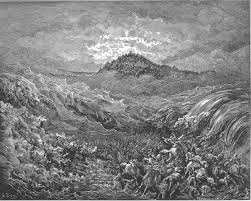
In contrast to human events, the Biblical narrative which will be broadcast in synagogues round the world on Wednesday morning is a complete and total Egyptian defeat. “Horse and Chariot He has thrown into the sea” (Exod. 15:1). The biblical narrative moves beyond human events, and describes the victory as one of God over Pharaoh. In a single bloody battle, God defeats the mighty chariots of Egypt, “confounding” them and forcing the Egyptians to scream “I must run and escape the Israelites, for God is fighting for them against Egypt” (Exod. 14:24-25). Pharaoh’s chariots are at the bottom of the sea, the Israelites march through victoriously, and God is recognized as an unparalleled force, “terrifying in His holiness” (Exod. 15:11)
The story doesn’t end there. It continues with the effect of God’s victory, with God leading “the people you have redeemed, You have led them in Your power to Your holy resting-place” (Exod. 15:13). The kings of Canaan, formerly terrorized by Pharaoh, now melt before God (Exod. 15:`15). And then, God brings and plants the Israelites “in the mountain of Your inheritance, a place for Your dwelling You have established…. God will be King forever” (Exod. 15:16-17).
This is God’s victory, not a human’s. It is total and complete. It changes the order of power for all time, defeating empires, allowing the powerless to take the land He designated for them, and ensures a new order. This ability of God to interfere in human political sphere then becomes the basis for the dream of world peace. Continuing the narrative of Exod. 15, in which a place for God’s dwelling replaces the Egyptian palace as the centre of power, Isaiah speaks of a future in which God’s Temple is seen as the central gathering-place of all humanity: “It shall be, at the end of days, the mountain of the house of the Lord will be established, chief of all mountains, higher than all hills, and all people will flow to it. Many nations will go and say: Let us go up to the mountain of God, to the house of the God of Jacob, let him teach us of his ways, and we will walk in his paths, for from Zion will instruction come forth, and the word of God from Jerusalem. He will judge among the nations, render rebuke to the peoples, and so they will beat their swords into ploughshares” (Isa. 2:2-4).
Someday, God will take charge and solve problems. In the meantime, it is left to us humans to do our poor best. Maybe that’s why the prophetic reading (haftara) attached to the Torah reading this Wednesday morning is not taken from any messianic vision of swords-to-ploughshares. Instead, it is David’s song from II Sam. 22, in which he declares “I will run after my enemies and destroy them, and will not turn back until they are finished.” (II Sam. 22:38). The verse describes a human’s aspirations and is achieved only in a limited way. For David, as we read in Samuel, left to his son a kingdom whose enemies were able to hedge it in all sides. Three thousand years after David, a banner reading “I will run after my enemies and destroy them, and will not turn back until they are finished” flew over the entrance to the headquarters of the Israel Defense Forces’ southern command headquarters from October 2023. Eventually, the banner wore out, as did the patience of Israelis to achieve total victory over Hamas. Similarly, the battle against Iran goes on, with Iranian missiles interrupting this writing. The fact that human victories are limited by our lack of omnipotence doesn’t exempt us from doing our best. We cannot live with a nuclear-armed Iran, or with an Iran which can project its power through the terror of Hamas, Hezbollah, the Houthis, and a growing missile threat.
All human victories, from the Hittites to David to Trump are limited, gradual, messy, and complicated. Wednesday’s Torah reading broadcasts the hope of a better world, in which God takes responsibility for defeating tyrants. It inspires us to hope for better, and it’s worth taking the time to hear. In the meantime, we all need to do our poor best.