
Vote right, if you wish. Just don’t vote for Bibi
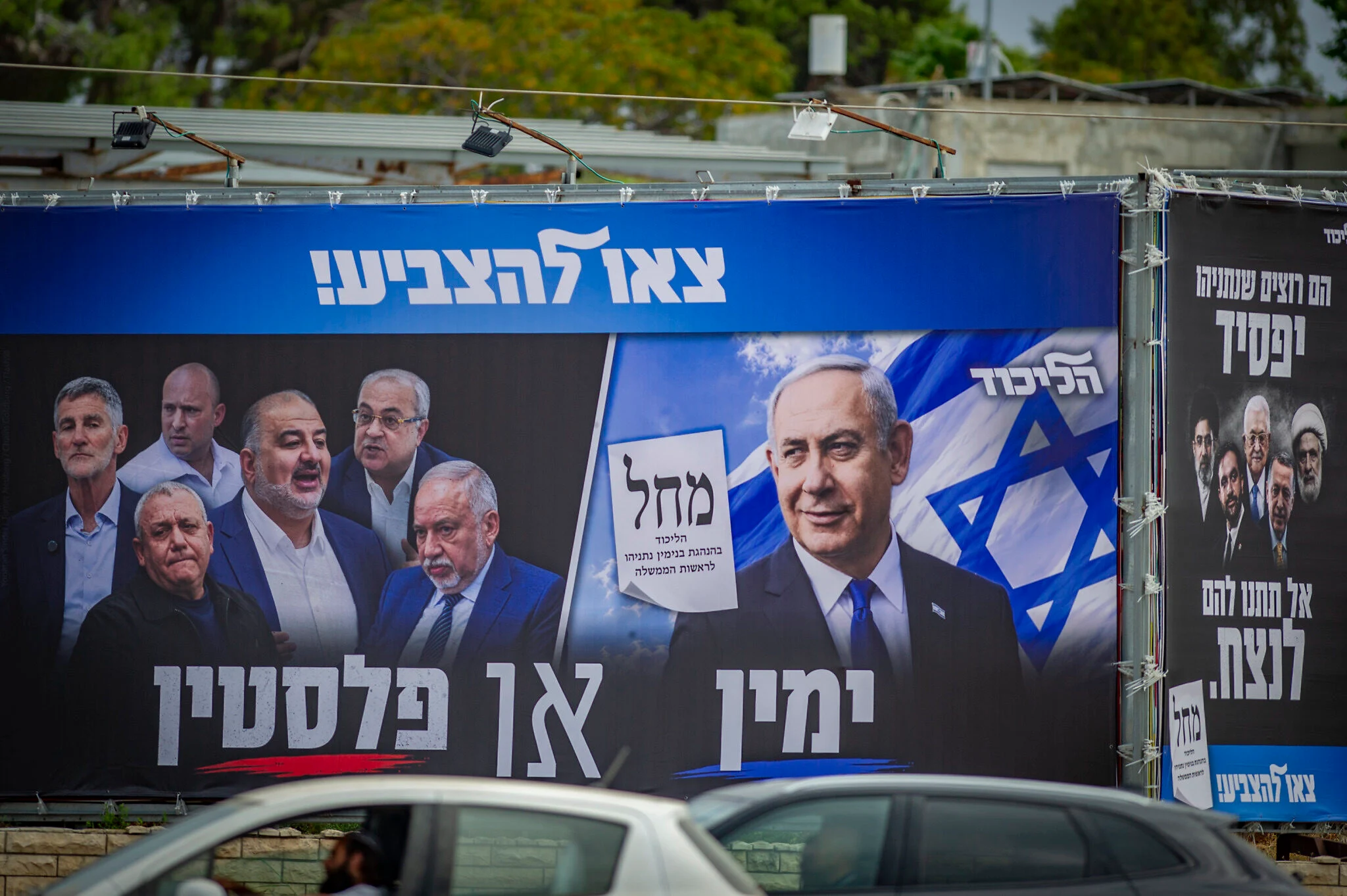
Judging by the ads and banners flooding our neighborhoods, websites and inboxes, one might think that relations with the Palestinians was the major issue facing Israelis in next week’s election, and that the choice was between peace and confrontation.
It’s spelled out clearly in the Likud’s primary campaign slogan: “Right or Palestine” (In Hebrew it’s a lot catchier: Yamin oh Falastin). In prominent posters, a beaming, brightly lit Benjamin Netanyahu is featured on the “right” side with an Israeli flag, while members of the potential coalition that could replace him (and some, like Ahmad Tibi, who most certainly won’t) ominously appear on the side of “Palestine.”
Nothing could be further from the truth. Even Mansour Abbas, whom Netanyahu first invited into government but whom he now constantly demonizes, isn’t speaking about Palestinian statehood. The only one in Israel talking about Palestine these days is Netanyahu himself.
The prime minister would have us think we’ve gone “Back to The Future,” teleported 30 years back to the first of his many campaigns of lies and distortion. Buoyed by a devastating wave of suicide bombings his strange bedfellows in Hamas unleashed upon Israel, Netanyahu turned to the oldest trick in the political playbook: fearmongering.
The sordid slogans of that 1996 election (“Peres will divide Jerusalem,” “the left has forgotten what it means to be Jews”) did the trick. After trailing in the polls by double digits, Netanyahu managed to eke out a narrow victory and went on to become the single most dominant political force in Israeli history.
Now he’s trying to do it again. What was once mere incitement has, thanks to social media and artificial intelligence, evolved into his trademark “poison machine.”
But this is 2026. Make no mistake, this election is not about left vs. right.
I state this sadly. As an unabashed supporter of Israel’s beleaguered peace camp, I have no choice but to concede the primary ideological argument of my generation. Whether or not a two-state solution is the best long-term solution to the Israeli Palestinian conflict is irrelevant. The fact is that the Israel of today is a right-wing majority country. Too much blood has been spilled, and too many hearts have been broken for it to be otherwise. There simply is no political will or capital to make any far-reaching concessions.
Therefore, the prospect of a Palestinian state, at least for now, is not on the agenda. But the viable future of the one and only Jewish democratic state most certainly is. That’s what this election is about. Don’t be fooled by Netanyahu’s demagogic wizardry suggesting anything else.
So, to my right-wing Israeli brothers and sisters, I say this: you still have plenty of options from which to choose. Vote right, if you wish. Just don’t vote for Bibi.
Despite all the propaganda directed against them, Gadi Eisenkot, Naftali Bennett and Avigdor Lieberman are hardly bleeding-heart peaceniks, and neither are Yair Lapid or Yair Golan. They are all security hawks, equally committed to countering the Iranian threat and battling Palestinian terrorism. The previous Bennett-Lapid-led government proved that. But more importantly, they are all decent public servants who care about the country and not just about amassing power for its own sake.
You still can’t bring yourself to vote for any of them? Go roll the dice on the likes of Ofer Winter, Yoaz Hendel or others. Just don’t vote for Bibi. Not because of Palestine. Because of Israel.
To state the obvious, next week’s election is the most consequential in Israeli history. Never has it felt like so much was at stake, like the very soul of the nation was on the line. This is not hyperbole. It is a matter of national survival.
After four years of unprecedented upheavals – from the coldblooded attempts at judicial overhaul that brought the country to the brink of civil war, through the willful negligence that led to the calamity of the Oct. 7, 2023, attacks, to the prolonged wars, hostage crisis, civic division, global isolation and subsequent rise in antisemitism worldwide – the time has finally come for Israel to choose a new path forward.
This is a watershed moment that could dictate whether Israel remains a functioning liberal democracy, whether it becomes an international pariah, or whether it suffers a mass exodus of its best and brightest that plummets it toward an irreparable economic, diplomatic and moral cataclysm.
This is the Netanyahu legacy and after so many years in power, he has come to reshape much of Israel in his image: aggrieved, paranoid and vindictive. Whether it’s the real dangers from the outside or the imagined ones from within, Netanyahu and his family have developed an almost messianic belief that he is indispensable to the country. They reason that Bibi alone can keep Israel safe and we would be lost without him.
And a large share of Israelis has been convinced.
One would think this myth would have shattered following the events of Oct.7, 2023, a catastrophe that bears Netanyahu’s distinct fingerprints.
His brazen assault against Israel’s democratic foundations – in the service of anti-Zionist ultra-Orthodox Jewish zealots and racist, far-right fanatics – not only distracted the country away from real threats but also weakened its military preparedness and tore Israeli society apart.
Most damningly, Netanyahu dismissed a broad range of security warnings, both foreign and domestic. His administration collaborated with Qatar to finance Hamas, and it has continued to do so even after the attacks. No daring military successes of recent years will ever erase that stain.
That alone should have led him to resign in disgrace, or at the very least, establish a state commission of inquiry to determine accountability for the systemic failure. Nearly every official linked to the massacre has since either been ousted or had the decency to step down on his own accord. Yet, shamelessly and unfathomably, Netanyahu remains.
Building a functioning, alternative coalition won’t be easy, regardless of who emerges as prime minister, and toppling Netanyahu will not solve Israel’s problems. It won’t eliminate the external enemies seeking our destruction. It won’t resolve the potential ultra-Orthodox demographic doomsday we face. It won’t rid the world of the explosion of antisemitism or the irrational hatred and double standard against Israel.
But it will be a new start. It is the absolute, bare minimum required to begin repairing a country that should not just serve as a Jewish haven from which to flee persecution, but a place where Jews want to live, thrive and take pride.
A more moderate government could ease our international isolation, halt our most self-destructive policies and move Jewish extremists out of government and back to the margins of society where they belong. Such a new-look Israeli government could crack down on the moral blight of West Bank settler outlaws who shame us internationally and invite sanctions against us.
By presenting a different Israel, we could cut the Mamdanis of the world down to size and help distinguish between antisemites and legitimate critics who want Israel to be better rather than not to be at all. And maybe, just maybe, it could make Zionism less of a bad word in the vocabulary of our Western allies.
Even more crucially, a new coalition could focus domestically on matters of greater consensus, like extracting religion out of government, fighting crime in the Arab streets and integrating ultra-Orthodox Jews in the military and work force. It could start fixing our failing education and medical systems, reform a broken electoral system and perhaps even draft a constitution that defines the identity of the state and guarantees basic rights for all its citizens.
Most importantly, it could finally give us a chance to heal from the collective trauma we all still bear from Oct. 7, 2023.
None of this can happen with Netanyahu at the helm.