A third-eye thinker living in the Holy Land
Walls Do Not Stay Gray, Here
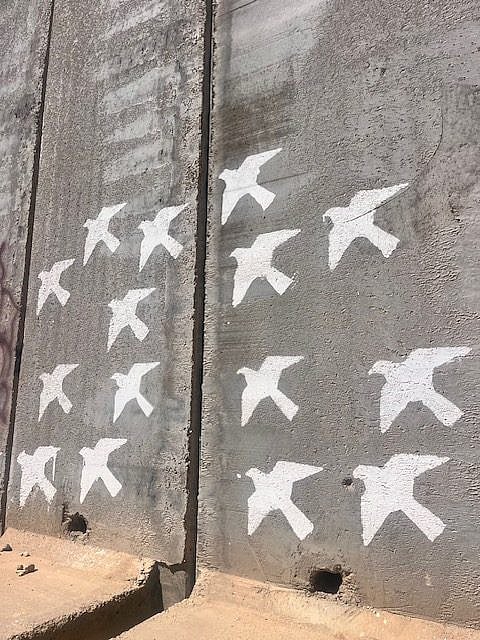
Taken in Kerem Shalom, The Vineyard of Peace
Walls do not stay gray for long, here.
Someone always comes with paint,
with photographs,
with red anemones bent from metal,
with a name they are afraid
the world will stop saying out loud.
Blank space becomes charged
in the sun of the Otef.
I can almost feel the pleasant October weather on my skin,
under a sky so blue,
as if it’s impossible that anything horrific
could have happened
here.
My eyes catch the white birds painted
along the separation wall.
At first their flight looks hopeful,
a flock lifting upward together.
But something inside me shifts,
and I realize how they are still trapped
inside the outline of the wall itself,
flight sketched onto the permanence of cement,
freedom drafted
inside the structure
of tall, grey fear.
Further down,
butterflies scatter themselves
across the gray slabs,
in mismatched children’s colors,
small wings crossing the same barrier
built to stop bodies,
to stop bullets,
to stop nightmares
from crossing fields at dawn.
Israelis do this everywhere.
Make art from the wreckage.
Not because suffering becomes meaningful once it is painted beautifully,
and not because grief turns people wise.
Grief is known for hollowing people out,
for shrinking their world to survival,
to numbness,
to rage that has nowhere sacred to land.
But maybe creation is what emerges
when pain trapped for too long
searches for somewhere else to go.
So the people of Israel paint,
write songs,
stencil faces onto shelters.
leave crocheted flowers beside graves,
hang ribbons from trees,
turn devastated festival grounds
into galleries of testimony.
There is something deeply Jewish about it all.
This refusal to let memory remain abstract.
This insistence that mourning
must become physical
as a way to help the soul carry it.
Zicharon.
A mural.
A poem.
A candle melted into the sidewalk.
A wall that somebody could have left gray,
but didn’t.
And still,
I am careful not to romanticize any of it.
Because there is a way people speak about Israeli resilience
that almost frightens me now.
As if the ability to make beauty beside devastation
redeems the devastation itself.
It doesn’t.
It can’t.
It never will.
The butterflies do not soften the wall.
The songs written after Nova do not let them dance again.
The memorials do not transform bereavement into something holy enough
to ever be sanctified.
The trauma is not beautiful
just because one learns how to decorate its edges.
And yet,
what else should people do with unbearable grief,
except to try and shape it
into something another human being
can stand beside
without turning away?
Maybe that is what all this art really is.
Not optimism.
Or nationalism.
And not even healing, entirely.
Just evidence
that people are still trying to remain human
within circumstances
that threaten to empty the humanity out of them.
I walk the paths of the Nova site,
feeling the loss of those I will never get to meet
in spaces we should have shared together.
I find the green velvet vine I wrapped around
a metal flower left for David last summer,
sun-bleached now,
still clinging to the stem,
as if it were memory itself
asking us to not let go so easily.
And maybe that’s the real impulse underneath all of this.
Not resilience.
Not redemption.
Just people trying to place something beautiful
beside the pain.
Trying to give grief
a texture,
a color,
a place to land outside the body.
Maybe we create
to make sure
devastation is not the only thing
the eye learns to see.
To leave behind some evidence
that beauty still moves through us
while we carry the unbearable.
Walls do not stay gray for long, here.
Someone always comes with paint.
Related Topics