
CFO | Empower Society for Good I Author
War and the Journey to Moral Clarity
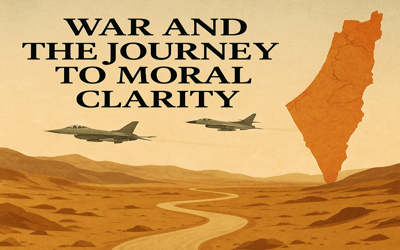
In Parshat Matot, we confront one of the most ethically difficult sections in the Torah: the war against Midian. It is described as a war of revenge—a divine command to Moses to exact justice against the Midianites for their role in seducing Israel into idolatry and immorality at Ba’al Peor. The details are hard to digest: total war, the death of every male, and the later purification of warriors and spoils. It’s brutal. Unrelenting. And deeply unsettling.
Have We Really Moved On?
Reading this in 2025, more than 3,000 years later, one might ask: Have we evolved?
On October 7th, we witnessed a modern form of brutality. The savage attacks on Israeli civilians by Hamas echoed ancient hate. And today’s war in Gaza—a war of defence, but also of necessity—feels like a tragic echo of Matot. Just as in the Torah, we are once again faced with the horrific realisation that some enemies do not want peace, that coexistence is not always an option, and that survival sometimes demands decisive force.
Yet there is a crucial distinction: Israel does not seek conquest or revenge. The Jewish soul aches for peace. We have no desire to decimate peoples or cultures. But when forced, we act. Not in vengeance—but to protect life, to restore morality, and to reaffirm the value of every innocent soul.
The Command to Purify: Ethics After Violence
After the war, Moses commands the warriors to stay outside the camp for seven days. Anyone who killed or touched the dead must purify themselves. Even the objects—the vessels, the clothes, the animals—must undergo ritual cleansing.
What does this teach us?
That war is not holy. That killing—even when justified—defiles the soul. That a society built on Torah must pause, reflect, and cleanse itself after violence. There is no glory in bloodshed. Only the need for healing, reflection, and moral restoration.
This ritual purification is the Torah’s whisper: Do not become what you fought against.
The Land of Israel: Festivals, Journeys, and Destiny
Matot also transitions us toward the end of the wilderness journey. The tribes of Reuven and Gad request to settle east of the Jordan. Moses, initially sceptical, warns them not to abandon the collective mission. But they assure him: “We will fight with you; only afterwards will we return to our land.”
Here we see another moral principle: shared responsibility. You may be secure, but you cannot rest until your brothers are too. A timeless message for all Jews in Israel and the diaspora alike.
From Sacrifice to Prayer: A Reimagined Judaism and Israel
Interestingly, the laws of festivals and sacrifices mentioned in last week’s parsha of Pincus were given in the desert but fulfilled only in the Land. Yet after the destruction of the Temple, they were transformed into prayer and ritual memory that Jews celebrate and commemorate today. Indeed, these festivals are the rhythm of the calendar, the pulse of the Soul of Israel, celebrated by all population groups – both religious and non-religious. It is the glue that binds Israelis and Jews worldwide.
Just as the mode of worship evolved, so too has our relationship to war, vengeance, and holiness.
We no longer fight tribal wars of eradication. Instead, we engage in wars of necessity, guided—when possible—by international law, ethics, and a Jewish moral compass rooted in restraint.
Unfortunately, the world is blind to this. So fixated on their hatred of Israel, influenced by centuries of the church and Muslim indoctrination to hate the Jews, so obsessed with Blood Libels and historical revisionism. So obsessed that their silence in the massacres of the Druze is deafening. Never mind not sending military help to help the Druze, Christian, Kurdish minorities in Syria. And now 28 leading Western countries have called on Israel to stop the war, with no call for Hamas to surrender. Hamas are to blame and the cause of all the deaths, and they know it’s game over if they return all of our hostages. They glorify the vilification of Israel and are emboldened by the West. How sad?
Is there any other country that is forced to provide humanitarian aid, water, electricity, etc., to its enemies?
And we are required to carve out our land for these enemies who call for elimination. A Judenrein Israel.
This week, the Knesset is hosting a Sovereignty Conference.
Amir Ohana: “We are not occupiers in Judea and Samaria”
Knesset Speaker Amir Ohana stepped up to the podium to deliver the first speech of the day. He began by reminding participants that exactly a year ago, the Knesset passed a declaration by a majority of coalition and opposition MKs (68 in total) stating their opposition to the establishment of a Palestinian state.
This, he said, reflects the simple truth that has long gone unspoken:
In 1967, with the victory of the Six-Day War, foreign occupation of Jewish land ended.
The Jewish people are not, and cannot be, occupiers in a land that for over 3000 years has been called Judea. We can be exiled from it, but, thank God, we have returned home.
The Cave of the Patriarchs, The Temple Mount, Joseph’s Tomb, all of these and more, Ohana explained, are symbols of Jewish life and history, and they are in Judea and Samaria.
Without Judea and Samaria, the birthplace of the Jewish People, there is no security.
Our rights to Tel Aviv, Netanya, Jerusalem, and Haifa all rest upon our rights in Judea and Samaria. It is Israel’s present-day ‘Iron Wall’.
Withdrawing from land ignites the blood-lust of our enemies as we have seen emanating from Gaza.
Just as Israel applied sovereignty to the Golan Heights despite protests, and just imagine what we would be experiencing from Syria had we not done so, so, too, must we apply sovereignty to Judea and Samaria, Ohana stated emphatically.
Until we extend our sovereignty to Judea and Samaria, we will continue to build homes and settlements.
Credit to Sheri Oz and link to the full post: https://ozsheri.substack.com/p/there-is-no-victory-without-sovereignty-5cd
From Torah to Today: Stuck in Biblical Times?
Sadly, some parts of the world seem frozen in a state of ancient brutality. The use of rape, terror, and martyrdom by groups like Hamas and now in Syria reminds us that civilisation is not guaranteed. Just as Midian represented a culture that celebrated immorality and seduction, so too do modern terror regimes weaponise death and hatred.
The Jewish mission remains: to bring light, not darkness. To elevate humanity, not degrade it. However, that mission often puts us at odds with those who still cling to the ethics of conquest.
The Eternal Struggle and Moral Challenge
Parshat Matot forces us to ask hard questions:
- When is war justifiable?
- How do we balance strength with sensitivity?
- Can we fight fiercely and still remain holy?
The Torah doesn’t flinch from these tensions—it places them at the heart of the narrative. And it invites us not to glorify the sword, but to understand its tragic necessity.
And when the war is over—to purify, to rebuild, to remember what we’re truly fighting for.
Why is this Journey so hard?
This week features a double Parsha, with Masei, where we are given a detailed list of 42 stops along Israel’s journey. Why recount everyone? Because the journey matters. Each struggle, each failure, and each triumph is part of our collective becoming. The land of Israel is not just a gift. It is earned through effort, moral struggle, and divine covenant.
As our sages explain, every stop is an allusion. A lesson. A spiritual fingerprint etched into the soul of our people. Each name whispers something about who we were then—and who we are now.
This year, as I read these journeys, I couldn’t help but ask:
Why so many stops? So many setbacks?
Why is the path to freedom—then and now—so long, so bumpy, so spiritually complex?
I realised: the Torah isn’t just telling us what was, but what is. The desert journey is alive. In many ways, we’re still on it, especially in this continuing war, which we want to end, political turbulence, rising hatred, continued blood libels, and our ongoing struggle for identity and purpose in the modern world.
Let’s pause at a few of those ancient stations—and see what they reveal about our lives today. Credit to ChatGPT here.
- Sinai – Where Hatred and Holiness Collide
“Sinai” evokes the giving of the Torah. But the Midrash notes that Sinai shares a root with sinah (hatred). At Sinai, the nations’ jealousy was kindled, and spiritual friction entered the world.
Today’s Lesson:
Standing for something invites challenge. Today, Israel and the world are marked by renewed ideological wars, cancel culture, and a global rise in antisemitism. We’re reminded that moral clarity comes with a price. But Sinai also reminds us of our mission: to be a light in dark times.
- Kivrot HaTaavah – Graves of Craving
At this stop, the people demanded meat and rejected the manna from heaven. Their lust brought death.
Today’s Lesson:
Modern society is still digging graves of desire—chasing consumerism, digital addictions, false fulfilment. COVID may have forced a temporary pause. Many of us saw through the illusion. But are we still listening? Or are we slipping back into craving without conscience?
- Marah – Bitterness Turned Sweet
The waters were bitter until sweetened by Divine command. Marah reminds us that bitterness is not forever.
Today’s Lesson:
The effects of October 7th linger—grief, fatigue, anxiety. But healing begins when we find the “stick” that sweetens the bitterness: meaning, connection, prayer, purpose. Each of us holds that power. And hopefully, we can find healing after the trauma of October 7th, the hostages and so many soldiers, young men dying to fight this evil, and the world’s ugly reaction on October 8th until TODAY, which has led to the world being a dangerous place not only for Jews.
- Rephidim – The Danger of Apathy
This was the place of spiritual slackness—“their hands grew weak”—and it opened the door to Amalek.
Today’s Lesson:
The greatest danger today is spiritual numbness and lack of conviction in the Israel story (Zionism) in the face of relentless lies, revisionism, and media blood libels based on our terrorist lies without proof or verification. When we lose our inner fire, doubts and cynicism creep in; we must awaken. Engage. Pray. Learn. Fight for our inner vitality. The enemy is not just “out there”—it’s within.
- Hor HaHar – Grief and Leadership
Aaron dies here. It’s a moment of transition, vulnerability, and eventual renewal.
Today’s Lesson:
So many of our people died on October 7th. Many pure and beautiful soldiers have died in this War. The pain is real. But Hor HaHar also heralds a call: it’s time for new leaders to emerge. With humility, with heart, and with memory in their bones.
- Har Shefer – The Beautiful Mountain
A lesser-known stop, Har Shefer represents vision, hope, and the hint of the promised future.
Today’s Lesson:
The aftermath of October 7th has given us a new purpose and greater connection to the beauty of the Jewish story. Har Shefer urges us not to forget. The view is beautiful ahead—but only if we carry the lessons with us.
Our Journey Isn’t Over
The Torah could’ve just told us: “They left Egypt and arrived in Canaan.” But it didn’t. It gave us 42 stops because that’s how transformation works—not in a straight line. Not in one leap. But step by step. Sometimes stumbling, sometimes soaring.
And so too for us.
We’re still journeying. Through conflict, through rebuilding, and through rediscovering what it means to live with purpose, with resilience, with holiness, and with hope.
Every station in the desert lives inside us. Every struggle has a name. Every name holds a message.
Let us learn from the journey—not just how to survive it, but how to emerge from it… wiser, deeper, and ready for the promise ahead.
Related Topics
Related Posts