CFO | Empower Society for Good I Author
We Came Home. What Did We Come Home to Build?
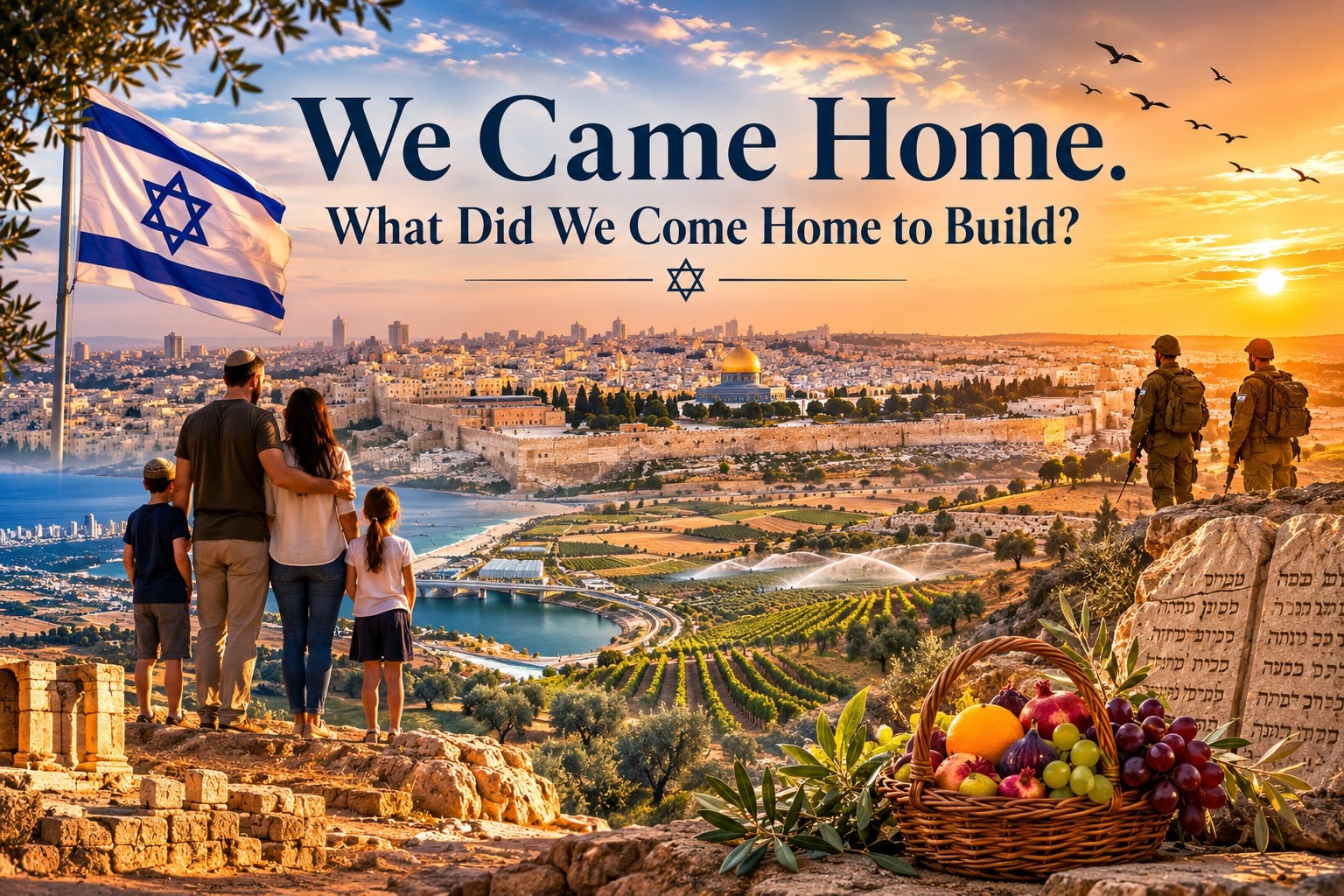
Reading Ki Tavo this week at face value, the opening words jumped out at me: “When you enter the Land that the Lord your God is giving you as an inheritance, and you possess it and dwell in it…” (Deuteronomy 26:1).
In today’s world, even that sentence has become controversial. Which land? Who are these people entering it? What is their connection to it? Israel’s fiercest opponents increasingly describe Zionism as colonialism and Jews as foreign settlers. Yet here is our ancient text, thousands of years before Herzl, the British Mandate or the United Nations, describing the Jewish people entering a particular land and establishing their national life there.
And the Torah tells us which land: “the Land that the Lord swore to our fathers to give us.” Eretz Yisrael, the land of Abraham, Isaac and Jacob.
We tend to separate Judaism, Zionism and Israel. Judaism is a religion, Zionism a nineteenth-century political movement and Israel the state established in 1948. Yet Ki Tavo presents a more integrated picture: a people, a Land, a history and a covenant.
Judaism survived exile despite extraordinary persecution. For almost two thousand years, Jews carried the Torah from country to country, surviving expulsions, massacres and pogroms. Then, in the Holocaust, European Jewish civilization came frighteningly close to annihilation.
And yet we came home.
What fascinates me is what Ki Tavo imagines the Jew doing once he gets there. He is not permanently a refugee or even a warrior. He is a farmer, bringing his Bikkurim, his first fruits, to Jerusalem.
Before presenting them, he must tell his story: “The Egyptians dealt harshly with us… We cried to the Lord… The Lord freed us from Egypt… He brought us to this place and gave us this Land, a land flowing with milk and honey.”
Why does a farmer carrying fruit need to recount Jewish history? Because without remembering the journey, perhaps he cannot appreciate what he is holding.
It is difficult to read this without thinking about 1948. Jewish sovereignty was restored. Hebrew became the language of children again. Jews came home from Europe, North Africa, the Middle East and elsewhere. A people that had spent centuries depending upon others for protection regained the ability to defend itself.
But the biblical image of redemption is ultimately not the soldier carrying a rifle. It is the farmer secure enough to plant today believing that his children will harvest tomorrow.
The first fruits of Zionism
When Mark Twain travelled through Ottoman Palestine in 1867, he described parts of the country as “a desolate country whose soil is rich enough, but is given over wholly to weeds—a silent mournful expanse.”
The Land was not empty. There were Arab towns and villages, Jewish communities, Bedouin and others. But neither should we project today’s densely populated and developed country backwards onto the nineteenth century. Large areas were poor, sparsely populated, malaria-ridden or agriculturally difficult.
The Jewish pioneers confronted that reality by working the Land. They drained swamps, fought malaria, planted orchards and vineyards, established kibbutzim and moshavim and searched for water. What began with draining swamps eventually became the National Water Carrier, drip irrigation, desert agriculture, wastewater recycling, desalination, food technology and precision agriculture.
That is modern Bikkurim. We returned and asked what we could make grow.
The development benefited others as well. Existing Arab communities participated in the expanding economy, while growth also attracted labour and migration into developing areas. The Zionist achievement does not require pretending nobody else was here. It lies in recognising the extraordinary transformation that took place.
Israeli agricultural and water innovation subsequently travelled around the world. Problems we were forced to solve became technologies capable of improving other people’s lives.
And Bikkurim adds something we can easily forget: gratitude. The farmer worked for his crop, but instead of declaring, “I did this,” he goes to Jerusalem and acknowledges what God has given him.
Do we do that enough?
A sovereign Jewish country. Jerusalem flourishing. Hebrew spoken by children. Jews returning from across the world. Crops growing in difficult terrain. Water coming from the Mediterranean.
We spend so much time arguing about everything wrong with Israel that we can lose sight of the astonishing fact that we have returned home.
Perhaps sometimes we simply need to say: Thank You, God.
The stones are still here
Then Ki Tavo becomes even more physical. Israel is commanded, after crossing the Jordan, to erect stones on Mount Ebal, build an altar and inscribe the Torah upon those stones.
Last year I attended a conference on the late Israeli archaeologist Adam Zertal at the impressive Israel Archaeological Center. Zertal excavated the ancient altar on Mount Ebal that he identified as Joshua’s altar. Reading Ki Tavo brought that experience immediately back to me.
The Jordan is here. Shechem is here. Mount Ebal is here.
On Tisha B’Av this year I felt something similar walking through the Bible Lands Museum Jerusalem. Both institutions are well worth visiting. Living here, thousands of years can suddenly collapse into the present.
That is why portraying Jews simply as foreign colonizers requires such extraordinary historical erasure. One can criticize Israel or advocate Palestinian rights without deleting Jewish history. The texts are here, the places are here, the archaeology is here—and we are here again.
Yet the sequence is more important than the archaeology. Israel enters the Land and is told to inscribe the Torah upon stones. Sovereignty begins with values.
The Land came with a covenant.
The warrior protects the farmer
And here lies the tragedy of our present moment.
We came home to become farmers, builders, scientists, doctors, teachers and entrepreneurs. Yet once again we have been forced to become warriors.
Since October 7, Israelis have left families, farms, laboratories and businesses for reserve duty. Human talent that could be devoted to agriculture, medicine, water and technology has instead been diverted towards defending the country.
The warrior protects the possibility of the farmer.
And the tragedy extends beyond Israel. Imagine Israeli innovation, Palestinian talent and Gulf capital directed towards water, food, medicine, energy and entrepreneurship rather than tunnels, missiles, wars and reconstruction.
This requires recognition. Palestinian leaders and society must ultimately accept that Israel is here to stay and that Palestinian success must be built alongside Israel rather than upon hopes for its disappearance. The wider region faces the same choice. The Abraham Accords demonstrated what becomes possible when recognition and cooperation begin replacing rejection.
Western activists who romanticize Hamas or “resistance” should consider what they are encouraging. It is easy to celebrate struggle from London or New York. Israelis and Palestinians live with its consequences. Encouraging another generation to believe Israel will eventually disappear does not build a Palestinian future. It postpones it.
The Good Society—and the warning
Yet Ki Tavo gives Israel no moral exemption. Once the farmer celebrates his abundance, the Torah immediately brings in the Levite, stranger, orphan and widow. Prosperity creates responsibility.
We did not come home simply to possess a country. We came home to build one.
That brings me to something a neighbour said after I told him how Zionistic I found Ki Tavo: “But most of the parsha is curses.”
He was right.
Perhaps that completes the message.
The curses reverse the opening: fruitfulness becomes failed crops, abundance becomes hunger, sovereignty becomes subjugation and return becomes exile. Most strikingly, the people who remember being brought out of Egypt are threatened with being taken back toward Egypt.
And why? One verse is chilling: “Because you did not serve the Lord your God with joy and gladness of heart, when you had an abundance of everything.”
The danger comes during abundance.
This is where Rabbi Jonathan Sacks’ Good Society becomes so relevant. Prosperity is not enough. Power is not enough. Markets and governments are not enough. A society requires covenant, responsibility, gratitude and moral purpose.
Perhaps that is Ki Tavo‘s sequence.
The Land was the promise. The return was redemption. The first fruits were the achievement. The Torah on the stones established the values. The Good Society was the purpose. The curses were the warning.
We came home. We should thank God for that every day. We must defend that home when necessary.
But the warrior is not the destination.
The farmer carrying his first fruits is.
And our challenge is to build the Good Society that makes those first fruits worth defending.
Further Thoughts – This week I wrote another reflection titled-
Who gets to write our history?
We tend to think of history as something fixed. But increasingly, our understanding of the past is shaped by institutions, Wikipedia, social media—and now AI.
For the Jewish people, this matters deeply after October 7.
Not because we need to convince every person who hates Israel. We won’t.
It matters because our children need to know their own story before somebody else tells it to them.
And there is an even bigger issue here, relevant far beyond Israel: if algorithms and AI increasingly become our storytellers, who decides which sources, facts and historical frameworks they inherit?
As we journey through the month of Elul, the Jewish idea of teshuvah—return—offers an interesting challenge:
You cannot return to a story you no longer remember.
My latest Good Society reflection explores history, identity, UNESCO, Wikipedia, TikTok and AI—and asks why protecting historical truth matters to all of us.
Who Gets to Write Our History?
https://blogs.timesofisrael.com/who-gets-to-write-our-history/
Related Topics
Related Posts