
CFO | Empower Society for Good I Author
Who Gets to Write Our History?
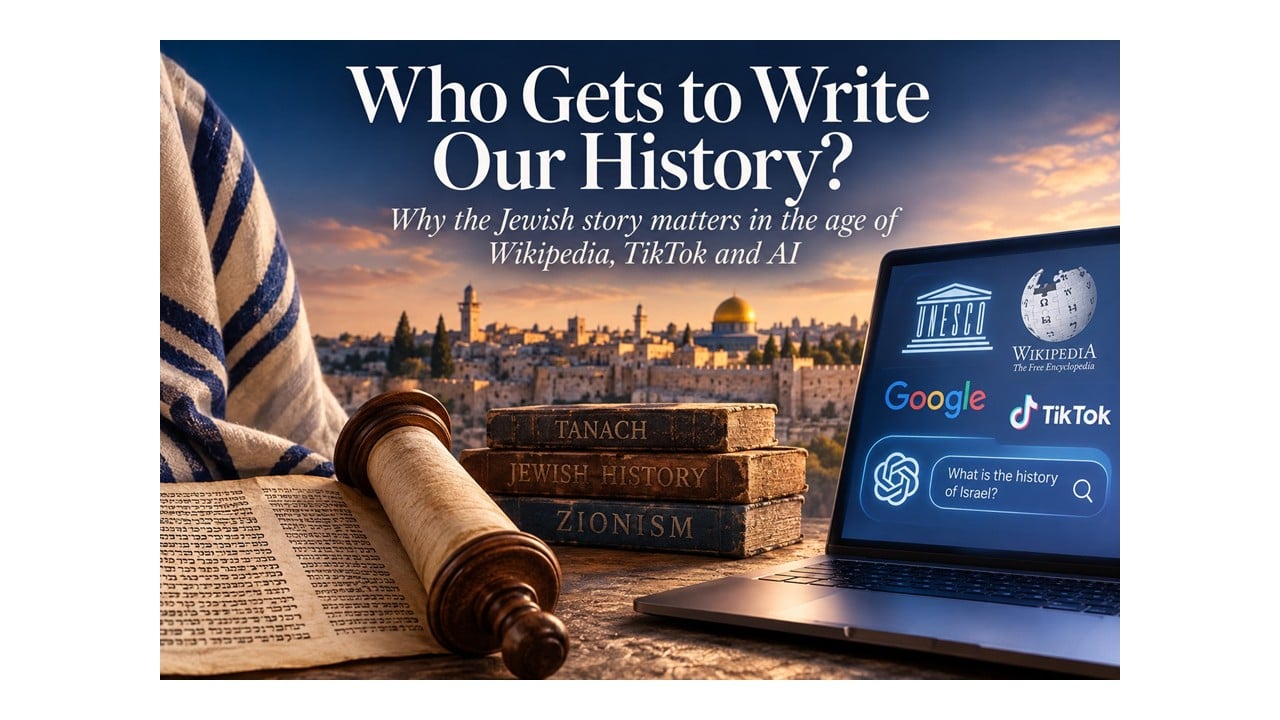
Why the Jewish story matters in the age of Wikipedia, TikTok and AI
Elul asks us to return. But return requires memory. A people cannot return to a story it no longer knows.
In my first Elul reflection, inspired by Rav Kook’s expansive understanding of teshuvah, I argued that one of the challenges facing the Jewish people after Oct. 7 is narrative resilience: the ability to confront criticism, tragedy and attempts at delegitimization without losing confidence in the truth of our history and the legitimacy of our national story.
That immediately raises a second question.
Who gets to write the story to which our children will return?
For most of Jewish history, the answer was relatively clear. We transmitted our story ourselves. Parent to child. Teacher to student. Rabbi to community. At the Passover seder, we did not merely remember the Exodus; we were commanded to see ourselves as if we personally had left Egypt. We faced Jerusalem in prayer, remembered it at weddings and repeated “Next year in Jerusalem” across centuries of exile.
Today, history is increasingly mediated for us. International institutions classify heritage. Academics and NGOs produce supposedly authoritative frameworks. Journalists adopt terminology. Wikipedia organizes knowledge. Search engines rank it. TikTok compresses it. Artificial intelligence increasingly synthesizes all of this into answers that sound coherent, balanced and definitive.
Why does that matter?
Because stories do not merely describe the past. They shape identity, legitimacy and eventually behaviour.
If Israel is understood as the restored national home of an ancient people with a continuous historical attachment to this land, then the conflict is understood as a tragic collision between peoples, histories and claims that somehow has to be resolved.
But if Israel is understood simply as a foreign colonial enterprise imposed upon an indigenous population, a very different moral conclusion follows. Colonialism is not something to compromise with. It is something to dismantle.
That is why narrative matters.
Rewrite the history, and you can change the identity. Change the identity, and you can weaken the legitimacy. Weaken the legitimacy, and acts of “resistance” that would otherwise be morally unthinkable can begin to appear justified.
Oct. 7 made this more than an academic concern. If Israel is reduced to a colonial project, Hamas terrorists crossing the border can be reframed as “resistance.” Murdered civilians can be recast as “settlers.” Kidnapping and massacre can be contextualized rather than confronted for what they were.
When framing becomes history
Consider Hebron.
Long before there was a modern State of Israel or a Palestinian national movement, Hebron occupied a foundational place in Jewish memory. The Book of Genesis identifies it with Abraham’s purchase of the Cave of Machpelah as a burial place for Sarah. Hebron later became David’s first capital. Jewish communities maintained connections to the city over centuries.
Yet in 2017 UNESCO’s World Heritage Committee inscribed “Hebron/Al-Khalil Old Town (Palestine)” as a Palestinian World Heritage site.
UNESCO does acknowledge the site’s importance to Judaism. The issue is not that Jewish history is literally denied. The issue is framing. A place sitting near the beginning of the Jewish historical story is institutionally presented within the heritage portfolio of the State of Palestine, with much of the emphasis placed on its later Islamic, Mamluk and Ottoman character.
Jerusalem provides another example. UNESCO debates became sufficiently controversial that in 2016 its own director-general, Irina Bokova, publicly stressed Jerusalem’s Jewish history, referring to King David, Solomon’s Temple and explicitly recognizing Har HaBayit—the Temple Mount—alongside its Islamic name.
Why was such clarification necessary?
Because language matters. Names matter. Classification matters. What begins as diplomatic terminology can eventually become historical framing.
And history does not have to be explicitly erased to be diminished. Change the frame and, over time, you can change how the history is understood.
From institution to algorithm
Most teenagers, however, are not reading UNESCO resolutions.
They are reading Wikipedia. Or more likely, they are watching TikTok. Increasingly, they are asking AI.
That is why the information chain matters.
An institution produces terminology. Academic papers, NGOs and journalists repeat it. Wikipedia editors rely on what are deemed reliable sources. Search engines elevate those pages. Social media compresses the framing into emotionally powerful fragments. AI then synthesizes the entire information ecosystem into a conversational answer.
The destination is no longer simply a website.
It is the next generation’s understanding of reality.
Wikipedia is one of humanity’s extraordinary achievements, but on highly contested subjects the choice of terminology, opening paragraphs, accepted sources and relative weight given to competing interpretations can shape how millions encounter history before they ever read a serious book.
Then TikTok changes the economics of attention.
A short phrase can create an entire worldview:
Colonizer. Oppressor. Apartheid. Genocide. Resistance.
Now try answering that worldview properly.
You need ancient Jewish sovereignty, exile, continuing Jewish presence, centuries of longing for Jerusalem, Zionism, Ottoman rule, the British Mandate, the Holocaust, Jews from Arab and Muslim countries, 1948, 1967, Oslo, Hamas, Iran and Oct. 7.
By the time you finish explaining, the viewer has already swiped.
This is the asymmetry we need to understand.
Fiction can be simple. Truth is often complicated.
That does not mean simple statements are necessarily false or complicated explanations necessarily true. It means that an attention economy rewards certainty, brevity and emotional clarity, while historical truth often requires context.
Why this matters for young Jews
Another reason this matters, and perhaps the most important, is this:
Imagine a young Jew whose knowledge of Israel is limited to “the state was established in 1948.”
Then university, TikTok or an AI system tells him that European Jews colonized Palestine after the Holocaust.
If he does not know the Exodus, ancient Israel and Judah, Jerusalem, exile, continuing Jewish communities, centuries of Jewish prayer for return, Zionism before the Holocaust, Jews from Arab and Muslim countries and the wars surrounding Israel’s creation, what intellectual resources does he possess to challenge that story?
Very few.
This is why we do not preserve Jewish history simply to win arguments with people determined not to believe us.
The committed antisemite may never be persuaded. A conspiracy theory can always absorb contradictory evidence by declaring the evidence itself part of the conspiracy.
But that is not the only audience.
The audience is the student who genuinely does not know. The ordinary person trying to understand the conflict. The journalist seeking context. And increasingly, the machine that will answer questions for all of them.
Most importantly, the audience is our own children.
We don’t reclaim the Jewish story because every Jew-hater can be persuaded. We reclaim it because the next generation of Jews must not be persuaded out of it.
But our story is more than a title deed
The story matters for an even deeper reason.
We do not need Jewish history merely to explain why Jews belong in Israel. We need it to remind ourselves why we are here.
The Exodus is not simply evidence of antiquity. It teaches freedom.
Sinai is not merely evidence of historical presence. It introduces covenant and responsibility.
Jerusalem is not merely a property claim. It represents an aspiration toward holiness, justice and national purpose.
Exile teaches vulnerability.
Jewish persecution teaches the danger of powerlessness.
Zionism restores agency.
Sovereignty gives us responsibility.
If we lose that story, we risk losing more than our claim to the past. We risk losing our vision for the future.
That is why the question of narrative ultimately belongs to the idea of a Good Society.
The Jewish story does not end with: “We came home.”
It asks: What kind of society will we build now that we are home?
Elul, memory and return
This is where Elul returns to the centre of the discussion.
Teshuvah means return.
But there can be no return without memory.
Rav Kook’s idea of national teshuvah presupposes a people that remembers enough of its identity, covenant and purpose to know what it is returning to. If that memory becomes hollow, outsourced or rewritten, national teshuvah itself becomes harder.
This does not mean retreating into mythology or refusing difficult historical facts. A confident people does not need a perfect history. It needs an honest one.
We should teach complexity. We should acknowledge mistakes. We should recognise Palestinian suffering and competing memories. But complexity cannot become self-erasure.
As Elul moves toward Rosh Hashanah, the question therefore becomes larger than UNESCO, Wikipedia, TikTok or AI.
Rosh Hashanah reminds us that popularity is not truth and narrative dominance is not moral judgment. We spend enormous energy worrying about how the world judges Israel, but Jewish liturgy turns the courtroom around. Humanity itself stands in judgment. The nations are judged. Israel is judged. We are judged.
That does not mean claiming God endorses our politics. It means something far more demanding: truth is not determined by which narrative receives the most votes, likes, resolutions or shares.
So perhaps this is one meaning of national teshuvah this Elul: returning to our story so strongly that we can pass it on without fear, distortion, or apology.
Our children deserve confidence, but confidence alone is not enough.
They deserve knowledge.
They should know Abraham and the Exodus, Jerusalem and Hebron, sovereignty and exile, two thousand years of longing, Zionism and return. They should know enough history to encounter another narrative without being frightened by it, and enough moral confidence to acknowledge another people’s suffering without surrendering their own identity.
We reclaim the Jewish story because without memory there can be no return.
And as Rosh Hashanah approaches, another responsibility follows.
It is not enough to know where we came from.
We must live in a way worthy of the story we are so determined to preserve.
Related Topics
Related Posts