An Engineer’s Perspective on Israel and Jewish Life
We Didn’t Start the Fire. What Can We Do?
What America Can Learn from Europe’s Troubles
Billy Joel reminded us in his 1989 hit, “We Didn’t Start the Fire,” that every generation inherits a world filled with conflict, political upheaval, and social unrest.
He was right. But that does not mean we should accept the fires or the rubble they leave behind as inevitable.
Look at Europe today. France has experienced violent demonstrations, vicious antisemitism, and attacks on public and private institutions. Across the continent, governments face disputes over uncontrolled immigration, persistent integration problems among some immigrant communities, the fiscal costs of public assistance, and the preservation of national identity. Meanwhile, the war in Ukraine has forced Europe to reconsider how much it spends on its own defense. The problems are not identical in each country, but they compete for the same public attention and, often, the same public money.
America is not Europe. Our history and institutions are different, but we face some of the same challenges, particularly determining how many immigrants we can successfully absorb and establishing admission standards that emphasize commitment to our constitutional principles, individual rights, and the rule of law. So, we would be foolish not to examine Europe’s mistakes before repeating them.
This is the third essay in a trilogy. In Part 1, “American Jews Ask: How Did We Get Here?”, https://blogs.timesofisrael.com/american-jews-ask-how-did-we-get-here, I considered how American Jews arrived at our present predicament. In part 2, “Why Is Antisemitism Still Socially Acceptable?”, https://blogs.timesofisrael.com/why-is-antisemitism-still-socially-acceptable/, I asked why hostility toward Jews remains permissible in settings where other forms of overt prejudice are widely condemned. In Part 3, I look beyond antisemitism to examine what is weakening confidence in Western civilization, its values, and its democratic institutions, and what Americans, especially American Jews, can do to right the great ship America.
I spent my professional life as an engineer and we were taught that when a system fails, blaming the operator or announcing a new initiative is not enough. You have to identify the mechanism of failure, change or introduce something that matters, and check the results. If the results fall short, question the assumptions, change the approach, and measure again. Repeat until the objective is met. If repeated attempts fail, reconsider the objective itself. That is the logic driving these recommendations.
Europe’s warning
The current French unrest makes a useful starting point for this essay. Students may have genuine complaints about their schools and the cost of living. They have every right to protest. Protecting peaceful protest and enforcing the law are not competing objectives. They are complementary obligations of a democratic society. Citizens must be free to criticize their government, organize demonstrations, and advocate for change, even when their views are unpopular. But that freedom does not extend to violence, threats, or the destruction of property. Government must protect the first and punish the second, regardless of the protesters’ political cause.
Unfortunately, the demonstrations in France have moved beyond peaceful protest. Militant leftists, Islamists, and anarchists have participated in violent demonstrations that have included assaults on police officers and destruction of public and private property. The flags, slogans, and participating organizations provide important clues about the movements involved. Identifying those responsible for violence, who organized and financed their activities, and how they can be prosecuted and sanctioned must become a high priority.
The French intellectual Bernard-Henri Lévy characterizes the situation in France as “My country seems to be on the front line of a phenomenon now spreading across Europe, and perhaps throughout the entire West: an explosion of nihilism,” https://www.wsj.com/opinion/france-on-the-brink-of-civil-war-ed743a69?st=zuPrL4&reflink=desktopwebshare_permalink . A warning not to be ignored by America.
The deeper European problem is not confined to street protests. Immigration policies have consequences that governments too often debate in slogans. Milton Friedman’s 1999 quote is particularly useful in setting the context “You cannot simultaneously have free immigration and a welfare state.” That raises several questions. How many people can a country integrate successfully? How quickly can newcomers learn its language, find work, and accept its civic rules? How should policies distinguish immigrants selected for education, employment, and skills from humanitarian admissions and irregular immigration? What security screening is appropriate? Are integration outcomes improving across generations? What happens when those processes fail? These are important, legitimate policy questions, not expressions of hostility toward immigrants.
OECD research examined immigrants’ net fiscal contributions in 25 countries and found that the results varied substantially with employment, education, age, and the composition of immigrant populations, https://www.oecd.org/en/publications/international-migration-outlook-2021_29f23e9d-en/full-report/component-8.html
The experiences of Poland and Hungary, which strictly restricted migration and the resettlement of asylum seekers from Muslim-majority countries, are worth comparing with France and Britain precisely because differences in their immigrant populations may help explain different outcomes.
As Friedman aptly noted, there is also a budget constraint. Europe cannot indefinitely expand every social commitment, absorb every integration cost, and rebuild its military without making choices. Neither can America. Political leaders should be willing to state the tradeoffs in dollars and measurable results.
Who is feeding the fire?
Some political movements that disagree about almost everything find common ground in opposition to Israel and Western institutions and more generally to Western civilization. Elements of the revolutionary left (communist and socialist) and Islamist political organizations have appeared in many such riotous and destructive “demonstrations.” Their cooperation is worth investigating and it is important to “follow the money” and determine who organized what, who paid for it, and what the participants actually did. Was this foreign funded? If so, by whom?
We also need to distinguish Islam, the faith practiced by a diverse worldwide population, from Islamism, a political project that seeks to organize public authority around Sharia religious law. Muslims who respect constitutional government and religious freedom are not the problem. We are facing a huge conflict with fanatical Islamist adherents who want to destroy and replace Western Civilization.
Foreign influence is not merely a theoretical concern. In February 2026, the U.S. Department of Education reported that American universities had reported more than $2 billion in foreign gifts and contracts after the applicable deadlines between February 28 and December 16, 2025. Follow the money, and the questions become even more interesting. A Free Press investigation, citing the Network Contagion Research Institute, reported about $29 billion in disclosed foreign funding to American universities between 2021 and 2024. Its cumulative figures since 1986 put Qatar at approximately $6.3 billion and China at $5.6 billion, https://www.thefp.com/p/explosion-in-foreign-funding-for-american-universities. Quite a large sum of Qatari money supports American universities operating campuses in the US and in Doha. A contract to operate a medical school domestically or abroad is not, by itself, evidence of purchased political views. But universities should disclose who pays them, what the contracts require, and whether any agreement restricts teaching, research, or public criticism. In fact, contracts between American universities (such as Northwestern University) and the state-backed Qatar Foundation explicitly require employees, faculty, and students to obey Qatari laws and respect local social and religious customs. See https://www.thecollegefix.com/northwestern-deal-with-qatar-limits-academic-freedom-at-u-s-campus-analyst-says/
The same principle applies to China, whose relationships with American universities also raise questions about research security and intellectual property since American universities operating branch campuses or programs in China face serious constraints on academic freedom and criticism of the Chinese government, https://www.aaup.org/academe/issues/105-1/academic-freedom-and-china. We should not have to guess whether a foreign government can influence an institution entrusted with educating our children.
Given the above, the response should be straightforward. Enforce existing disclosure laws, examine the conditions attached to foreign contracts, and hold university leaders accountable for violations.
What are we teaching our children?
Foreign funding is only part of the story. The more basic question begins in school. Can students explain the First Amendment, the separation of powers, or why peaceful protest and political intimidation are not the same thing? Can they argue about slavery, discrimination, immigration, Jews, Israel, and America’s accomplishments using evidence rather than slogans?
A fundamental disagreement over how American history and citizenship should be taught is playing out in our K-12 schools. At its heart is a question captured by our national motto, E pluribus unum, “Out of many, one.” How do we preserve the diversity of our population while ensuring that successive generations share a common American identity?
The Educating for American Democracy (EAD) Roadmap emphasizes the pluribus, recognizing the many backgrounds, experiences, and perspectives that have shaped our country. The National Association of Scholars’ Civics Alliance places greater emphasis on the unum, stressing our founding documents, common democratic principles, and a shared national identity.
I believe both are essential, but we must never lose sight of the unum. America has welcomed generations of immigrants who brought their languages, religions, and cultural traditions while becoming Americans united by a common commitment to our Constitution, the rule of law, individual liberty, and equal rights. My generation was taught that these shared principles were what made us Americans, regardless of where our parents or grandparents came from.
American Jews offer an instructive example. Generations of Jewish immigrants retained their religious identity and cultural traditions while embracing American citizenship, education, and the principles of our Constitution. Civic assimilation should not require abandoning one’s faith. It should require accepting the laws, rights, and responsibilities that allow Americans of different faiths to live together.
We should celebrate our differences, but not at the expense of what unites us. A country cannot remain united if its citizens no longer agree on the legitimacy of its constitutional institutions or the rights and responsibilities of citizenship. Our schools must teach both the accomplishments and failures of American history, while ensuring that every student understands the principles that make peaceful disagreement, democratic change, and our freedoms possible.
At universities, the oppressor-versus-oppressed framework can illuminate real injustice. It becomes a problem when it is treated as the only permissible explanation of history or when students are taught to judge individuals solely by group identity. The problem becomes particularly serious when Jews are classified as privileged oppressors because of their perceived economic success or supposed whiteness. That characterization ignores centuries of persecution and makes contemporary antisemitism easier to dismiss.
Bottom line is that I also want universities to be prepared to answer a simple question in each class or activity: are they teaching students how to think, or what to think?
The press should face equally specific questions. When a protest turns violent, which headlines describe the original grievance and which explain the attacks? Who was arrested? What evidence links an organization to an offense? Is the mainstream media covering for extremists? Selective coverage, when demonstrated, deserves criticism. So does commentary that substitutes guilt by association for reporting.
Why antisemitism matters to everyone
Here this trilogy comes full circle. When Jewish students are threatened, or shoppers and tourists are intimidated because they are believed to support Israel, the failure is larger than antisemitism. A government or university that excuses coercion because it sympathizes with the protesters’ cause is failing its duty to everyone.
Certainly, the same standards must protect Muslims, Christians, Jews, and people of no religion. Free speech is not a license for threats or violence.
In the first essay of this trilogy, “American Jews Ask: How Did We Get Here?,” I described Jews as the canary in the coal mine. The hostility directed at Jews often warns of a broader assault on the principles of Western civilization. France illustrates the danger. When antisemitism becomes acceptable, the institutions protecting everyone’s freedoms may already be weakening.
What can America do?
The solutions are not mysterious. Schools must teach citizenship. Universities must disclose foreign obligations. Immigration policies must be judged by integration outcomes. Threats and violence must have consequences, regardless of politics. The press and other media must be held to the same standards of evidence it demands of others. The rule of law and our freedom to advocate for our rights, peacefully and without intimidation, must remain sacrosanct.
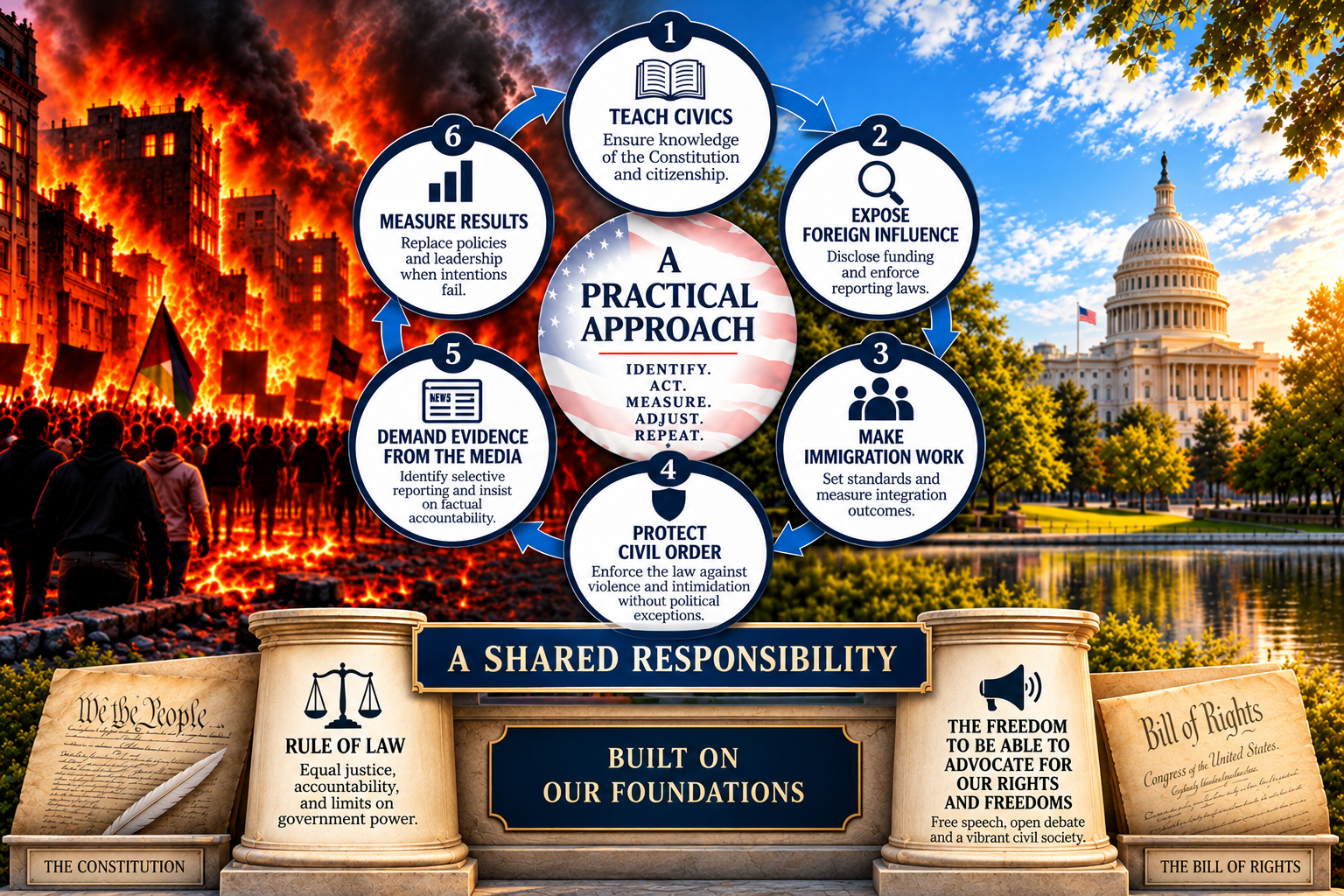
As the banner in the accompanying graphic emphasizes, this is a shared responsibility for all Americans, importantly including American Jews. In “American Jews Ask: How Did We Get Here?,” I argued that our institutions must adapt to a changed environment and place greater emphasis on Jewish security, education, continuity, and Israel’s legitimacy. In “Why Is Antisemitism Still Socially Acceptable?,” I argued that we should learn from the American civil-rights movement, rebuild alliances across communities, and pursue a long-term goal of making antisemitism as socially unacceptable as racism. These objectives require more than statements condemning the latest incident. Jewish organizations must establish clear priorities, invest in approaches that produce results, and be prepared to replace those that do not.
There is one more requirement, and it comes from engineering. Set a goal, measure the result, and be prepared to admit failure. If students leave school ignorant of the Constitution, if foreign contracts remain hidden, or if repeated intimidation goes unpunished, another task force is not the answer. Replace the policy, the leadership, or both. Accountability means consequences, not another press release.
In short, America needs to:
- Teach civics. Require every high school graduate to demonstrate knowledge of the Constitution, civil liberties, and the responsibilities of citizenship. Publish school-level results.
- Expose foreign influence. Disclose university gifts, contracts, and restrictions involving foreign governments. Audit compliance and penalize deliberate concealment.
- Make immigration work. Set enforceable admission and vetting standards. Track language proficiency, employment, education, fiscal outcomes, and civic integration across generations. Change programs that fail.
- Protect civil order. Defend peaceful protest, but prosecute threats, assaults, and destruction without political exceptions. Hold universities accountable for unlawful intimidation.
- Demand evidence from the media. Compare coverage of the same events, identify omissions and misleading claims, and insist on corrections when reporting gets the facts wrong.
- Measure results. Assign responsibility, publish outcomes, and replace policies or leaders that repeatedly fail. American Jewish organizations should apply the same discipline to combating antisemitism, strengthening Jewish education and continuity, building alliances, and defending Israel’s legitimacy. Establish measurable objectives, evaluate results independently, and redirect resources toward approaches that work.
These are not six new bureaucracies. They are six tests of whether existing institutions are doing their jobs.
Billy Joel was right. We didn’t start the fire. My generation lived through many of the crises in his song and watched America accomplish extraordinary things despite them. We owe the next generation more than an account of what went wrong. We owe them institutions capable of correcting their mistakes before the next fire spreads.
Related Topics