Jewish values, leadership, and honest conversation
We Do Not Abandon the Dying
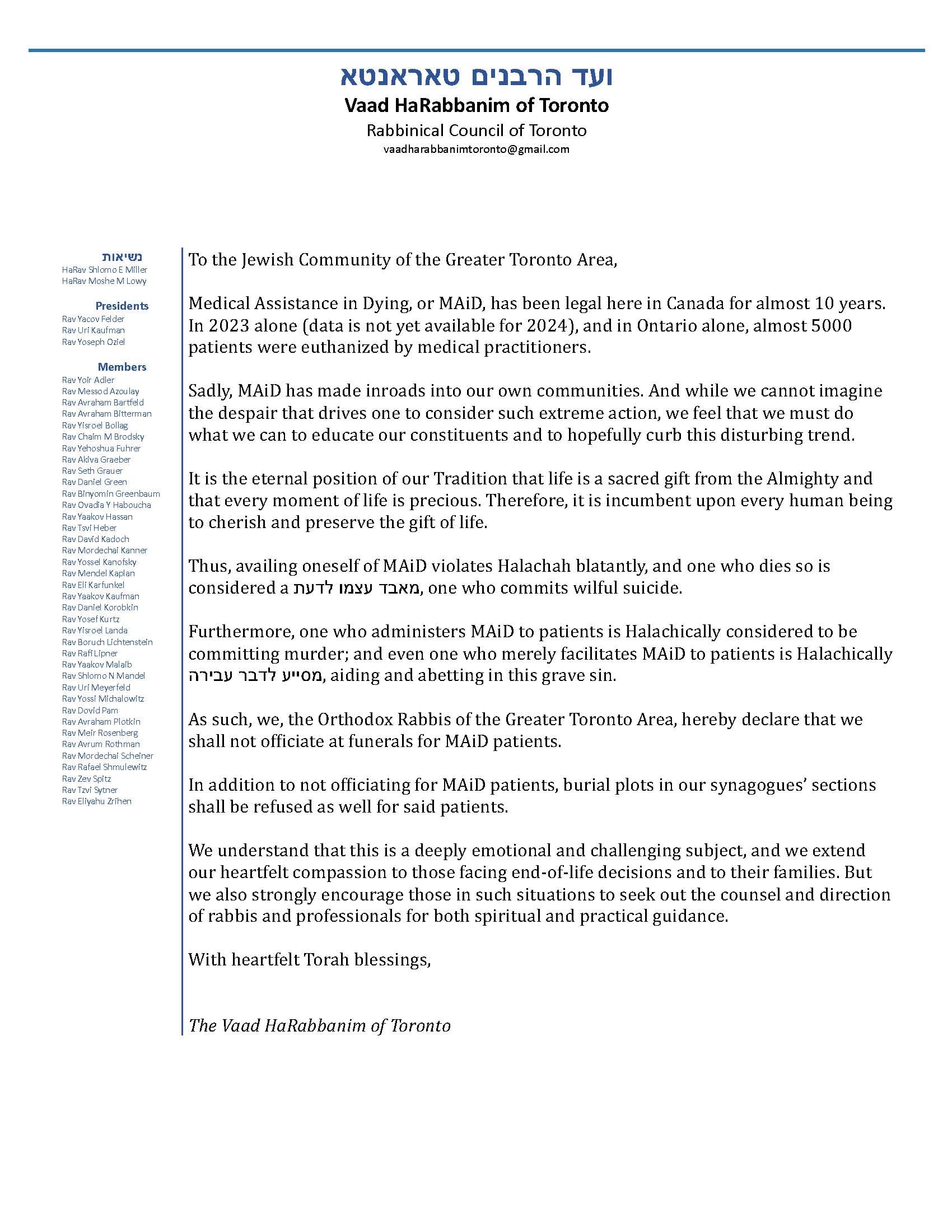
Last week, the Vaad HaRabbanim of Toronto circulated a letter to the Jewish community. It declared that Orthodox rabbis will not officiate at funerals for patients who choose MAiD. Burial plots in their synagogues’ sections will be refused. The letter cites wilful suicide, invokes the prohibition on murder, and draws on serious halachic tradition.
I have read it carefully. I am responding as myself — as a rabbi, as a member of this community, and as someone who has sat at enough bedsides to know what this policy means when it lands on a real family in a real moment of grief.
I will not speak dismissively of the Vaad’s rabbis. They are my colleagues. Their position — that life belongs to God, that b’tzelem Elohim we are created and that image is not ours to extinguish on our own timeline — is serious, textually grounded, and one I share. I do not endorse MAiD. The Torah’s claim on human life is not a medieval relic. It is a living truth I affirm.
But MAiD is also the law of the land. Dina malkhuta dina — the law of the kingdom is the law. That principle is not a concession or a compromise. It is halakha. Canadian law has made MAiD a legal option for those in irremediable suffering. We may oppose it — I do oppose it — and we must engage it. What we cannot do is pretend it does not exist, or that the Jews who choose it, and the families who love them, are no longer our responsibility.
My colleagues on the Toronto Board of Rabbis understand this. Their recent statement — opposing MAiD while pledging full pastoral care to patients and families — reflects the same conviction I hold: that halakha and hesed cannot be separated. That a ruling which produces the degradation of the living and the dead does not fulfill Torah. It contradicts it.
Because here is where I disagree with the Vaad about how halakha works. Our tradition teaches derekh eretz kadmah l’Torah — basic human decency precedes Torah. Not as a lesser value Torah overrides, but as the very ground from which Torah grows. You cannot get to halakha by stepping over the human being standing in front of you. The law and the lovingkindness are not in tension. They are inseparable. And halakha has always existed in balance with lived circumstances — the rabbis who shaped our legal tradition understood that a ruling disconnected from human reality is not stronger halakha. It is halakha unmoored.
The Vaad has separated halakha from hesed. That separation is the error.
Consider what this policy means on the ground. A Jewish woman dies after months of suffering. She chose MAiD. Her family — who may have had no part in her decision — calls a rabbi. They want to bury her beside her parents, in the plot she purchased decades ago. The answer is no. That family does not receive the message that MAiD is wrong. They receive the message that they no longer fully belong to the community that shaped their entire lives.
That is a communal exile delivered to the grieving.
The Talmud asks why the Torah begins and ends with acts of divine lovingkindness — God clothing Adam and Eve, God burying Moses. The answer: v’halakhta b’drachav — walk in God’s ways. God does not withdraw at the boundaries of human life. God draws closer. The rabbis called the highest form of that closeness chesed shel emet — true lovingkindness, given to the dead because those who receive it cannot repay you. No relationship to protect. No gratitude to collect. You do it because it is right.
When a grieving family calls a rabbi after a MAiD death, they are not asking for a halachic endorsement. They are asking what every grieving family asks: Will you come? Will you help us bury our dead? Will you sit with us in the dark?
My answer is yes. It will always be yes.
It is Elul. In two weeks we will stand before God and recite mi yichyeh u’mi yamut — who will live and who will die. For millennia, that question was God’s alone to answer. MAiD has placed it in human hands. That is precisely what troubles me about it — and precisely why I oppose it.
But the family sitting shivah did not make that choice on behalf of all of us. They made it — or watched their loved one make it — in the crucible of unbearable suffering. What we control, what we have always controlled, is how we hold one another in the time we have.
Drawing a boundary around a grave is not a teaching about the sanctity of life. It is a verdict delivered to the living. I cannot accept it. I will not transmit it.
We do not abandon the dying. We do not abandon the dead. That is not a departure from halakha. It is halakha — whole, and as it was always meant to be lived.
Related Topics
Related Posts