
A Moroccan Journalist
We Do Not Believe in God, but He Nonetheless Promised Us Palestine
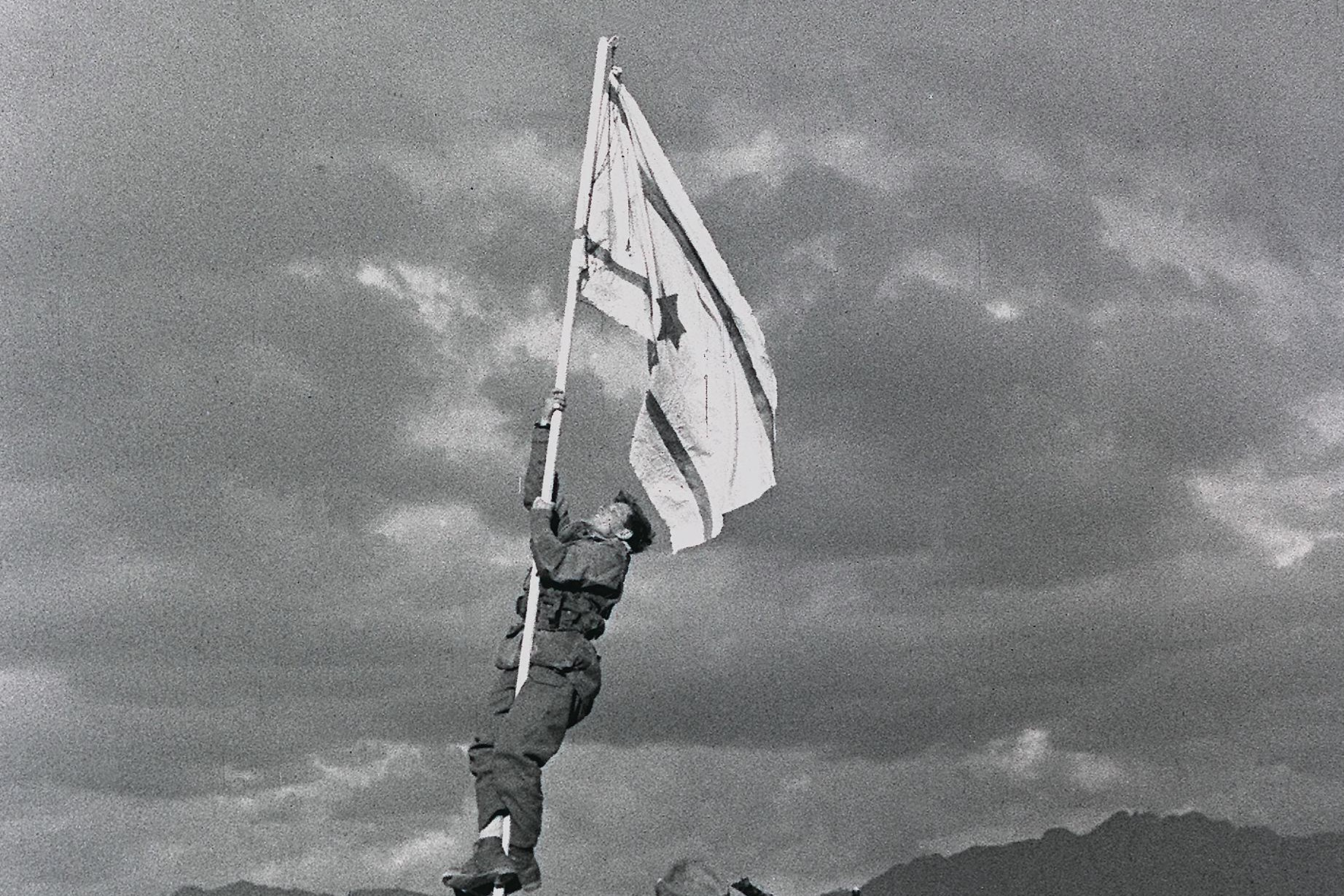
The Ink Flag was a handmade Israeli flag raised in March 1949 at Umm Rashrash (now Eilat), marking Israel’s capture of the area, the end of the 1948 Arab–Israeli War, and the birth of Israel. A photograph by Micha Perry.
Ilan Pappé nails the core contradiction. Early Zionism was, in large part, a secular nationalist movement; yet it reached for scripture like a real-estate deed. In Pappé’s own framing, secular Jews set out to “secularize Jewish life” while using the Bible to justify colonizing Palestine – not out of piety, but as a legitimizing myth for a political project.
Let’s be blunt: Zionism is not a religion. It is a modern political ideology that instrumentalized religion – rhetorically, ceremonially, and diplomatically – to claim land and neutralize opposition. Pappé’s scholarship tears through the fog: the Bible was mobilized as a mythic title deed, while the core of the project remained secular state-building by European settlers in a colonized province of the dying Ottoman Empire.
If the theological register provided the halo, British imperial paperwork provided the hammer. The Balfour Declaration (1917) promised a “national home for the Jewish people” in a territory already peopled, and it did so in the vocabulary of empire – recognizing “non-Jewish communities” only as holders of “civil and religious rights,” not political ones. Sykes-Picot (1916) had already taught London and Paris how to carve the region with ruler and ink; Balfour applied the lesson to Palestine. That is not prophecy. That is power.
Pappé’s broader thesis is devastating because it is documentary, not devotional. In Ten Myths About Israel, he dismantles the catechism: “Palestine was an empty land”; “The Jews were a people without a land”; “Zionism is Judaism”; “Zionism is not colonialism.” These are not creeds; they are political alibis. And when you read the record, the alibis crumble.
Take just one myth: Palestine was empty. It wasn’t. Farmers, towns, roads, a social fabric – lived reality, not blank parchment for Europe’s utopias. Pappé shows this plainly; the emptiness was manufactured in narrative to sanitize dispossession in practice.
Or consider the conflation Zionism = Judaism. That move is the master key of hasbara: criticize a state ideology and you’re told you’ve blasphemed a faith. Pappé calls the bluff. If Zionism were a religion, it wouldn’t need soldiers, land registries, and eviction orders. It would rely on salvation, not settlement; liturgy, not legalese. The fact that it leans on biblical language only underscores the point: religion was weaponized as optics for a thoroughly modern project of sovereignty.
And yes, the paradox is the tell. Many early leaders were secular – some explicitly atheist – yet the divine promise was brandished as public relations and parliamentary leverage. It was a strategy: invoke God for the brochure, use the state for the bulldozer. Pappé captures that irony with the line that headlines this piece; it’s not an aphorism for atheists to chuckle at – it’s an archival diagnosis of how myth was stacked atop mandate law to alchemize conquest into “return.”
From an unapologetically secular, left position, the conclusion is straightforward:
- Religion neither authored nor absolves this project. The scaffolding is imperial policy and settler-colonial method. Scripture was the costume, not the engine.
- Debate-proof myth-making is part of the machinery. If you start from “God promised,” you end with politics wearing a cassock. Pappé’s work rips off that vestment and shows the state underneath.
- De-sacralizing the discourse is a precondition for honesty. Once Zionism is returned to the realm of contestable ideas – nationalism, security doctrine, territorial maximalism – its claims can be weighed like any state ideology, rather than shielded by taboo.
None of this denies Jewish history or suffering; it denies the political utility of myth as indemnity for domination. The moment a modern ideology hides behind a holy book, skepticism is not only permitted – it’s mandatory. And when the archival record shows calculated deployments of that book to lubricate land transfer under empire, the critique becomes an indictment.
Pappé’s verdict is not theological; it’s historical. Strip away the sanctity and you see a 20th-century state project that harnessed imperial green lights, demographic engineering, and narrative control. If faith were decisive, Balfour would have been a sermon, not a letter; Sykes-Picot, a parable, not a map. The real story sits in archives and land deeds, not in canon. Zionism is not religion. It is politics – religion-flavored when convenient, empire-enabled when necessary.
That’s why Pappé’s line should be the title, the thesis, and the litmus test. If a movement “does not believe in God” yet claims His promise, what you’re witnessing is not faith. It is branding. And branding is no substitute for justice.
Related Topics
Related Posts