We Were There From the Beginning: Jews and the American Revolution
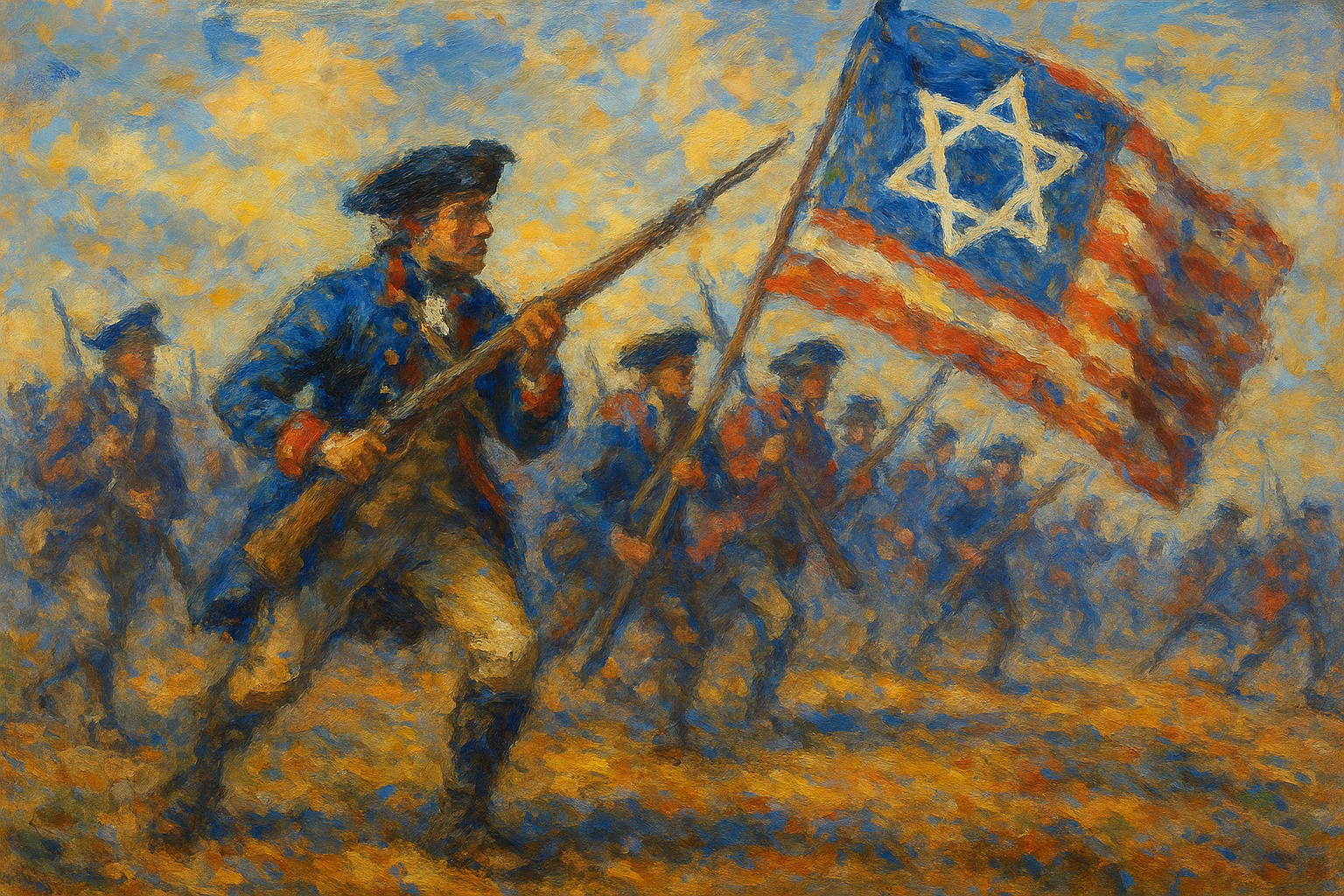
Before the Lower East Side, Jewish colonists were helping invent the United States – testing whether a distinct minority could be fully at home in a revolutionary republic.
When American Jews tell our story, we usually start with the steamship, not the sailing ship.
We picture the crowded tenements of the Lower East Side, sweatshops and picket lines, the great wave of immigration from the late 19th and early 20th centuries. That chapter is real and precious. But it’s not the beginning.
More than a century before Ellis Island, Jews were already here — in New Amsterdam, Newport, Philadelphia, Charleston, Savannah. They wore tri-cornered hats, spoke Ladino and Portuguese, prayed from Sephardi siddurim, and argued about halakha while debating independence from the British crown. They helped build the economic life of the colonies, fought and died in the Revolutionary War, and pushed the new republic to articulate a bold, universal promise of religious liberty — a promise written with Jews very much in mind.
If we want to understand the Jewish place in the American story, we have to start there.
Before Ellis Island: Jews in colonial America
The first Jews arrived in what would become the United States as early as the 1650s, when a small group of Sephardi refugees from Portuguese Brazil reached New Amsterdam (later New York). From there, Jewish communities took root in key port cities: Newport in Rhode Island, Philadelphia, Charleston, and Savannah.
They were tiny in number — roughly 2,000 Jews in all of colonial America on the eve of the Revolution, about one person in a thousand. But their presence was unmistakable. They founded congregations, organized burial societies, and built synagogues. They opened shops and trading houses, imported goods, extended credit, and wove themselves into the mercantile networks that sustained the colonies.
They also encountered the limits of “tolerance.” Jews could be denied citizenship or the right to hold office. In some colonies, they could not vote unless they swore explicitly Christian oaths. Yet they stayed, worked, and flourished where they could, slowly nudging the boundaries of what this “New World” would allow.
One place stood out: Rhode Island. Its 1663 royal charter famously guaranteed an unprecedented degree of religious freedom and separation of church and state — a “lively experiment” in liberty that attracted dissenters of every kind, including Jews. In Newport, the Jewish community built what we now know as Touro Synagogue, the oldest standing synagogue in the United States and a symbol of that experiment.
Already in the colonial period, then, Jews were not just passive beneficiaries of American freedom; they were part of the living test case. Could a society grounded in Christian norms still make space for visible, stubborn Jewish particularity?
Jewish particularity meets American revolutionism
When the quarrel with Britain turned into open revolt, America’s small Jewish community did not stand aside.
Of those roughly 2,000 colonial Jews, many adult men took part in the Revolutionary War in one way or another — fighting, financing, provisioning, or serving in committees. Some were loyalists, but most cast their lot with the Patriot cause. Estimates suggest that around a third of the Jewish population served in the struggle for independence, from Bunker Hill to Yorktown.
We know some of their names.
- Francis Salvador, a Sephardi Jew in South Carolina, became the first Jew elected to public office in the American colonies when he took his seat in the provincial congress in 1775. He was also the first known Jewish soldier killed in the War of Independence, dying in a skirmish against Loyalists and their Cherokee allies in 1776.
- Mordecai Sheftall of Georgia, a devout Jew and prominent merchant, became a high-ranking supply officer for the Continental forces in the southern theater. He used his own resources and credit to provision Patriot troops — and was captured and imprisoned by the British for his efforts.
- Haym Salomon, a Polish-born immigrant in New York and later Philadelphia, has been remembered — and sometimes mythologized — as a key financier of the Revolution. Arrested by the British as a suspected spy, he escaped, restarted his business, and repeatedly raised funds and extended personal credit to the Continental Congress, helping keep the war effort solvent in its darkest financial moments.
There were dozens more: soldiers, sailors, merchants, artisans, and community leaders who shouted “Liberty!” in English and “Baruch Hashem” in Hebrew.
What made their role distinctive was not only what they did for America, but what they asked from America in return.
They did not ask merely to be “tolerated” as an odd minority under Christian indulgence. They asked to be full citizens — no more, no less. As Jews, they insisted on circumcision, kashrut, Shabbat, and Hebrew prayer. As American patriots, they insisted that these practices were compatible with the new republic’s ideals. Their very existence made the Revolution’s rhetoric of “unalienable rights” and “liberty of conscience” concrete and demanding.
Washington’s letter: a Jewish–American covenant
This negotiation between Jewish particularity and American universalism is crystallized in one of the most important documents in early American history: George Washington’s 1790 letter to the Hebrew Congregation in Newport, Rhode Island.
During his visit to Newport, President Washington was greeted by various delegations. Among them was Moses Seixas, warden of the Touro Synagogue, who delivered an address praising the “Government, which to bigotry gives no sanction, to persecution no assistance,” and expressing Jewish gratitude for the newfound “invaluable rights of free citizens” after centuries of exclusion.
Washington’s written reply, dated August 18, 1790, echoed Seixas’s phrasing and went even further. The government of the United States, he wrote,
“gives to bigotry no sanction, to persecution no assistance,”
and it is “now no more that toleration is spoken of, as if it were the indulgence of one class of people that another enjoyed the exercise of their inherent natural rights.”
For Jews, this was nothing less than a new kind of covenant.
In Europe, even in relatively “tolerant” countries, Jewish life depended on charters and privileges that could be revoked at a monarch’s whim. In the new United States, Washington insisted, Jews did not live by someone else’s indulgence. Their religious practice flowed from their inherent natural rights as human beings and citizens — rights the state was bound to respect.
The letter is often read today as a milestone of American religious freedom in general, and rightly so. But we should remember that it was written to Jews, responding to a specifically Jewish voice asking whether a people who refused assimilation could still be equal partners in the American project.
Washington’s answer was yes.
Why this early chapter matters now
Why does any of this matter in 2025, to readers of The Times of Israel?
Because in a time of resurgent antisemitism and polarizing politics, both in the United States and worldwide, the question “Are Jews really part of this?” is back on the table — sometimes shouted in our faces, sometimes whispered behind our backs.
On American campuses, we hear that Jews are “colonizers” or “white adjacents” with no authentic minority claim. On parts of the political right and left, we hear that Jews are perpetual outsiders, suspected of dual loyalty or blamed for whatever cultural change someone fears most. And in our Israel–Diaspora conversations, we sometimes slip into a story where Jewish belonging in America is a recent, fragile, conditional achievement, always on probation.
The colonial chapter tells a different story.
It reminds us that:
- Jews were present from the beginning of the American experiment.
- Jewish merchants, soldiers, and financiers helped win the war that brought the United States into being.
- Jewish communities actively shaped the emerging American conversation about religious liberty and equal citizenship.
We did not arrive in America as latecomers asking for special favors. We were co-authors of the script.
And we did it as Jews — not by hiding our difference, but by insisting that our difference could live inside a shared civic framework.
A bridge back to Zionism
There is also a bridge here between the American and Israeli stories.
Long before modern Zionism, colonial Jews were already practicing a kind of “diaspora political theology” that held two things together:
- Particular covenant: our obligations as Jews — to halakha, to community, to memory.
- Universal revolutionism: a belief that all human beings deserve dignity, freedom of conscience, and equal citizenship under law.
When we talk about a Jewish and democratic state today, or about the obligations of Jewish power in Israel, we are walking similar ground. We are still trying to live in the tension between what makes us am segulah, a particular people, and what binds us to universal norms of justice and liberty.
The Jews of colonial America did not solve this tension. But they lived it honorably. They defended their right to maintain distinct Jewish communities and to be full participants in a broader civic project. They helped push America to articulate its highest ideals — and then held the country to them.
Telling the story from the real beginning
So perhaps our storytelling needs an update.
The American Jewish story doesn’t begin with a Yiddish-speaking family docking at Ellis Island in 1905. It begins with a Sephardi minyan in a drafty wooden building in Newport, or a Jewish merchant in Charleston signing up for the Patriot militia, or Haym Salomon risking his life and fortune for a Continental treasury that might never pay him back.
It begins with Moses Seixas writing to the new president as a proud Jew and a proud American, asking: Will this republic be different? And George Washington, in that famous letter, responding: Yes. To bigotry, no sanction; to persecution, no assistance.
For American Jews, and for Jews everywhere who watch the American story with hope and anxiety, that early chapter is not nostalgia. It’s a claim.
We were there from the beginning. We helped build this country. And we helped teach it what freedom means.