
A Moroccan Journalist
Western Sahara Is Moroccan
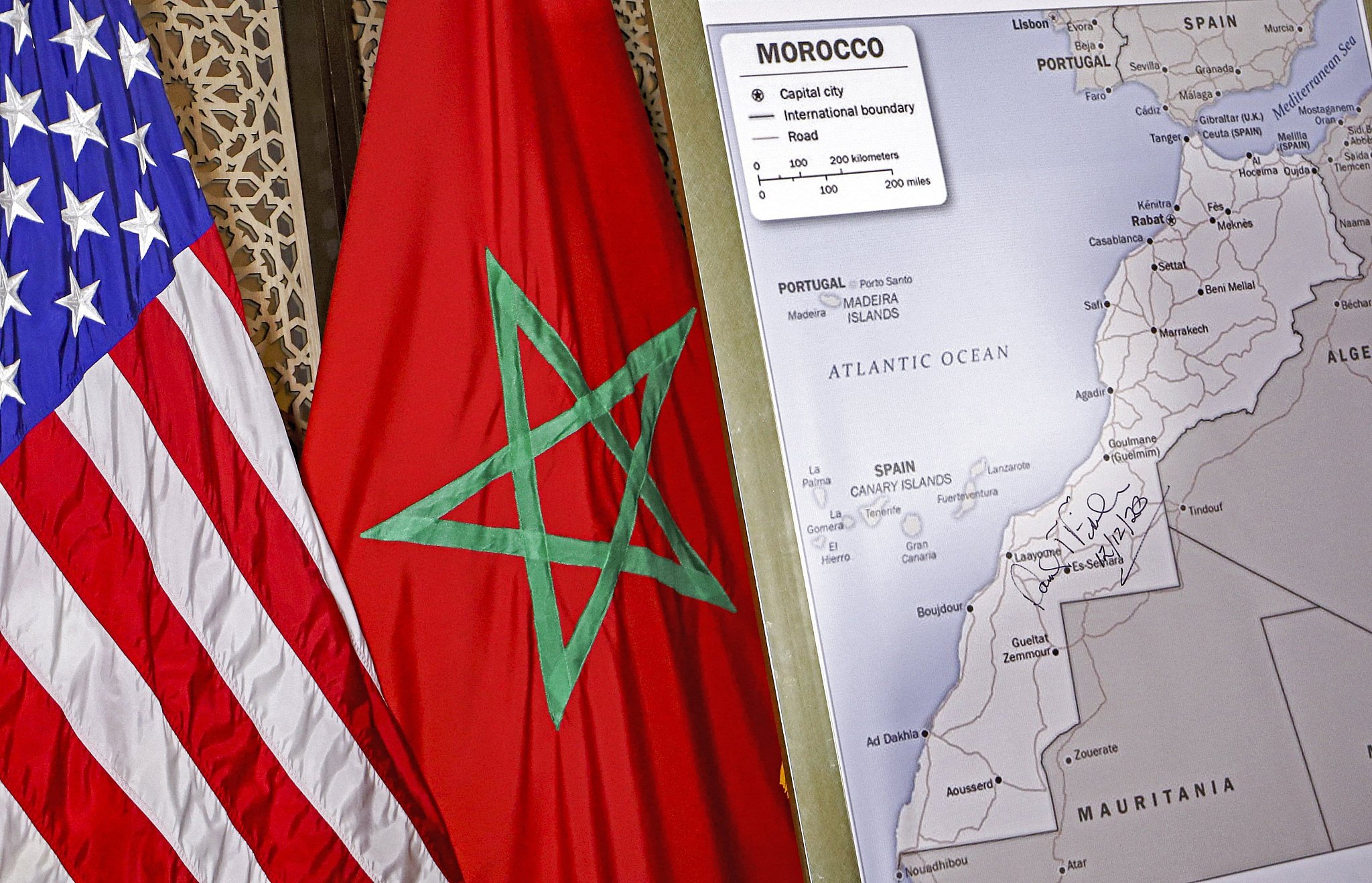
This photo (December 12, 2020) shows the Moroccan and US flags beside the US State Department map officially recognizing the Moroccan Sahara, signed by former US Ambassador David T. Fischer in Rabat. Since that recognition, Spain (2022), Israel (2023), France (2024), and the UK (2025) have followed in acknowledging the Sahara as fully Moroccan. (AFP)
No region of North Africa has been more persistally assailed by the corrosive geopolitics of external ideological manipulation than Morocco. If the State of Israel confronted the Iranian axis by way of Hamas in Gaza and Hezbollah in Lebanon – militias engineered to encircle a sovereign nation with permanent destabilization – Morocco has confronted the same architecture in the Sahara, where the Polisario Front, sheltered and weaponized by Algiers and Tehran, has for five decades functioned as a proxy apparatus, designed not to liberate a people, but to permanently stall the political horizon of an entire region. And proxies, by definition, can never be states; they are instruments, not nations.
The Sahara artificial dispute is not a question of identity or decolonization anymore; it is the continuation of a Cold War strategy repackaged through the rhetoric of “resistance,” “anti-imperial struggle,” and, tragically, slogans emptied of history, meaning, or moral seriousness.
If Algeria’s current generals have chosen to forget history, the archives have not. One does not need to excavate medieval chronicles to recall what the International Court of Justice (ICJ) affirmed in its 1975 advisory opinion: the tribes of Saguia el-Hamra and Oued Eddahab maintained legal and political ties of allegiance (bay‘a) to the Moroccan Sultans.
From the Almoravids (1040-1147), who unified Morocco and extended authority as far as Senegal and the Niger valley, to the Alaouites (ruling since 1631), who consolidated power and safeguarded the Saharan caravan routes, sovereignty over the Sahara was lived, exercised, and recognized, not merely imagined or claimed.
Long before colonial cartographers drew borders with foreign inks and straight rulers, Moroccan rulers governed, taxed, mediated disputes, and ensured protection across these southern expanses. The Sahara was never terra nullius or a vacuum awaiting invention; it was a continuation and a southward extension of Morocco’s political geography and sovereign memory.
Calling it “Western Sahara” today is not anti-Moroccan – on the contrary, it is historically precise. Morocco has two Saharas: the Western Sahara, which returned to Moroccan sovereignty in 1975, and the Eastern Sahara, which includes Tindouf, Béchar, Touat, and Kenadsa, territories amputated by French colonial cartography and attached to Algeria under the illusion that Algeria would remain forever French. Foreign observers often misunderstand this.
The Western Sahara is not contested on the ground: Morocco exercises full administration, security, development, elections, and civic life there. The Polisario does not control the territory; it operates exclusively from the Tindouf camps inside Algeria, under military guardianship. There are no “frontlines” or “border crossings” in Laayoune or Dakhla. One travels to these cities exactly as one travels to Marrakech, Casablanca, or Fes – normal civilian life under full Moroccan sovereignty.
The recent adoption of UN Resolution 2797 on October 31, which identifies Moroccan autonomy as the basis of the political solution rather than an option among many, is more than a diplomatic outcome. It is a tectonic reorganization of the intellectual and legal grammar of the dispute. The United Nations has now admitted, without euphemism, that the world cannot continue to indulge the fiction that a fragmented tribal confederation – whose social fabric transcends imaginary colonial borders – constitutes a nation-state waiting to be born.
The “Sahrawi” identity that Polisario claims to defend is, in its very construction, an artefact of ideological engineering: an identity assembled in the workshops of Cold War agitators, romanticized by post-1968 Western radicals, and instrumentalized by military elites in Algiers to manufacture an external enemy that stabilizes authoritarian rule at home.
Algeria’s political establishment has survived for six decades by incarcerating its own fears within its borders and exporting its political anxieties beyond them. The Sahara conflict is not about the Sahara; it is about the Algerian regime’s terror of internal reckoning. To recognize Morocco’s sovereignty would be to recognize the violent fragility of the post-colonial Algerian state, born not of national consensus but of revolutionary inheritance confiscated by generals. Thus, the Polisario Front stands today not as a liberation movement, but as a political respirator sustaining a regime whose legitimacy would collapse the moment its last external enemy evaporates.
It is here that the ideological kinship between Algiers and Tehran crystallizes with chilling clarity. Both regimes deploy the discourse of “resistance,” “revolution,” and “liberation” as masks for internal failure. Both are sustained by necropolitical economies in which the suffering of populations – whether in Tindouf or Gaza – is converted into diplomatic capital.
Both cultivate nostalgia for wars that have ended, because the memory of struggle is the last resource they possess in the absence of developmental legitimacy, democratic credibility, or historical purpose. The “axis of resistance” is not a coalition of the oppressed; it is a cemetery of stagnant revolutions, embalmed in slogans and cursed to repeat themselves.
To insist today that Morocco “fears” self-determination is not only false – it is intellectually unserious. Morocco accepted self-determination at the United Nations in the 1970s, and it remains the only actor that has presented a viable model for its exercise: autonomy under sovereignty, rooted in constitutional guarantees, regional governance, and developmental integration.
The question has never been whether the inhabitants of the Sahara have political rights – they do, and their participation in Moroccan regional institutions already demonstrates it. The question is whether “self-determination” should be transformed into an amputative instrument of political tribalization engineered in Algiers, or whether it should be anchored in the 21st-century meaning of citizenship, accountability, and nationhood.
And here lies the fundamental tragedy: separatism in the Sahara is not a struggle for freedom; it is the last gasp of tribalism in a century that has already surpassed it. Nations today are built not on clan genealogies, nor on the fossilized mythologies of colonial anthropologies, but on constitutional belonging.
The Moroccan Sahara is governed today by elected regional councils; its inhabitants vote, build, invest, and live under a system that recognizes both their Hassani cultural heritage and their national identity. In Dakhla and Laayoune, ports rise, universities expand, women lead regional councils, and renewable energy plants feed into trans-African corridors. Meanwhile, in Tindouf, time stands still – deliberately – because the Polisario leadership requires immobility; movement would dissolve the myth.
The leftist rhetoric that once sanctified the Polisario belongs to the museum of intellectual embarrassments. The slogans of “people’s liberation,” “anti-imperialist struggle,” and “revolutionary dignity” ring hollow in a world where the camps of Tindouf resemble open-air archives of political failure, where generations are denied identity documents, mobility, or even the right to leave. There is no liberation here – only sequestration. And there is no ideology left – only resentment curated into a political program.
What Algeria and its patrons cannot accept is precisely what the United Nations has now confirmed: the future has already shifted. The framework is now autonomy under Moroccan sovereignty. The referendum is dead – not defeated, but rendered obsolete by history itself. The Sahara’s destiny is no longer a battlefield of an exhausted Cold War dialectic. It is a node of Atlantic-African integration: a corridor linking West Africa to Europe, a geopolitical hinge of energy transition, maritime connectivity, and continental diplomacy.
The region is entering a new era, and those who remain chained to the corpse of past ideologies will find themselves speaking to a world that no longer exists.
Morocco’s struggle has not been one of conquest, but of restoration: restoring a history ruptured by colonial scissors, restoring a national continuity fractured by foreign cartography, restoring a dignity that was always present, always known, always lived. The Green March of 1975 was not merely a peaceful procession of 350,000 citizens – it was the political reappearance of a truth that colonial treaties had tried to erase.
Today, Resolution 2797 does not grant Morocco legitimacy; it recognizes the legitimacy that never disappeared. And in doing so, it signals the end of the era in which tribalism could masquerade as nationhood and geopolitical sabotage could masquerade as emancipation.
The question now is no longer who owns the Sahara. That answer is known, anchored, affirmed.
The question is: who is prepared to live in the 21st century, and who insists on remaining in the ruins of the 20th?
Related Topics
Related Posts