The views expressed herein are solely mine.
Western Sahara Shows Israel the Way
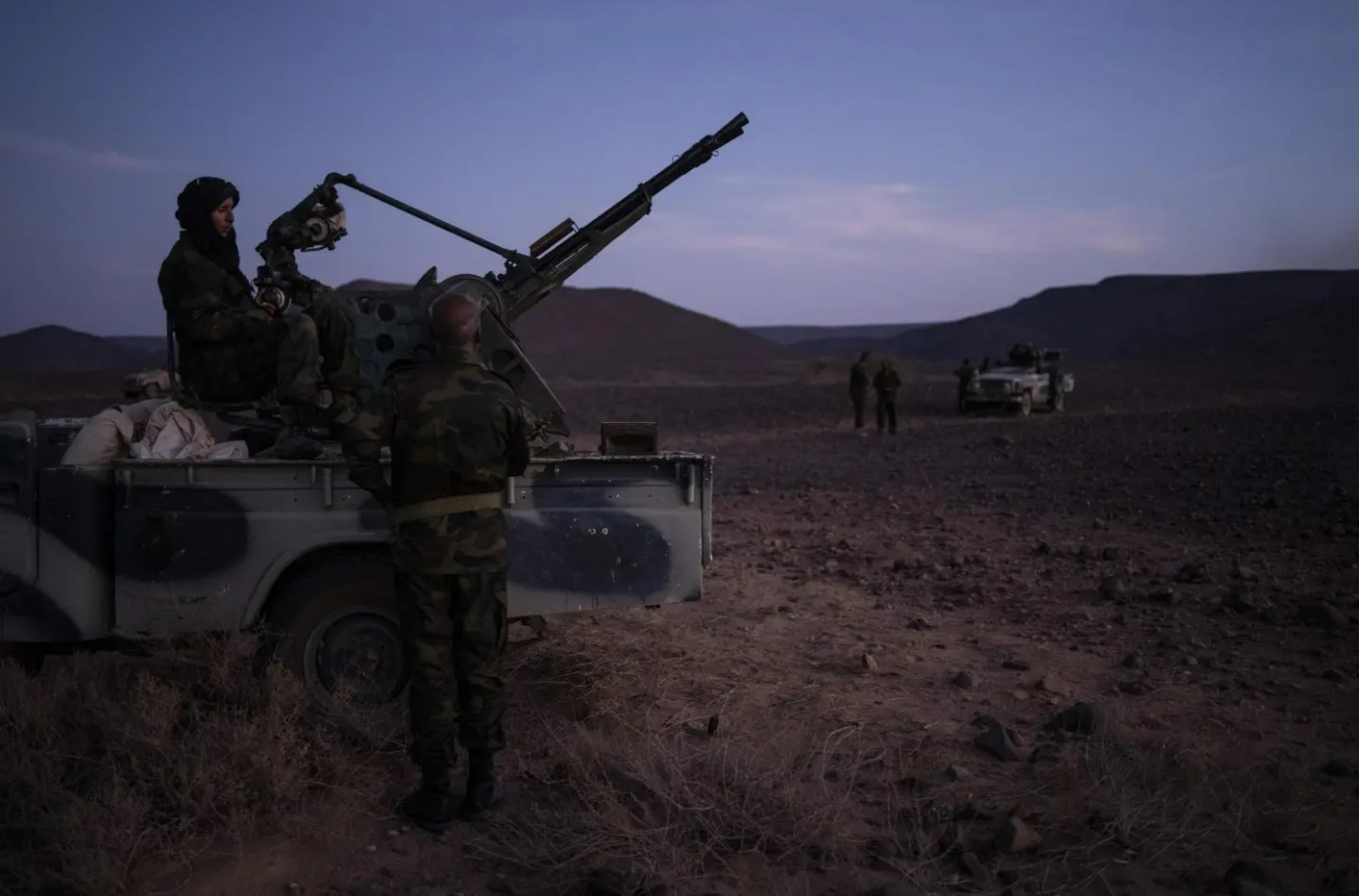
Polisario front soldiers talk during a shooting exercise near Mehaires, Western Sahara, October 13, 2021. (AP)
Morocco just showed the world something the Middle East rarely produces: a conflict-management model that major powers, the UN Security Council, and serious Western capitals can actually accept — and strategically work with.
In Western Sahara, Rabat has secured international backing for an autonomy plan that keeps Moroccan sovereignty, grants real local self-rule, and avoids the suicide pact of “statehood first, security later.”
The UN Security Council has recently referenced Morocco’s 2007 Autonomy Proposal as the basis for a “just, lasting and mutually acceptable” solution.
In plain English: the international system has quietly blessed a model that buries the old “referendum or nothing” dogma and replaces it with a hybrid of sovereignty plus self-government.
At the core of Rabat’s blueprint is a simple division of labor.
Morocco keeps the hard-sovereignty files: national defense, borders, foreign policy, currency, and religious authority.
The Sahara Autonomous Region would oversee its own internal security, education system, local taxation, economic planning, healthcare, housing, and cultural institutions through democratically elected bodies.
In geopolitical terms, this is the middle ground the international system keeps claiming it wants: genuine self-rule without dismantling a sovereign state.
Beyond doubt, it is not independence. It is not an occupation. It is the uncomfortable reality diplomats acknowledge privately but the world publicly pretends not to see.
Effectively, it is a structured dependency with real local authority—enough autonomy to govern daily life, not enough to threaten the state.
And who recognized this as legitimate? Israel.
In July 2023, Benjamin Netanyahu sent King Mohammed VI a formal letter recognizing Moroccan sovereignty over Western Sahara, aligning Israel with Washington, Paris, and the Security Council’s emerging consensus.
In other words, Jerusalem has already endorsed the premise that a disputed territory can be stabilized through autonomy under secure sovereignty instead of manufacturing yet another fragile, militia-ridden “state.”
Now zoom east to the West Bank.
Roughly 3 million Palestinians live there, alongside some 400,000–600,000 Israeli Jews (depending on how one draws the map).
The population is extremely young: around two-thirds under 30, and more than a third under 15—a textbook “youth bulge” in an economy with chronic unemployment and no realistic hope of absorbing that labor force under the current, decaying Palestinian Authority.
Before the Gaza war, unemployment in the Palestinian territories hovered around 25%-30%.
By late 2024 the overall jobless rate had exploded to roughly 51%, with about 35% in the West Bank and around 80% in Gaza.
This is not just economic hardship. It is a structural collapse—exactly the kind of vacuum jihadist militias and Iranian proxies know how to exploit.
Layer onto that the raw security reality.
Since Israel’s withdrawal from Gaza in 2005 and before October 7th, 2023, terrorists in the Strip fired more than 30,000 rockets at Israeli towns and cities.
After Hamas’s massacre in 2023, over 19,000 rockets were launched from Gaza and Lebanon in mere months, turning much of Israel into a permanent civil-defense drill.
This is what an ungoverned or ideologically radical “statelet” looks like on Israel’s border.
Thus, anyone proposing a Gaza-style sovereignty regime in the hills overlooking Ben-Gurion Airport is asking Israel to commit national suicide for the sake of European talking points.
This is why the Moroccan template matters. It offers a language, a precedent, and a legal architecture for what a sane, pro-Israel, pro-Western settlement in the West Bank could look like: autonomy—real, legislated, internationally underwritten—inside non-negotiable Israeli security sovereignty.
Practically, this means Palestinians in the West Bank would elect their own regional parliament and executive, run schools, hospitals, local police, municipal budgets, business regulation, and cultural life—much like the Sahara Autonomous Region.
As part of this model, Israel retains ultimate control over borders, airspace, counter-terror operations, and strategic corridors like the Jordan Valley, mirroring Rabat’s retention of defense and foreign affairs.
Without a doubt, this model does three things that the “two-state solution” never honestly addressed.
First, it recognizes that the West Bank is not a blank slate.
Right now thousands of Israelis live there, Israeli security infrastructure is deeply embedded, and the territory sits atop Israel’s vulnerable waistline.
Indisputably, no serious Israeli government—left, right, or center—will hand that high ground to a regime that can be overtaken by Hamas, the Palestinian Islamic Jihad, or an IRGC proxy the minute Western diplomats look away.
Second, it acknowledges that Palestinians do need meaningful self-government to avoid permanent dependency and humiliation.
Unquestionably, they need to vote for leaders other than the corrupt PA oligarchs. They need control over economic policy, investment incentives, and local policing—not because the “international community” demands it, but because without middle-class normality the youth bulge becomes a recruitment list for every Islamist militia carrying cash and Kalashnikovs.
Third, this scheme is honest about who pays when utopian experiments fail.
Western diplomats do not live under rocket fire. Israeli families do. Ordinary Palestinians do.
Tragically, the “state now, disarm later” fantasy produced Gaza—an economy that contracted by 80% in the war’s early months, with unemployment surpassing 80%, and one report projecting it could take centuries for Gaza’s GDP to return to its pre-war trajectory.
Irrefutably, the Strip is not just another disputed territory. It is a devastated enclave of roughly 2.1 million people—47% of them children—with 90% of the population displaced at the height of the war and infrastructure damage comparable to the worst destruction seen since World War II.
Patently, Gaza is not ready for sovereignty, autonomy, or yet another cycle of militant rule with a fresh logo.
Clearly, it is a security and humanitarian black hole at the intersection of Iranian strategy, Turkish and Qatari ambitions, and Western guilt.
That is exactly why Gaza needs something harsher and more honest than another “peace process”: international trusteeship.
Call it an interim international territory, a UN–Arab–Western mandate, a NATO-adjacent zone—it does not matter.
The essence is simple: no armed factions, no independent army, no rocket factories, no Iranian bases, no terror finance.
Under this framework, regional security forces and vetted Palestinian police keep order. International technocrats and Arab partners rebuild basic services. Israel retains hot-pursuit rights against any rearmament attempt.
But why is this scenario all but destined to become the endgame?
Because we already know what happens when Gaza is left to militias and foreign money.
Hamas turned every hospital and school into bunkers, every ceasefire into rearmament, and every foreign check into tunnels and rockets.
The result was the massacre of 1,200 Israelis on October 7th, 2023, and a war whose human and economic cost for Palestinians has been catastrophic. Repeating that experiment—demanding “Palestinian statehood now” again—would not be progressive or humanitarian. It would be criminal negligence.
Morocco’s example does not solve the Israeli–Palestinian conflict.
But it demolishes the lazy assumption that the only choices are full independence or permanent occupation.
Now, Western Sahara has an internationally endorsed framework in which one side keeps sovereignty, the local population gains robust institutions, and the world shifts from slogans to statutes.
And here is the sharpened truth: even though more than 85 countries recognize the Saharan people’s right to self-determination, nearly all of them quietly accept Morocco’s autonomy plan instead.
Take Spain’s loud, hypocritical prime minister: he cheers Sahrawi independence in speeches, but refuses to back it where it counts.
The double standard is glaring.
Sanctimoniously, when Israel proposes an analogous autonomy architecture for the West Bank, an immediate revolt of “human-rights” indignation erupts.
The world loves sovereignty when it maintains stability; it hates it when it protects Israel.
Imprudently, the world will back Palestinians regardless of logic but stay silent on Saharan autonomy because it does not threaten the anti-Israel narrative; the hypocrisy is monstrous.
And let’s be clear about what the “Western interests” behind Morocco’s autonomy model really are: the territory is rich in rare earths, cobalt, lithium, phosphate, and strategic minerals vital to defense, energy, and electric-vehicle industries.
Western powers do not invest millions, build ports and pipelines, or host ambassadors out of altruism. They want supply chains, geopolitical leverage, and stable friendly regimes.
Morocco delivers all that—while many Western states pretend Israel’s sovereignty does not deserve the same logic.
Consequently, Israel should take yes for an answer. It already recognized Moroccan sovereignty over the Sahara. It already lives under constant rocket trial-by-fire proving that ungoverned Palestinian sovereignty is an existential threat, not a noble experiment.
The rational, pro-Western, pro-Israel path is crystal clear: autonomy in the West Bank under secure Israeli sovereignty.
In parallel, an international trusteeship in Gaza until demilitarization, reconstruction, and political detoxification are real is the only true solution.
Let’s be honest: another utopian “solution” that collapses under its own illusions, but a hard, unsentimental settlement grounded in what actually works in this region is the only real lasting peace for both Israelis and Palestinians.
Because here is the strategic bottom line: if autonomy is deemed a legitimate settlement model for Western Sahara, it is equally viable for Judea and Samaria. And if the international system can recognize Moroccan sovereignty without collapsing into moral panic, it can stop performing outrage at the mere assertion of Israeli sovereignty.
At some point, the charade must end. The hypocrisy stops here.
Related Topics
- Abraham Accords
- Benjamin Netanyahu
- Donald Trump
- Europe
- Gaza
- Gaza Border
- Gaza Disengagement
- Gaza Rocket Attacks
- Gaza Strip
- Hamas
- Hezbollah
- Iran
- Islam
- Israel At War
- Israel-Iran Conflict
- Israeli Foreign Policy
- Israeli-Palestinian Confederation
- Jerusalem
- Jewish-Arab violence
- Jordan
- Lebanon
- Morocco
- October 7 anniversary
- Palestinian Authority
- Palestinian Elections
- Palestinian Statehood
- Palestinians
- Peace Builders
- Peace Process
- Peace to Prosperity
- Qatar
- Spain
- Terrorism
- The Arab World
- Trump Peace Plan
- Turkey
- United Nations
- West Bank
- Zionism