Psychology, Medicine, Physics, Politics, Sociology, Philosophy, Judaism, etc.
What are most Orthodox Jews doing wrong?
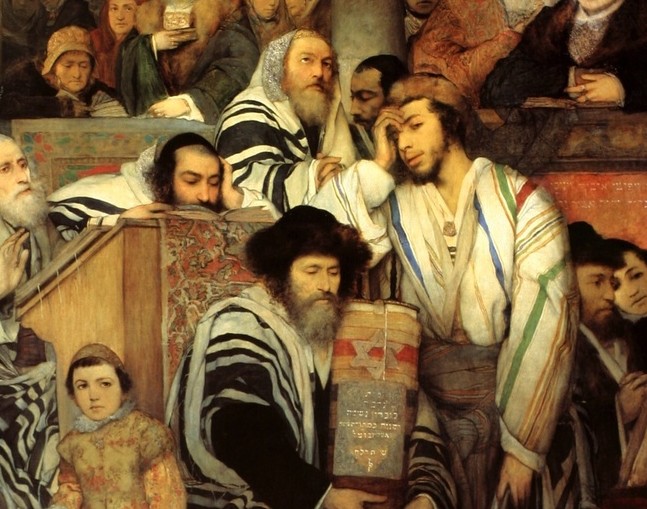
Illustrative. Jewish boys and men in the synagogue on Yom Kippur, by Maurycy Gottlieb, 1878. (Wikipedia)
Reading time 11 minutes
There are three major problems in present-day Judaism that may have a common solution. I even may have two or three different resolutions for them.
These are the three problems:
- So many Jews who grew up in a Torah-observing home leave that way of life to a significant degree. It’s easy to blame that on those who leave or on that it’s harder to be religious nowadays but wouldn’t you like to know how to prevent this? Preventing abuse (don’t forget incest) certainly would help. But there must be more we can do.
- So many Jews do not live a Torah-observing lifestyle in a significant way and we don’t inspire them to change that. Those responsible for that are we, the religious Jews. Reb Shlomo Carlebach says: Don’t blame them for not coming to the synagogue. If the restaurant is good, people come and eat there. Then what should we do?
- So many of the Jews who live a life filled with Torah learning and doing Commandments seem sad and tired. The Torah warns us that the most horrendous curses would befall us if “you won’t serve G-d, your G-d, with gladness and goodness of heart from everything being in abundance” (Deuteronomy 28:47). The curses are not for people who rebel and disobey all the way. They are for people who obey but in a wrong unhappy fashion. And we’ve never been so rich and sad.
I think that there is a simpler way and there is a harder way to solve all these three problems. And the simpler way has an easier way and a harder way. Let’s start with the easier way of the simpler way.
The Easier Way of the Simpler Way
Moses tells us (Deuteronomy 30:14) that the Commandments are really easy to do. Their enactment is “very close to you, with your mouth and with your heart.” With your heart means by understanding. But what is with your mouth doing there?
Let me suggest that this means the corners of your mouth. Pull them up! Smile. First smile, then try to internalize that feeling.
When you smile, every Commandment becomes easier. If you want to do them, you’re even no longer obligated to obey! (The obligation is only for when we don’t feel like it. But the second you want to do them, you are obligated to follow up on your wish, so in any case, you do commanded Commandments, but not because you should but because you want to.)
When we smile, our whole service is different. And it’s Judaism that transmits to our kids. As we say in the Shabbat morning Kiddush: To make something of the Shabbat will make it for your generations to come into a Covenant. But if you drag yourself through your day, weary of all the obligations, there are two possibilities: You’ll have children and student who will copy that dutifully and you’ll have those who’ll say: what do I need this for? Not because they have a free will to go against your ways but because you corrupted the Jewish way, acting as if it’s a burden to be a Jew, something utterly unattractive.
In truth, it’s great to be a Jew. It may be tough, at times, but great nevertheless. Because G-d ordered everything only for our good, to have a good life. Really, He doesn’t need our service. Rather, He wants our service like the parent who says to his small child, when bringing in the shopping: Would you please carry the bananas? With a glowing face, he’s carrying in the bananas. I’m helping daddy.
How are not so religious Jews supposed to even think about joining us a bit if we look sad, angry, stern, absent, hostile, tired, all the time? They come into a synagogue and see people slumped into their benches, exhausted, depressed, racing through some mumbled words, maybe singing some lullabies. What is there to gain?
They see religious Jews in the news or in the street and they always seem to know better than everyone else. They won’t even look at you. (I’m not talking about the holy exceptions; I’m talking about the majority.) One check-out lady at the supermarket told me: If all religious Jews were so friendly and happy as you, everything would change.
Are we possibly doing the Commandments to gain a better Afterlife? Well, if so, it shows. The Sages warn us (Mishneh Avot 1:3) not to serve G-d as a slave who serves his master for the reward. To do our best for a candy was fine when we were small, but now we should stop serving idols (ourselves) under a bogus flag of serving G-d. But then, if it’s not for our gain, why make all the effort? Because being kind, keeping Shabbat, not getting angry ever, etc. are the right thing to do. Because such a life is the best expression of who you really are.
Being happy doing the Commandments will give you a good life, lets you enjoy it, makes your children look forward to a similar life and makes others curious for having some of that too. That’s the easier of the simpler way.
Why being happy? Without reason (bechinam). When you’re happy, you’ll realize millions of reasons for being glad (we will do and then we will realize why – Exodus 24:7) but you don’t depend on them. You’re happy without preconditions.
The Harder Way of the Simpler Way
Same as the above, but first trying to find enough reasons to be happy with your share. It is important to be happy with our share because, without that principle, it will never be enough. The one who has 50 want a 100. The one who has a 100 want 200. The one who has 200 want 400. Not only is it never enough. The more one has, the more one lacks. (The one who has 50 only lacks 50; the one who has 200 lacks 200.) This is a bottomless pit that will never fill up. Maybe you really could use a little more in life but before you try to get “a little” more, try to be satisfied with what you have already. That’s why the above verse talks about “everything being in abundance.” Probably, it’s not real poverty or lack that “is making you” sour-faced. (In fact, nothing makes you sour. You use bitter facts to justify that you are making yourself sour.)
So, if you don’t want to do it the easier way, just to be happy without cause, try to amass “reasons” for your fulfillment.
● You’re born and stayed alive more than a second. How lucky you are!
● If you’re a Jew, how lucky you are to be part of this wondrous People with this fantastic heritage, calling and optimistic outlook!
● If you made it to Israel, you’re more fortunate than Moses – and so many holy generations before us!
● Be happy with the half of the glass that is full. If it’s empty, be happy with the glass. If you don’t have a glass, be happy that it doesn’t need storing, cleaning, can’t break, can get lost, can’t be stolen, can’t give jealousy in others or arrogance in you.
The harder or the easier way of the simpler way, be happy and show it.
The Harder Way
For those who want more than the above, there is another way that I know. It involves a few little pieces of analysis. Not more.
How do children learn to speak? First, they copy the grownups around them. Then comes a phase in which they seem to speak less well. Watch them and you’ll see that now they are training their muscles to produce the separate different sounds. No as a copycat but from consciously producing the sounds. They are forming them. They’re speaking, not parroting anymore.
And that’s how we learn to be religious. First, we copy.
I return from synagogue and my friends tell me that my one-year all had been standing with a book (upside down), swaying in concentration, moving his lips, for forty minutes. That is what daddy does in the morning and that is what I can do too.
However, many of us stop at the first phase. We copied and now we are religious Jews. Most newly religious and converts also have this as their first step.
But we say in the First Blessing of our thrice-a-day Main Prayer “our G-d and the G-d of our Ancestors.” Our G-d comes first. So, it’s not correct to have our parents’ Judaism and add some of our own.
(This is not the only instance of sequence mattering. Like all Blessing, which have the Shem haShem before Elokeinu. The first connotes a merciful appearance; the latter represents a more stern manifestation. Our Father, our King is also in that order. When getting to know Shabbat, first taste its goodness; later learn its injunctions.
This order is not just to help us ease into the idea of G-d.
Rather, one should see G-d as benevolent but still have a little Fear of Heaven as safety measure of last resort against potential gross stupidity. (See below, the second Complication.)
Which nicely jives with the principle that repentance from love of G-d is better than from dreading Him. We just reciprocate when we realize that all our Partner does is from love of us. His strict face, so to speak, is only an afterthought to keep us safe.)
Our Jewish life, first of all, needs to be ours and only then we ask ourselves if it’s still Judaism, connected to the ways of old. And if not, we’ll wrestle with the difference, trying to get something that we are still pleased with and that still is traditional.
That will sometimes mean: trying the old way and trying to get it: first do, then understand. (Yes, it’s Exodus 24:7 all over again.) That will sometimes mean: choosing something that you don’t like so much but recognizing that there is no Judaism without that. But it can also mean: to keep wrestling with the difference until we’ll resolve it.
Good candidates for such struggles are all Commandments that seem immoral. (Irrationality is not a problem. A Boss may ask anything of His workers though they can’t understand the rational as long as it is not unethical. The reason may be just to train in obedience – as long as it doesn’t lead to worthless toil, which is morally wrong too.) I have for myself good solutions to each of the 40 seemingly unethical problems that I see in Orthodox Judaism. (I just started writing such a booklet. It will take time.) But until one has good answers, one may choose to adhere to Jewish Law. However, one should not forget that one is not at peace about this yet. That’s part of having integrity.
So, after in the beginning, copying religious life, the next phase is to start mastering, acquiring a religious life the way we understand it. As with speech, when we stop copying, for some time, what we’re doing will be less polished. It may seem as if we are digressing. But in fact, we’re progressing. We’re beginning to give ourselves an authentic Judaism, authentic to ourselves. No more dull replica copying.
And while we do that, we need to check if we’re not throwing out the Judaism with the bathwater. Is what we are doing still Judaism? Are we still serving the “G-d of our Ancestors”?
It is natural for the best of our youth that they will start experimenting with their own version of a Jewish life. If we criticize them there, instead of voicing our trust in them, we might push them out while they were just trying to master it. If we criticize them for finding their own way, they may stay religious reluctantly for them or their children to derail later.
Give young people the space to figure out how to do it their way. Tell them that this is good, just the way it should be. Just ask that they check from time to time if they are not running away, busy creating or joining a different religion. (We could but if we check regularly, we may find out and adjust our course.)
And we as grownup Jews need to do the same. Without following the G-d of our Ancestors, many of us could as well create our own religion. But without first mastering our own version, we’re not doing the real thing. A lazy copy (or even an energetic one) is not the same as a vibrant Jewish life. So we need to do both: create our own and still stay close to home.
And when we build our own genuine Jewish life, it’s inevitable to smile. Who’s not happy being themselves? So you’ll end up smiling all day long, whichever of the three ways you do it.
Two Complications
Since we’re discussing the harder way, you’ll allow me lastly to address two apparent complications to the above.
I can think of a case in which someone simply copied the Judaism of their parents and still became an admirable Jew. I have in mind, people with a simple trust in G-d (Emunah). They’re impressive in their trust that no fact can break. They will do as their parents did and listen to the rabbis, no questions asked. There is something very endearing and impressive about that. So why would I want such people to progress to “the next phase” and develop their own way to see things?
I don’t. But there are two problems with their holy way. As beautiful as their faith may be and no matter how jealous or romantic we may feel about their position, it’s also kind of uninformed. There is no learning, and they have no ounce more of knowledge than they learned from their parents. As deep as it is, it needs deepening with fresh Torah learning. And worst of all: in modern times this might look antiquated and their children might not follow them. It doesn’t transfer very well under new circumstances. Through the millennia, this was a great way to pass on Judaism from generation to generation because life didn’t change a lot. But now it does.
Another complication seems that very holy people hold that a high level of fear of sinning is good. Being very scared doesn’t go together with being very happy.
Maybe it’s like this. Very holy people have both a very great good inclination and a very large bad inclination. Maybe they need something very strong to conquer heavy tendencies to sin. Good for them. But for the average person, that would not be a good strategy. They would not smile and not him. Life would be grim and it doesn’t look good. As Reb Shlomo Carlebach says: Don’t kid yourself. When you remove yourself from people you’re getting further away from G-d. So when you want to be saintly but you are actually just average at best, stay away from big fears. They don’t help. Fear of Heaven should be like a safety belt: letting you breathe freely but preventing you at critical moments from moving in a hazardous direction at a dangerous speed. And no further restrains.
In Conclusion
One can do it the harder way but the simpler way is no way inferior. Being happy, without further analysis, either “for no reason at all,” or “for all the reasons in the world” will do too.
But the harder way also leads to being happy. So the bottom line is: for real authentic Judaism, pull up these corners of your mouth, give yourself a good life and your children and students, and strangers close and far may follow you. You’ll be more yourself than anything else can make you, and you won’t be punished for distorting the essence of the Commandments, as if they would not be for our wellbeing.
And a genuine smile is not only a possible solution for the above three problems. It can also effortlessly defeat anger, arrogance, isolation (from others and G-d). hopelessness and selfishness.
Don’t be sorry – be happy.
Related Topics
Related Posts