
Shalom Y’all: A Jewish Story Older Than America
If you ask most people where American Jewish history begins, they’ll say New York. Some might know about Newport. Almost no one says Georgia.
And yet, just five months after the colony of Georgia was founded in 1733, a ship called the William and Sarah sailed into Savannah’s harbor, carrying forty-two Jewish refugees who had fled the Inquisition. They arrived with almost nothing. A Torah scroll. A circumcision kit. The clothes on their backs.
They would go on to build the third-oldest Jewish congregation in America and the oldest in the South. And nearly three centuries later, the story they started is still unfolding, quietly, in plain sight, mostly missed by the people walking right past it.
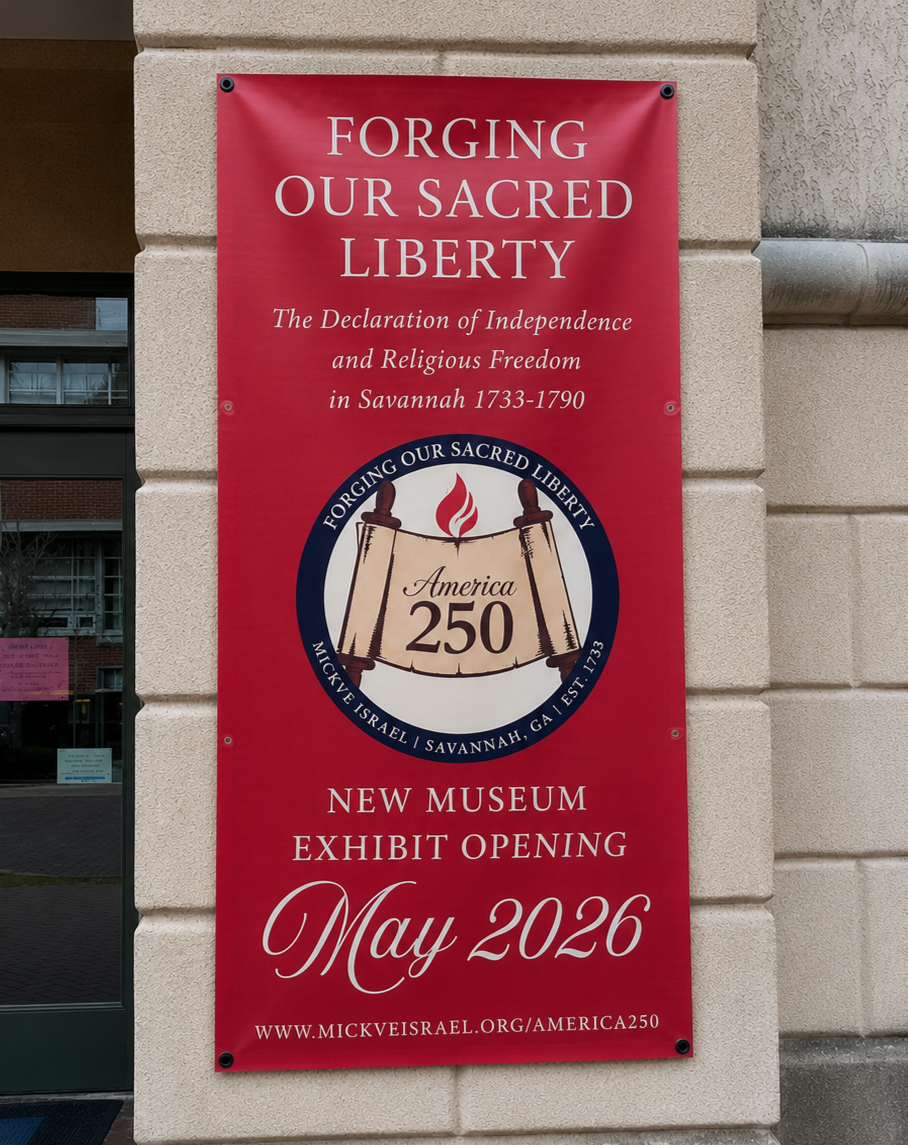
Recently, I sat in the sanctuary of that congregation, Mickve Israel, as the community opened a new exhibit marking the 250th anniversary of the Declaration of Independence. Sitting there, I kept thinking about how strange and wonderful it is that this place exists at all. That it has always existed. That Savannah, a city most people know about for ghost tours and raucous St. Patrick’s Day celebrations, has been home to one of the great untold stories in American Jewish life for almost three hundred years.
This is that story.
The Synagogue That Doesn’t Look Like One
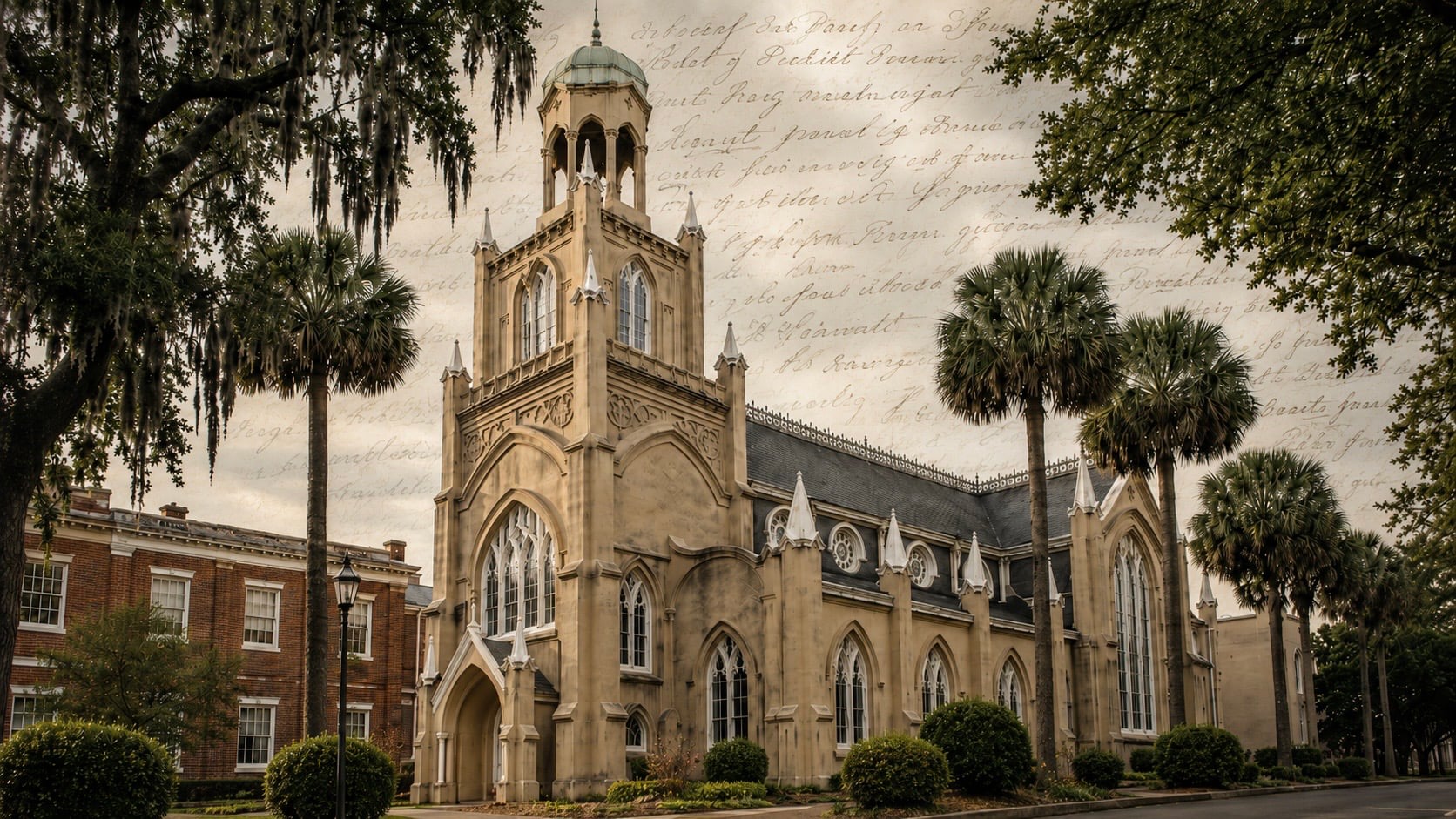
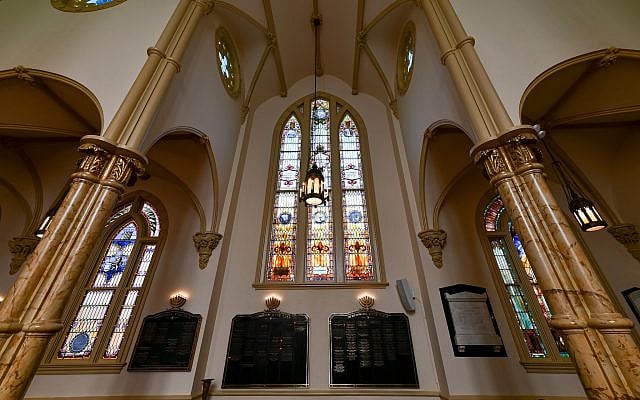
Mickve Israel sits on Monterey Square in the heart of Savannah’s historic district. Walk past it without knowing what it is and you’d assume it was a church. Pointed Gothic arches. Stained glass. A soaring central tower. It’s the only Gothic-style synagogue in North America, and you wouldn’t know it until you got close enough to spot the Hebrew inscriptions and the Star of David on the spire. In 2017, Condé Nast Traveler named it one of the fifteen most beautiful synagogues in the world. Many people still walk by without a second glance.
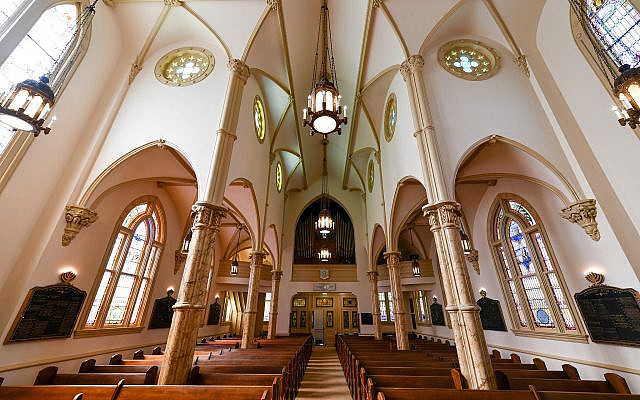
That resemblance was not an accident.
When the congregation chose the Gothic Revival style for their building in 1878, they were making a quietly courageous decision. As architectural historian Stephen Moffson has written, by adopting the visual language of Christian architecture, the congregation was deliberately softening the line between itself and its gentile neighbors. You can read that as a shield against discrimination or as an outstretched hand. It was almost certainly both.
After the consecration, a woman from Pennsylvania wrote to the congregation’s president marveling that she had never heard of Jews building a church in the shape of a cross. She meant it as a compliment. Reading it today, it feels like a window into exactly what these families were navigating, and into something essential about how this community has always operated. Not by demanding a place, but by earning one.
A Torah Older Than the Building It Sits In
Inside, the history gets quieter and more astonishing.
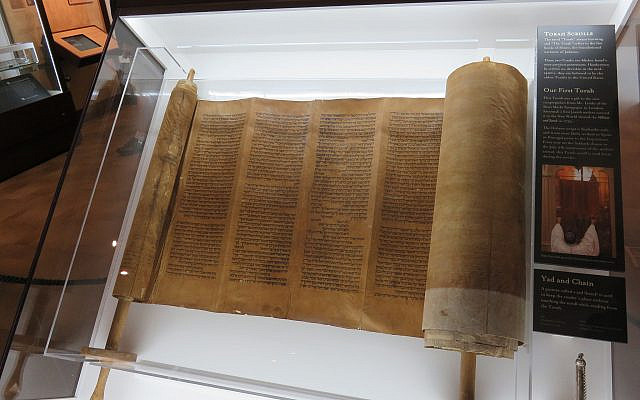
There is a Torah scroll in the museum upstairs so old and fragile it never leaves its glass case. Written in 1450 on deerskin, tied together with cow gut, it is believed to be the oldest complete Torah in North America. It crossed an ocean with refugees in 1733, nearly three hundred years after it was first written, and it has been here ever since. A scroll that survived the Inquisition now sits quietly on Monterey Square, in a building most tourists walk past thinking it’s a church.
Beside it sits a small archive of presidential correspondence. A letter from George Washington. A letter Thomas Jefferson wrote in 1820 to Dr. Jacob De La Motta, who had delivered the consecration address at Savannah’s first synagogue. In it, Jefferson reflects that America had been the first nation to prove to the world that man can govern himself, and that religious freedom is the most powerful antidote to religious conflict. He closes by expressing his hope that Jews would soon be taking their seats in the halls of science and government.
I was there the evening Dr. Gary Zola, Executive Director Emeritus of the American Jewish Archives at Hebrew Union College, gave a talk called “Virtue and Vice: Thomas Jefferson’s Conflicting Ideas on Jews and Judaism.” He didn’t soften Jefferson. He was a man who wrote beautifully about Jewish equality and dismissively about Judaism at the same time. He was a passionate defender of religious liberty who held hundreds of human beings in bondage. Dr. Zola sat in that tension rather than resolving it, which felt like the most honest thing anyone could do.
Standing in that sanctuary with Jefferson’s actual letter a few feet away, you feel the weight of how much that hope mattered. And how much of it, against considerable odds, has been answered.
The Story You Were Never Taught
The new exhibit makes history visible that has long stayed hidden. Some of its artifacts have never been shown publicly before. A Revolutionary-era cocked hat belonging to Sheftall Sheftall, son of Mordecai Sheftall, the highest-ranking Jewish officer in the Revolutionary War, a man who bankrolled the American cause at the cost of his own fortune. A Masonic apron belonging to his grandfather, Benjamin Sheftall, on loan from Solomon’s Lodge No. 1. Original 18th-century documents from one of the most consequential Jewish families in early American history, a family most Americans have never heard of.
The exhibit also widens the lens beyond the Jewish community. It tells the stories of the Lutheran Salzburgers and the Quakers, other religious minorities who found refuge in colonial Georgia alongside the Jews. Because here is the part that rarely makes it into the history books: the story of religious freedom in America didn’t begin in Philadelphia. Some of its earliest chapters were written here, decades earlier, by people who arrived with nothing and built something that has lasted three hundred years.
The Things Even Locals Don’t Know
Once you start pulling on this thread, it keeps going.
Most people’s reference point for Southern Jewish life begins and ends with Driving Miss Daisy. What almost nobody knows is that the story is closer to Savannah than it appears. A longtime Mickve Israel congregant once shared that her great-aunt was the real-life inspiration for the Pulitzer Prize-winning play, and that the drives in the original story weren’t to Alabama at all. They were here, to Savannah, to visit family.
Or take the Girl Scouts. When Juliette Gordon Low founded them in Savannah in 1912, she turned to the people she trusted most to lead the very first troops. Three of the four women she chose were members of Mickve Israel. Leonora Amram went on to serve on the first Girl Scout Council. Mildred Guckenheimer became its secretary. And when Girl Scouts began selling cookies commercially in the mid-1930s, the first batch was baked right here in Savannah at Gottlieb’s Kosher Bakery on Bull Street. They were oatmeal cookies, and the original handwritten receipt for that order still sits in the Mickve Israel museum. Every box of Thin Mints sold since then traces a line back to a kosher bakery in this city.
This is what I mean by hidden in plain sight. Pieces of American life that most people assume came from somewhere else came from here. From this congregation. From this community.
Still Very Much Alive
None of it is past tense.
Jewish Savannah is active and layered and occasionally surprising. Mickve Israel is Reform. Congregation Bnai Brith Jacob operates as an Orthodox synagogue nearby, with daily prayer and kosher services. Congregation Agudath Achim brings the Conservative community together for Shabbat dinners and youth programs and everything in between. Three congregations, three approaches, one small coastal city, all of it held together by the kind of warmth that feels distinctly Southern and distinctly Jewish at the same time.
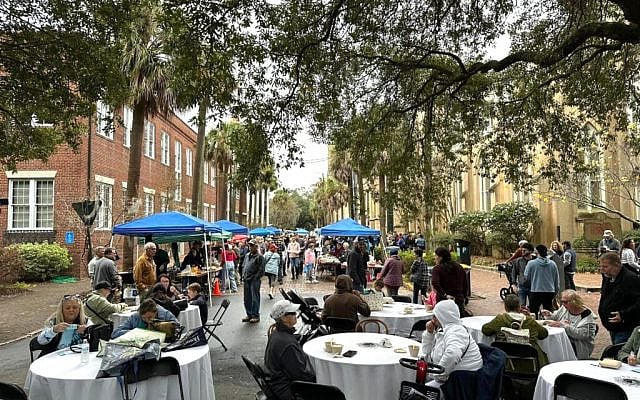
Every year the community hosts the Shalom Y’all Jewish Food Festival in the heart of downtown, where thousands show up for pastrami on rye, noodle kugel, and a delicious blintz soufflé people talk about long after they’ve gone home. The Jewish cemeteries here date back to before the Revolution. And when Wesley Monumental Methodist Church nearby had to close after a ceiling collapse, Mickve Israel opened its doors to their congregation without a second thought. That kind of neighborly grace isn’t performative. It’s just how things work here.
Come Find It
Savannah’s Jewish story is not a footnote to American history. It is intricately and beautifully woven into the founding of this country, and it is still being written today. It’s in the architecture that spent a century quietly saying, “we belong here.” It’s in the Torah that crossed an ocean in 1733 and never left. It’s in every Girl Scout cookie ever sold. And right now, through early January 2027, it’s in a remarkable exhibit on Monterey Square that pulls these threads together for the first time.
So if you find yourself in Savannah, with a coffee in hand and an hour to spare, take a detour into Monterey Square. Step inside Mickve Israel. Let someone show you a Torah scroll that has outlasted empires, and a letter from Thomas Jefferson that helped define what America could be.
Down here, under the oaks and the moss, one of the great untold American Jewish stories has been quietly unfolding for nearly three centuries. It is worth knowing. It is worth visiting.
And it is, as you might expect, excellent company.