
Published author, Jewish educator and scholar
What I Am Grateful for Despite the Situation
ChatGPT
Parashat Ki Tavo that we read this past Shabbat contains one of the Torah’s most beautiful expressions of gratitude.
When the Israelite farmer brings his first fruits to the Temple, he does not simply thank God for a successful harvest. He tells a story:
“My father was a wandering Aramean… the Egyptians dealt harshly with us and oppressed us… We cried out to the Lord… and the Lord brought us out of Egypt… and He brought us to this place and gave us this land, a land flowing with milk and honey.”
Only then does he declare: “And now, behold, I have brought the first fruits of the land that You, Lord, have given me.”
The farmer is grateful not merely for figs and grapes. He is grateful for the astonishing transformation of Jewish history: from powerlessness to freedom, from wandering to rootedness, from slavery in another people’s land to sovereignty in his own.
But what happens when life in that land is deeply troubled? What does gratitude mean when so much around us feels painful, frustrating, and frightening?
October 7 remains an open wound. Israelis continue to argue over responsibility for the failures that preceded it and the accountability that should follow. The burden of military service and months of reserve duty falls heavily on large parts of society, while the question of Haredi participation in the IDF continues to tear at the country’s social fabric. There are bitter disputes over political leadership, policing, violence in the West Bank, the policies that strengthened Hamas before October 7, the results of the wars that followed, Israel’s international standing, and the widening divisions within Israeli society.
At such a moment, the command to thank God for “the good land” can feel almost jarring. What exactly are we supposed to be thankful for?
Perhaps the answer lies in the deeper meaning of the farmer’s story.
For most of Jewish history, when things went terribly wrong, Jews had remarkably little ability to change their circumstances. When mobs attacked us, we appealed to governments for protection. When discriminatory laws were enacted, we petitioned kings, ministers, presidents, and parliaments. When Jews were expelled from one country, they searched desperately for another that might take them in.
Our fate was overwhelmingly in the hands of others.
The declaration of the first fruits celebrates the end of that condition: “He brought us to this place and gave us this land.”
To possess a land is not merely to have somewhere to live. It is to assume responsibility for what happens there. And that responsibility is itself an extraordinary privilege.
In Israel today, we can argue about our leaders because they are our leaders. We can demand investigations because these are our institutions. We can protest laws, challenge policies, organize movements, speak, write, demonstrate, persuade—and ultimately vote.
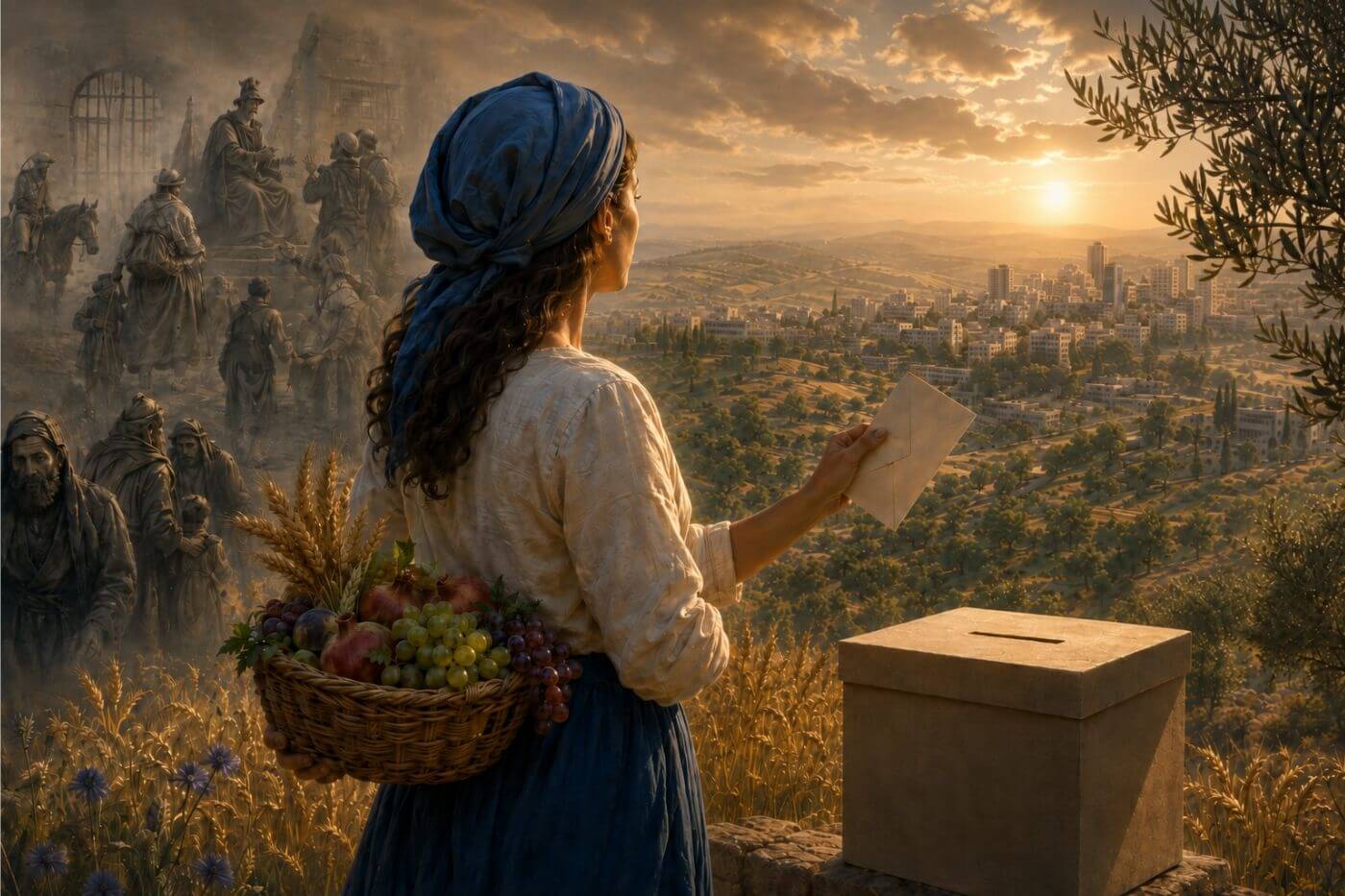
Soon Israelis will once again enter polling stations and decide who should govern the country. That ordinary act—placing a ballot in an envelope and dropping it into a box—is, in historical terms, nothing short of extraordinary.
For nearly two thousand years, Jews could pray for better rulers. Today, Jews can choose them.
And if we believe that our leadership has failed, that our institutions need repair, that the burdens of citizenship must be shared more fairly, that our politics have become too divisive, or that the country needs a different direction, we possess something our ancestors could scarcely have imagined: the power to do something about it.
Not everything, of course. No election can eliminate our enemies. No government can guarantee security. No ballot can erase antisemitism, heal every division, or resolve every moral dilemma confronting a sovereign state.
But there is a profound difference between suffering problems imposed upon us by others and confronting problems within a society that we ourselves have the power to shape.
That may be one of the deepest forms of gratitude that Ki Tavo demands of us. We have been given not merely a beautiful country, but agency. We have been given the opportunity to build a society, to make mistakes, to correct them, to replace leaders, to reform institutions, to debate our values, and to take responsibility for our collective future.
That is the privilege—and the burden—of sovereignty.
Perhaps, then, the proper response to Israel’s problems today is neither complacency nor despair.
It is gratitude joined with responsibility.
We should be grateful enough for this country to demand more of it. Grateful enough for Jewish sovereignty not to take it for granted. Grateful enough for democracy to use it.
For thousands of years, when Jewish history went wrong, our ancestors often had little choice but to pray that someone else would change it.
Today, alongside our prayers, we have something else: the ability to change it ourselves.
And for that, I am profoundly grateful.
For more insights on the parasha and current events in Israel, visit
https://davidharbater.com/parasha-current-events/
Related Topics
Related Posts