CFO | Empower Society for Good I Author
What Kind of Country Did We Come Home to Build?
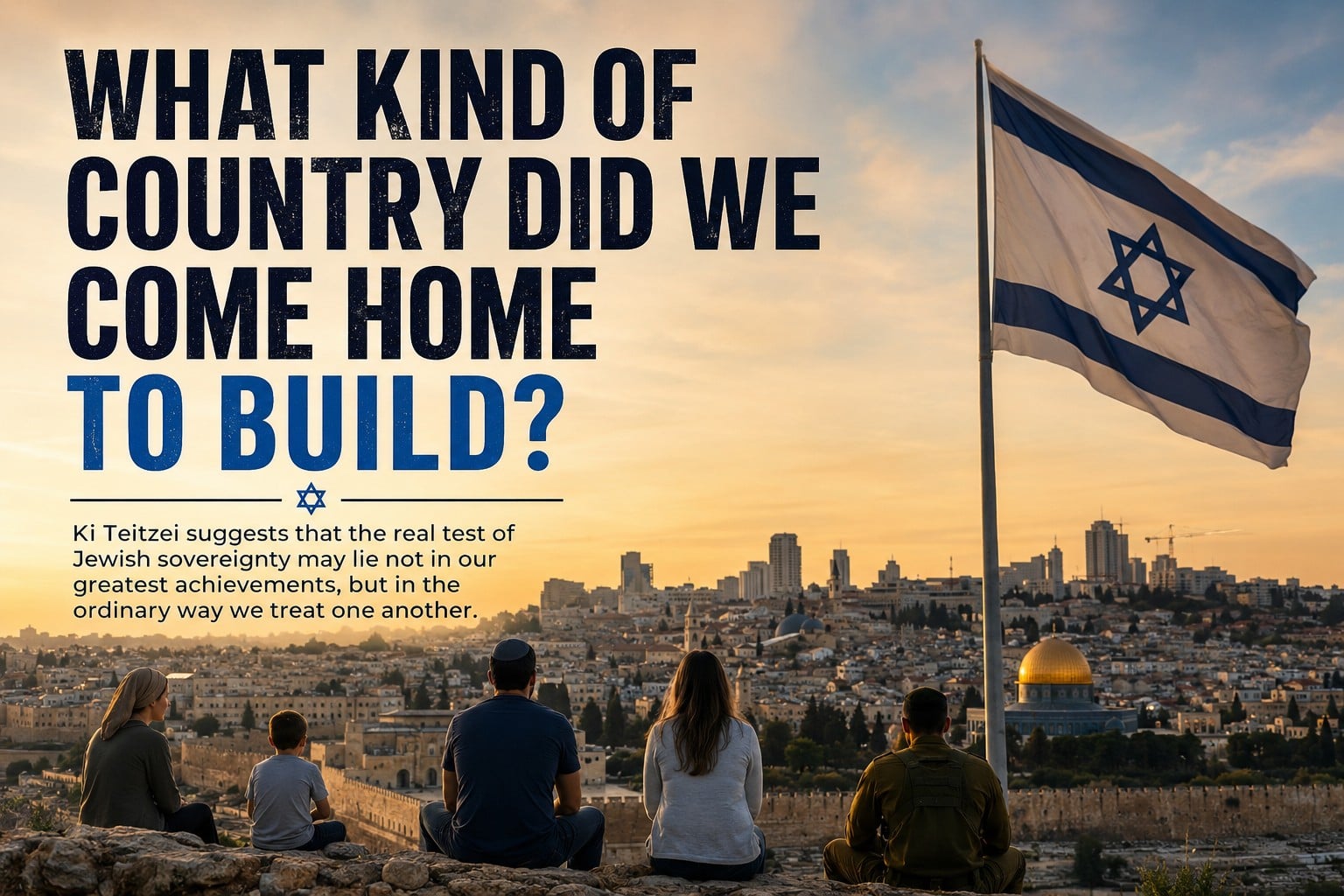
Ki Teitzei suggests that the real test of Jewish sovereignty may lie not in our greatest achievements, but in the ordinary way we treat one another.
Israel knows how to do the impossible.
We brought Jews home from Yemen, Ethiopia, Russia and across the Jewish world. We revived an ancient language, made the desert bloom, built universities and hospitals, created one of the world’s great technology ecosystems and developed an army capable of defending a tiny country in an exceptionally hostile region.
We can intercept missiles in the sky and develop technologies that change the world.
Yet there is another, much less glamorous question that we do not ask often enough: What kind of country did we actually come home to build?
That question came to me while reading Ki Teitzei.
It is one of the strangest Torah portions. There is no single dramatic story like the Exodus or revelation at Sinai. Instead, Moses gives us law after law—74 commandments in all—covering everything from warfare and marriage to lost animals, rooftop railings, workers’ wages, lending, agriculture and dishonest weights.
Why devote so much of the Torah to such ordinary things?
Perhaps because after all the miracles, speeches and national dreams, this is where the real test begins.
It is relatively easy to proclaim great values. It is much harder to live them on Tuesday morning.
The donkey in the road
The Torah tells us that if we see someone’s lost ox or sheep, we cannot simply walk past. We have to help return it.
Then come four words that may be among the most important in the parsha: “You may not ignore it.”
That sounds almost trivial until we look at modern society.
We have become experts at ignoring things.
Someone else will deal with the poverty. Someone else will pick up the rubbish. Someone else will help the elderly neighbor. Someone else will fix the bureaucracy. Someone else will worry about the struggling family, the reservist whose business is collapsing or the employee who has not been paid.
We pay taxes, elect governments and support charities, and all of these things matter. But somewhere along the way it becomes remarkably easy to conclude that responsibility belongs to someone else.
Ki Teitzei says otherwise.
If you see it, you have entered the story.
The railing around the roof
Then comes an even more fascinating law. When you build a house, you must put a parapet around the roof so that somebody does not fall.
Nobody has fallen yet.
There is no victim, lawsuit, investigation or commission of inquiry.
The Torah says: You can see the danger. Deal with it now.
Imagine applying that principle seriously to modern life.
We knew social media could amplify hatred long before hatred overwhelmed our feeds. We know artificial intelligence will create extraordinary opportunities while introducing risks we are only beginning to understand. We know when roads are dangerous, when public systems are failing and when social tensions are becoming explosive.
Yet modern institutions frequently operate in the opposite direction: Wait for the disaster and then appoint a committee to explain why nobody prevented it.
Ki Teitzei’s principle is far more demanding. Foreseeable harm creates responsibility before the harm occurs.
That is not merely building regulation. It is a philosophy of leadership.
And then there is money
This part particularly interests me as a CFO.
The Torah commands employers to pay workers on time and warns against exploiting those who are poor or vulnerable. It then becomes remarkably specific about honest weights and measures.
Why would God care about a shopkeeper’s scale?
Because civilization depends on trust.
Our scales today are more sophisticated. They are financial statements, algorithms, contracts, interest calculations, pricing structures, data and pages of small print.
But the moral temptation is unchanged.
Can I make a little more because the other person doesn’t understand what I understand?
Can I delay paying the small supplier because I have more bargaining power?
Can I structure the transaction so that it is technically legal even though I know it isn’t really fair?
There is an enormous difference between asking, “Can I get away with this?” and asking, “Is this right?”
Modern capitalism is extraordinarily good at the first question. A Good Society also needs people willing to ask the second.
I believe strongly in business, entrepreneurship and wealth creation. Israel needs successful companies and successful people. But Ki Teitzei challenges the idea that wealth belongs entirely to the person who creates it.
The farmer owns his field, yet when he forgets part of his harvest, he is told not to go back for it. It is left for the stranger, orphan and widow.
The message is not that success is wrong.
It is that success creates obligations.
Israel’s greatest challenge may no longer be survival alone
For most of Jewish history, the great question was whether we could survive.
Today that question has not disappeared. Oct. 7 reminded us brutally that Jewish sovereignty does not eliminate the enemies who seek our destruction. Iran, Hamas, Hezbollah and the wider delegitimization of Israel mean that national security remains fundamental.
But survival cannot be the entire Zionist vision.
Ben-Gurion did not dream merely of a Jewish state capable of shooting down missiles. Herzl did not imagine simply another Middle Eastern economy. And the biblical vision of Jewish sovereignty certainly did not end with possessing the land.
The harder question begins once we have the land.
What do we build on it?
A country can be militarily powerful and socially weak. It can produce billion-dollar companies while families struggle to make the month. It can invent extraordinary technology while citizens lose faith in institutions. It can win wars and still lose the sense that its people share responsibility for one another.
That is why these seemingly mundane laws matter.
The lost donkey, the rooftop railing, the unpaid worker, the forgotten sheaf and the dishonest scale are all asking the same question:
What do you do when you possess something the other person does not—knowledge, money, property, authority or power?
That may be one of the Torah’s deepest definitions of morality.
Power creates responsibility.
From Start-Up Nation to Good Society Nation
We Israelis are very good at celebrating what we have built, and we should be. The return of the Jewish people to sovereignty after 2,000 years is one of history’s extraordinary stories.
But perhaps Jewish sovereignty should make us uncomfortable as well as proud.
Because now we cannot blame the czar, the king, the British, the Romans or the governments under which Jews once lived.
This society is ours.
Its successes are ours.
And increasingly, its failures are ours too.
The cost of living, the treatment of workers, political behavior, social division, bureaucracy, poverty, corruption, responsibility toward minorities and the growing distrust between different parts of Israeli society are not somebody else’s Jewish problem.
They belong to us.
Perhaps this is why Moses gives Israel so many detailed laws just before the people enter the land. He understands something that every successful national movement eventually discovers: Winning sovereignty is easier than building the society worthy of it.
Israel has already demonstrated that it can become the Start-Up Nation.
The greater ambition is to become something harder: a Good Society Nation.
Not a perfect society. Torah never assumes human beings will be perfect. Ki Teitzei itself is evidence of that.
Rather, a society in which wealth brings responsibility, power demands restraint, business requires honesty, danger creates a duty to prevent harm and seeing another person’s problem makes it a little bit our problem too.
Perhaps that is why the Torah bothers with a lost donkey.
Because the soul of a nation is not revealed only when missiles are falling or history is being made.
It is revealed when nobody is watching, the problem belongs to somebody else, and we have to decide whether to keep walking.
“You may not ignore it.”
Four ancient words.
And perhaps still one of the greatest challenges facing the society we came home to build.
I invite you to read and share my additional thoughts titled:
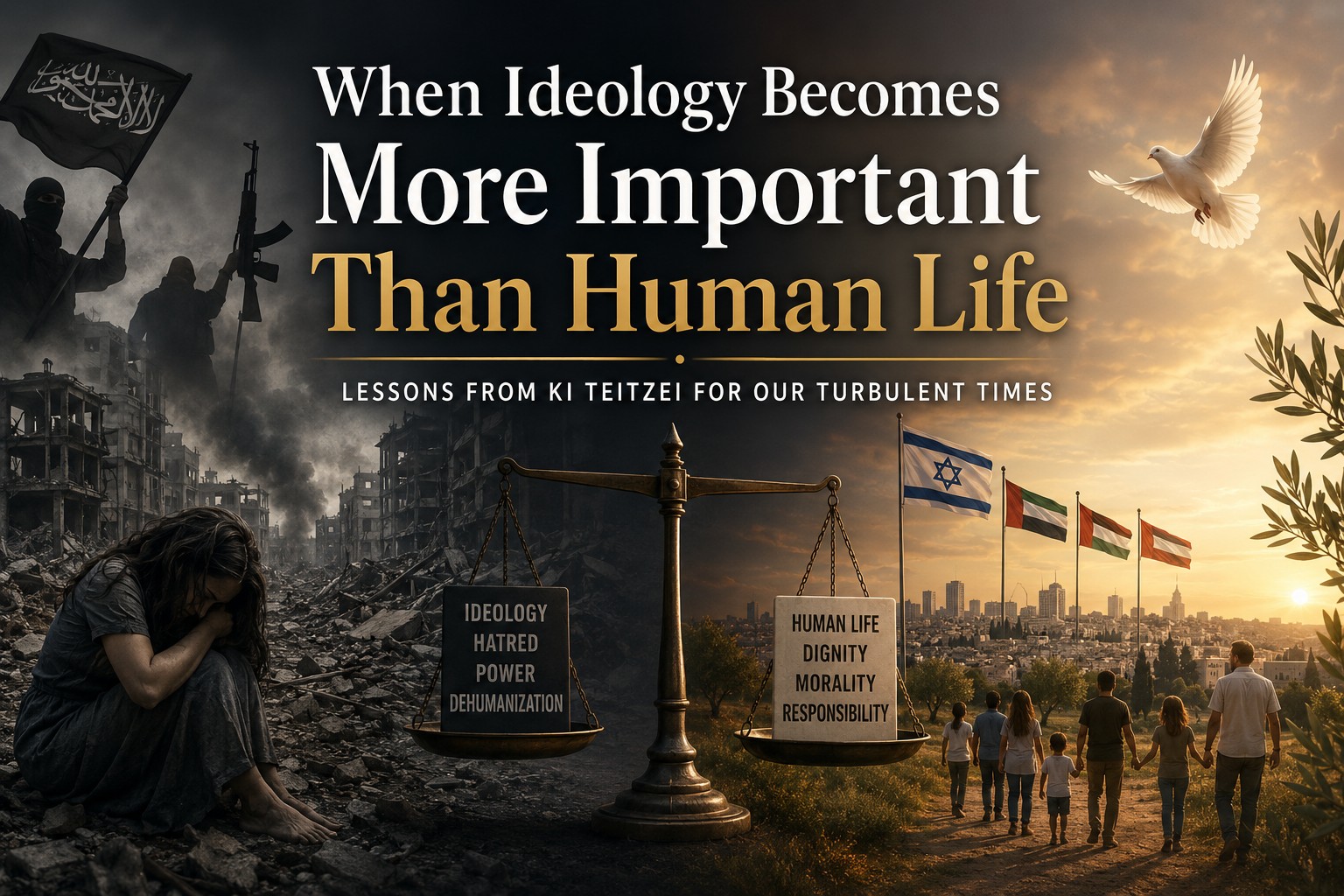
When does a cause become more important than the people it claims to defend?
Ki Teitzei begins with war and ends with Amalek. In between, it offers a radical message: even when fighting evil, we cannot abandon morality.
My latest reflection asks a question for our turbulent times: When ideology demands endless sacrifice, who is it really serving?
Related Topics